


Close Menu
Savannah HeraldSavannah Herald
    • Home
    • News
      • Local
      • State
      • National
      • World
      • HBCUs
    • Events
    • Directories
    • Weather
    • Traffic
    • Jobs
    • Sports
    • Politics
    • Lifestyle
      • Faith
      • Senior Living
      • Health
      • Travel
      • Beauty
      • Fashion
      • Food
      • Art & Literature
    • Business
      • Real Estate
      • Entertainment
      • Investing
      • Education
    • Guides
      • Back to School Savannah
      • Summer Camp Guide
      • Juneteenth Guide
      • Black History Savannah
      • MLK Guide Savannah
    We're Social
    • Twitter
    • Facebook
    • YouTube

    Subscribe to Updates

    Get the latest creative news from FooBar about art, design and business.

    Trending
    • Top Home Workouts for Busy Professionals
    • Mysterious Spheres Found in Australia Are Likely Space Debris
    • Mammalian meat allergy: The allergy that can make daily activities deadly
    • Trump Is Squeezing Canada. Don’t Expect Carney to Roll Over.
    • MEAC Football: Five Takeaways in the Preseason Honors as Bulldogs Pace Foes
    • Kanishka Narayan takes on AI sovereignty in Burnham cabinet
    • We’ll Get a Look at The Witcher 3: Wild Hunt — Songs of the Past Next Month
    • Why States Are Making It Harder to Save Money With Solar Panels
    Facebook X (Twitter) Instagram YouTube
    Login
    Savannah HeraldSavannah Herald
    Savannah HeraldSavannah Herald
    Home » Why States Are Making It Harder to Save Money With Solar Panels
    Investing

    Why States Are Making It Harder to Save Money With Solar Panels

    Savannah HeraldBy Savannah HeraldJuly 21, 20266 Mins Read
    Facebook Twitter Pinterest LinkedIn WhatsApp Reddit Tumblr Email
    Why States Are Making It Harder to Save Money With Solar Panels
    Share
    Facebook Twitter LinkedIn Pinterest Email

    Business Briefing: Economic Updates and Industry Insights

    Key takeaways
    • Utilities and states are replacing net metering with net billing, paying much lower rates for exported solar energy.
    • Lower buyback rates cut homeowner savings, making rooftop solar less attractive and slowing growth of the solar industry.
    • Utilities argue net metering shifts grid maintenance costs onto non-solar customers, prompting regulatory fights over fair cost allocation.
    • Batteries let homeowners store midday solar for evening use; some states subsidize them, but high installation costs often hinder payback.

    The math on solar panels is getting tougher.

    President Trump ended the federal tax credit last year, but the story goes back further than that. Over the last decade, more than a third of U.S. states have changed their rules to allow utilities to pay homeowners less for the energy they send to the grid.

    In some places, those changes have reduced savings for homeowners by hundreds or thousands of dollars each year, making solar a less appealing investment and dealing a blow to the industry.

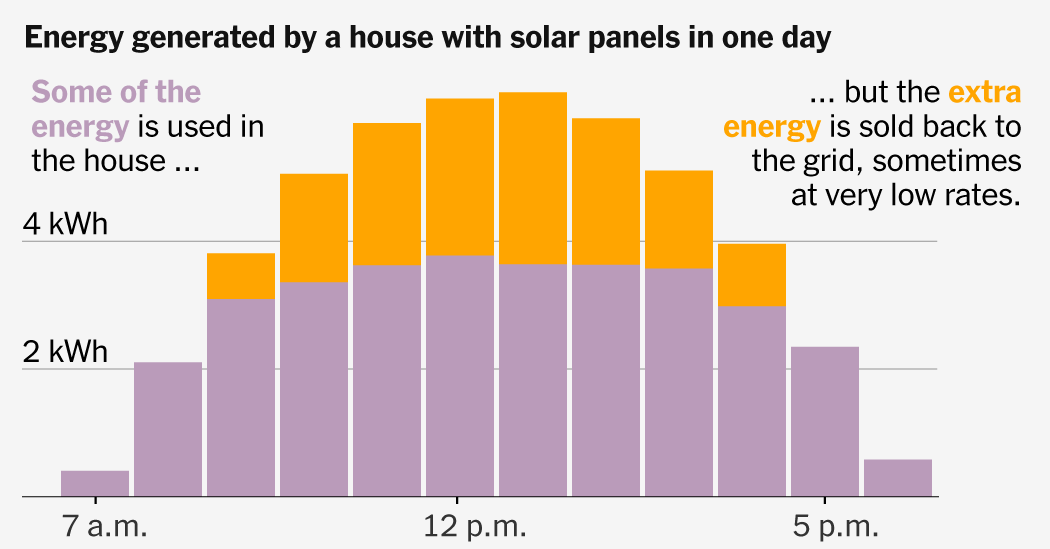
    The changes all spin out from a simple fact: Solar generates most of its power in the middle of the day, but houses use power all day. Here is a hypothetical home in Arkansas:

    What the utility does with that extra energy makes a big difference.

    Many utilities pay homeowners the same rate they charge for electricity, meaning the energy sent to the grid when the sun is out offsets the cost of the energy pulled from the grid at night. That’s called net metering, a system where the energy you send is worth typical U.S. prices of 10 to 30-plus cents per kilowatt-hour.

    Under newer policies, often called net billing, utilities buy the extra energy back at a lower rate, often 2 to 10 cents.

    Arkansas switched from net metering to a net billing system in 2024, lowering the value of extra electricity from around 12 cents to closer to 3 cents. Houses with solar were grandfathered into the old system, but homeowners adding solar now will be paid less for the extra electricity they send back. Here’s how it would look for our hypothetical house under both scenarios:

    Utilities have long waged a campaign to get rid of net metering, and over the last decade, many have succeeded. Since the mid-2010s, major utilities across the country have moved away from traditional net metering (most notably in California) and toward programs where extra solar is credited at lower rates.

    Some states passed laws ending net metering statewide; in others, regulators gave individual utilities permission to move to new programs. A few states and utilities kept net metering intact but added fees or changed their rules in other ways that lower savings.

    These changes are happening in very different places and don’t map neatly onto politics or how much sun and solar energy a state has:

    Net metering policies began to appear in the 1980s, as a way to kick-start rooftop solar when installation costs were extremely high.

    “Net metering was created in a different era,” said Leah Stokes, a professor at the University of California, Santa Barbara, who specializes in energy and environmental policy. “It wasn’t envisioned by legislators and utilities to get as big as it got.”

    In the early 2010s, utilities had a relatively small number of customers who sent electricity back to the grid. But as panels got cheaper, millions of homeowners installed them and enrolled in net metering programs.

    And as home solar got bigger, those programs became more expensive for utilities, who started to petition their regulators to let them pay less for all that rooftop solar.

    In their fight against net metering, utilities have long argued that they don’t just source and generate power, but also build and maintain the grid, costs that are included in the price of electricity. Houses with solar pay less for the grid but still rely on the same poles and wires as everyone else.

    That means, utilities say, maintenance costs are shifted from houses with solar to those without. (The research on this is limited, but one analysis found that net metering added less than half a cent per kilowatt-hour to average electricity costs in most places in recent years, and up to 2 cents in places with more solar like California.)

    Utilities can also get energy from other places at lower prices than they have to pay homeowners. In Vermont, for example, utilities will soon pay 46 percent more for rooftop solar than they do for other sources of solar energy, according to the state’s public utility commission.

    But net metering incentivizes people to install panels, which can make a bigger difference in states with small home solar markets like Indiana and Louisiana. In these states, electricity is already relatively cheap, lowering the incentive to install solar, and both ended net metering in recent years.

    And more rooftop solar, advocates for solar power say, lowers the burden on the grid, reducing expensive upgrade costs for everyone. (It’s especially useful in summer, tamping down peak demand in heat waves.) The energy is also easy to transmit from neighbor to neighbor and can quickly increase the supply of clean electricity.

    For states that end net metering, how they do it matters.

    California, which has more than a third of the country’s residential rooftop solar, ended its net metering program abruptly in 2023 and replaced it with much lower payback rates that vary by day and hour. The solar industry staggered after the decision but has begun to rebound. (California’s electricity is so expensive that panels can pay themselves off quickly even after the end of net metering.)

    In Illinois, by contrast, lawmakers decided to let homeowners sell excess energy for about half the retail rate, and the transition took place over more than three years.

    “California got rid of traditional net metering, and Illinois got rid of traditional net metering,” said Amy Heart, vice president of public policy at Sunrun, the country’s largest residential solar and storage company. “You didn’t hear about it in Illinois because it was planned out.”

    The battery solution

    Debates over solar in Illinois, California and other states have reflected solar’s central — and growing — problem: Power generated in the middle of the day just isn’t worth as much when there’s an abundance of solar on rooftops and in large-scale solar farms.

    On some days, California has so much energy and low enough demand that it has to throw away extra solar. Even in New England, an influx of rooftop solar has pushed down demand on spring afternoons, only for gas plants to ramp up after sunset.

    This is where batteries come in.

    Illinois is one of several states that subsidize home batteries. Instead of selling back their excess solar energy for cheap, homeowners can store it in their battery to use in the home in the evening, saving money. That helps reduce emissions and demand on the grid; in some places, homeowners can even be paid to discharge their batteries.

    The battery and solar market is growing rapidly, according to data from Lawrence Berkeley Lab. In Hawaii, where rooftop solar is popular and net metering long gone, the vast majority of new solar installations come with a battery. In California, the share of new solar installations that came with a battery soared after net metering ended.

    Excluding California, the average rate in the U.S. rose more modestly, to 8 percent from 5 percent.

    But like solar panels, battery installation can be so expensive that homeowners might not recoup their costs. And the math has changed there too: Last year, President Trump ended the federal subsidy for residential batteries.

    Read the full article from the original source


    Related Posts

    • Grants & Resources For Black-Owned Charm Brands
    • 9/4: CBS Evening News – CBS News
    • A second chance at success for Georgia Southern graduate student
    • What Is Memory Care? Your Guide to Joy & Purpose
    • Best Multipurpose Beauty Products to Streamline Your Routine
    • Can I Go Swimming With Braids?
    • 2026 BIG HBCU Southern Classic Battle of the Bands
    • 2026 NBA playoff bracket: Knicks pull off huge comeback to take Game 1 vs. Cavaliers
    Alternative and Renewable Energy Business Development Business News Business Strategy Business Technology Company News Corporate Finance Economic Growth Economic Insights Economic Policy Electric Light and Power Entrepreneurship Fees and Rates) Financial Planning Global Economy Harvard Business Review Investment Trends Leadership and Management Market Trends Prices (Fares Real Estate and Housing (Residential) Small Business Advice Solar Energy Startups and Innovation States (US) Stock Market Updates United States Politics and Government Workplace Trends
    Share. Facebook Twitter Pinterest LinkedIn WhatsApp Reddit Tumblr Email
    Savannah Herald
    • Website

    Related Posts

    Business July 21, 2026

    Trump Is Squeezing Canada. Don’t Expect Carney to Roll Over.

    Business July 20, 2026

    The New Rules for Becoming an Enterprise Leader

    Local July 20, 2026

    City of Pooler Achieves Class 5 CRS Rating, Saving Residents 25% on Flood Insurance | Savannah Herald

    Business July 19, 2026

    Oil Prices Cross $90 a Barrel as U.S.-Iran Conflict Widens

    Investing July 19, 2026

    Nolan’s ‘The Odyssey’ Brings in $124.5 Million at the Box Office on Opening Weekend

    Business July 18, 2026

    Madison Square Garden Sues Wired Magazine Over L.G.B.T.Q. Tracking Report

    Comments are closed.

    Don't Miss
    Fashion August 28, 2025By Savannah Herald02 Mins Read

    Sporty Style Inspo for Summer 2025 » coco bassey

    August 28, 2025

    Style Spotlight: Looks, Trends & Fashion Inspiration SSporty style is here for spring and summer!Sporty…

    A Mormon father and his gay son, LDS pop culture icons, choose to ‘stay in the room’

    July 4, 2026

    There’s a new members examination for Alzheimer’s. Right here’s whatever you require to understand about it.

    May 8, 2026

    Southern And Bethune-Cookman Rivalry Playing At NFL Stadium

    November 3, 2025

    Culture Type | The Month in Black Art: Here’s What Happened in May 2025

    December 7, 2025
    Archives
    • July 2026
    • June 2026
    • May 2026
    • April 2026
    • March 2026
    • February 2026
    • January 2026
    • December 2025
    • November 2025
    • October 2025
    • September 2025
    • August 2025
    • July 2025
    • June 2025
    • May 2025
    • April 2025
    • March 2025
    • February 2025
    Categories
    • Art & Literature
    • Beauty
    • Black History
    • Business
    • Climate
    • Culture
    • Education
    • Employment
    • Entertainment
    • Faith
    • Fashion
    • Food
    • Gaming
    • Georgia Politics
    • HBCUs
    • Health
    • Health Inspections
    • Investing
    • Lifestyle
    • Local
    • Lowcountry News
    • National
    • National Opinion
    • News
    • Politics
    • Real Estate
    • Senior Living
    • Sports
    • State
    • Tech
    • Traffic
    • Transportation
    • Travel
    • World
    Savannah Herald Newsletter

    Subscribe to Updates

    A round up interesting pic’s, post and articles in the C-Port and around the world.

    About Us
    About Us

    The Savannah Herald is your trusted source for the pulse of Coastal Georgia and the Low County of South Carolina. We're committed to delivering timely news that resonates with the African American community.

    From local politics to business developments, we're here to keep you informed and engaged. Our mission is to amplify the voices and stories that matter, shining a light on our collective experiences and achievements.
    We cover:
    🏛️ Politics
    💼 Business
    🎭 Entertainment
    🏀 Sports
    🩺 Health
    💻 Technology
    Savannah Herald: Savannah's Black Voice 💪🏾

    Our Picks

    Emily Odwin Represents Barbados with Pride at the US Women’s Open – African American Golfer’s Digest

    November 3, 2025

    Ultrahuman Ring PRO is back in the US, and it makes every other smart ring look overpriced

    May 8, 2026

    Every little thing to Know From Day 6 of Diddy’s Test

    August 28, 2025

    A Letter to Bangkok and the New Wave of Expats — Minority Nomad

    September 3, 2025

    The Hidden Causes of AI Workslop—and How to Fix Them

    July 4, 2026
    Categories
    • Art & Literature
    • Beauty
    • Black History
    • Business
    • Climate
    • Culture
    • Education
    • Employment
    • Entertainment
    • Faith
    • Fashion
    • Food
    • Gaming
    • Georgia Politics
    • HBCUs
    • Health
    • Health Inspections
    • Investing
    • Lifestyle
    • Local
    • Lowcountry News
    • National
    • National Opinion
    • News
    • Politics
    • Real Estate
    • Senior Living
    • Sports
    • State
    • Tech
    • Traffic
    • Transportation
    • Travel
    • World
    Copyright © 2002-2026 Savannahherald.com All Rights Reserved. A Veteran-Owned Business

    Type above and press Enter to search. Press Esc to cancel.

    Manage Consent
    To provide the best experiences, we use technologies like cookies to store and/or access device information. Consenting to these technologies will allow us to process data such as browsing behavior or unique IDs on this site. Not consenting or withdrawing consent, may adversely affect certain features and functions.
    Functional Always active
    The technical storage or access is strictly necessary for the legitimate purpose of enabling the use of a specific service explicitly requested by the subscriber or user, or for the sole purpose of carrying out the transmission of a communication over an electronic communications network.
    Preferences
    The technical storage or access is necessary for the legitimate purpose of storing preferences that are not requested by the subscriber or user.
    Statistics
    The technical storage or access that is used exclusively for statistical purposes. The technical storage or access that is used exclusively for anonymous statistical purposes. Without a subpoena, voluntary compliance on the part of your Internet Service Provider, or additional records from a third party, information stored or retrieved for this purpose alone cannot usually be used to identify you.
    Marketing
    The technical storage or access is required to create user profiles to send advertising, or to track the user on a website or across several websites for similar marketing purposes.
    • Manage options
    • Manage services
    • Manage {vendor_count} vendors
    • Read more about these purposes
    View preferences
    • {title}
    • {title}
    • {title}
    Ad Blocker Enabled!
    Ad Blocker Enabled!
    Our website is made possible by displaying online advertisements to our visitors. Please support us by disabling your Ad Blocker.

    Sign In or Register

    Welcome Back!

    Login below or Register Now.

    Lost password?

    Register Now!

    Already registered? Login.

    A password will be e-mailed to you.