




Business Insights: Global Markets, Strategy & Economic Trends
- War in the Middle East disrupted shipments via the Strait of Hormuz, driving fertilizer and energy prices that squeezed farmers' costs and incomes.
- Lower fertilizer use forecasts smaller harvests and higher food prices, and the United Nations Development Program warns millions face increased poverty risk.
- Cooperatives like Ecakoog adopt compost and savings schemes but remain dependent on imported chemical fertilizers such as urea, keeping vulnerability high.
Until recently, Michel Bla’s life presented a classic tale of upward mobility in one of the world’s fastest growing economies. His plantation in Ivory Coast was yielding swelling volumes of cocoa pods, allowing him to cash in on global demand for chocolate. His oldest son was attending university, aiming for the white-collar comforts of a civil service career.
At his home on the fringes of Divo, a city in the south of the country, Mr. Bla, 52, hoped to drill a well to replace his family’s reliance on a muddy river for drinking water. He was saving to buy solar panels to power fans that would bring relief from restless nights in tropical swelter.
But last year, the price of cocoa began plunging worldwide. This year brought another shock as the United States and Israel began a war on Iran. The effective closure of the Strait of Hormuz lifted the prices of fertilizer, pesticides and food, along with energy.
For Mr. Bla, the war has meant skyrocketing costs just as his revenues dropped, making it impossible for him to afford fertilizer. His cocoa trees are withering. The family still fetches buckets of river water. He reluctantly brought his son home from university.
“This year has been a catastrophe,” Mr. Bla said, as chickens pecked at the musty soil. “I have nothing in my pocket.”
Like tens of millions of people in lower-income countries worldwide, Mr. Bla was suffering a reversal of fortune as the war in the Middle East damaged his economic prospects.
And even if a tentative deal between the United States and Iran to end hostilities holds, shortages of critical goods like fuel appeared likely to persist for months. Less fertilizer applied earlier this year means smaller harvests ahead — a driver for higher food prices.
From Latin America to Africa to Asia, some 33 million people are at risk of falling into poverty this year because of higher food and energy costs, the United Nations Development Program warned in April.
In the most exposed countries like Sudan and Somalia, the stakes have reached lethal proportions. A doubling of food and fuel prices in areas already threatened by famine has combined with a slashing of the world’s humanitarian relief system to expand the contours of hunger.
Yet even in scores of nations removed from dire circumstances, a downgrading of aspirations has unfolded. After regaining momentum following the trauma of the Covid-19 pandemic, many of the world’s developing countries are contending with a new source of alarm from the war.
“This is a massive hit,” said Ian Goldin, a professor of globalization at Oxford University. “Like all crises, poor countries, and poor people, suffer most.”
Global economic growth is expected to slow to 2.5 percent this year, down from 2.9 percent in 2025, marking the slowest pace of expansion since the pandemic, the World Bank warned this month. Prospects have deteriorated in two-thirds of all economies since January, according to the report.
Ivory Coast, a West African nation of nearly 34 million people, has long exemplified the benefits of investing in education and infrastructure. After the country emerged from a decade of civil war and instability, its economy expanded by more than 8 percent a year from 2012 to 2019, maintaining modest growth even during the pandemic, according to the World Bank.
A major exporter of cocoa and cashews, the country also produces offshore oil and gas. Its largest city, Abidjan, has swelled into a hub for regional trade, with skyscrapers dotting a lagoon that empties into the Atlantic Ocean. Tin-roofed shacks fringe swampland. Tennis courts and shopping malls occupy choice parcels.
Growth has translated broadly into meaningful gains for Ivorians. By 2023, the share of households with electricity exceeded 72 percent, up from 56 percent a decade earlier. Modern highways thread the countryside. Schools and hospitals fill out every town.
Yet a recent journey through the midsection of the country revealed communities grappling with an unfamiliar sensation: diminished expectations.
“This plantation used to be the source of a bright future,” said Mr. Bla, the cocoa farmer. “Now, it’s not even profitable.”
Dreams Deferred
Two-thirds of Ivory Coast’s export revenues come from the cocoa industry, making the downturn a national calamity.
The drop in cocoa prices was the result of chocolate makers in Europe and the United States adapting to the previous situation: record-high costs for their raw materials.
From 2022 to early 2025, prices for cocoa roughly quadrupled, as drought, disease and aging plantations decimated much of the harvest in Ivory Coast and Ghana, which together produce about 70 percent of the world’s supply.
In Ivory Coast, the government regulates the price of cocoa to protect smaller farmers while maximizing exports. In October 2025 — not incidentally, just ahead of national elections — the government lifted the price of cocoa by more than one-fourth.
Chocolate makers bought less cocoa and shifted to alternative ingredients. Demand fell. Since the peak in January 2025, cocoa prices have surrendered some two-thirds of their value.
When the United States and Israel started the war on Iran in February, prompting retaliatory strikes on oil and gas installations throughout the region, farmers confronted a new problem.
Most synthetic forms of nitrogen fertilizer are derived from natural gas. Five Gulf countries — Iran, Saudi Arabia, Qatar, the United Arab Emirates and Bahrain — collectively produce one-third of the global supply of urea, the dominant nitrogen fertilizer. The same countries are the source of about one-fifth of phosphate fertilizers.
The almost complete shutdown of the Strait of Hormuz prevented existing stocks from being shipped out. Iranian strikes on production facilities then limited manufacturing of more fertilizers. The result was shortages and higher prices in places far removed from the Middle East.
As chaos disrupted international shipping, cargo prices soared, making imported food more expensive virtually everywhere. Rising diesel prices raised the cost of trucking, adding to the inflationary wave.
If marine traffic on the Strait of Hormuz resumes in a meaningful way, that should eventually reverse some of these effects. But prices have a long way to fall.
At a market in Yamoussoukro, the Ivorian capital, the price of carrots had risen by one-third since the war. Black pepper was 50 percent more expensive. Eggplant, tomatoes and fish were all pricier.
At his shop in the center of Divo, Adama Toure had grown accustomed to local farmers reacting in shock as he quotes prices for fertilizer and insecticides.
He pointed toward a 1 kilogram bag of herbicide trucked in from Abidjan. A year ago, he sold it for 28,000 West African francs (about $50). On this afternoon, it was 30,000 francs ($3 more). A sack of urea had risen to 22,000 from 18,000 francs.
“They blame me and sometimes they are angry,” Mr. Toure said. “I blame America. The United States has been the aggressor in Iran. Ivory Coast has no stakes in this conflict and yet we are affected.”
Konan Kouaidio had walked more than three miles to reach Mr. Toure’s shop. He had arrived to buy insecticide for his farm, where he and his brother grow eggplant, corn, rice and tomatoes. His mother sells some of their harvest in the village. They use the proceeds to buy shoes and fabric that he resells for greater profit.
He aimed to expand his farm and buy a tractor.
“I dream of buying a motorbike,” he said.
That dream was on hold.
Lowered Expectations
In Ivory Coast, agriculture has been a primary source of increased livelihood for decades.
A former French colony, the country gained independence in 1960. Its first president, Félix Houphouët-Boigny, urged the populace to cultivate the soil, both to expand the food supply and to raise cash.
Edouard Yao is the product of that history. His parents grew up in the center of the country, coaxing cotton from sandy soils. They lived in a mud house without electricity. In the 1960s, they moved south to a fertile area near the city of Daloa, hacking into lush forest to establish a cocoa plantation.
Now, 57 and in charge of the plantation, he considers himself fortunate to be living through a period of possibility.
“The world is continuing to progress,” Mr. Yao said. “I have a mobile phone and a television.” He had been constructing three new houses in town — two for rental income, and the third to put his children in reach of school.
His trajectory has collided with the drop in cocoa prices plus the war. Last year, he applied 10 bags of fertilizer that cost him about 18,000 francs each. When he bought more in March, the price had risen to 25,000 each. Worse, he was short of cash.
He had already delivered a ton of cocoa beans to a customer who resells to exporters. His customer had been unable to find a taker, so Mr. Yao had yet to receive payment.
His fertilizer supplier extended credit. By then the government had cut the price of cocoa by 57 percent. He bought only five bags of fertilizer, accepting a depleted harvest as the cost of thrift.
He has put off work on his new homes, their concrete skeletons serving as monuments to stymied aspirations.
“I’m worried,” he said. “I’ve lowered my expectations.”
Using What’s Available
Even farms that are cushioned against shocks are concerned about the bewildering challenges.
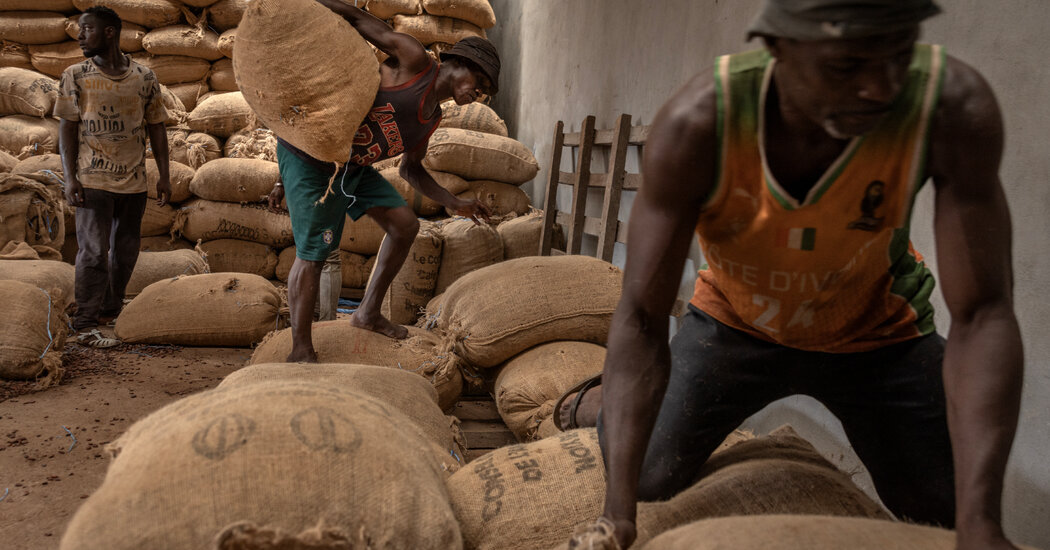
Ecakoog, a cooperative near the town of Lakota, includes more than 4,000 members who jointly sell their cocoa. It adheres to environmental and workplace standards that allow it collect a premium by exporting under the Fairtrade label.
A savings and loan operation dispenses credit that allows members to buy what they need — new trees, insecticides — and repay their loans out of proceeds from their harvests. The cooperative distributes young trees that eventually tower over plantations, providing shade that protects soils from heat and drought.
Not least, the cooperative has in recent years begun to reduce its traditional dependence on chemical fertilizers by making organic compost. The cooperative has been able to reduce its exposure to the Strait of Hormuz by exploiting local ingredients — cocoa husks, leaves, chicken droppings.
Yet for now, the cooperative relies on chemical fertilizer for 70 percent of its needs, leaving it prone to higher prices.
“We are scared,” said the cooperative’s founder and president, Ousmane Traore. “We don’t know what will come next.”
Read the full article from the original source
