




Black Arts & Culture Feature:
- One-access ticket covers both Giardini and Arsenale, not necessarily same day; a three-day ticket is often worthwhile.
- Summer hours 11:00 to 19:00; Arsenale extends Fridays and Saturdays to 20:00. Autumn 29 September to 22 November 10:00 to 18:00.
- Closed Mondays except 11 May, 1 June, 7 September and 16 November; those open Mondays are the quietest days.
- Do the Arsenale first and early; it rewards fresh attention and punishes tired legs. Keep the Giardini for the afternoon.
- About 46 city pavilions are scattered and mostly free; give them a dedicated day and plan routes by sestiere.
The Venice Biennale is a six-month exhibition that most people attempt in an afternoon, and this is the root of nearly every complaint ever made about it. Two million came to the 2024 edition. A substantial proportion of them bought a ticket at eleven, walked the Giardini until their feet gave out, glanced at the Arsenale, and left with the impression that contemporary art is exhausting. It is not the art that exhausts them. It is the logistics, which are unforgiving and almost entirely knowable in advance.
What follows is the practical apparatus for the 61st International Art Exhibition, In Minor Keys — prices, hours, closures, routes, and the handful of things that are obvious only once you have got them wrong. All figures are from La Biennale di Venezia and current as of August 2026.
Venice Biennale 2026 Tickets: Every Price
One ticket covers both principal venues. There is no separate Giardini ticket and no separate Arsenale ticket, which surprises people who have budgeted for two.
| Ticket | Full | Under 26 / student | Reduced |
|---|---|---|---|
| One-access | €30 | €16 | €20 (over 65, Venice residents) |
| 3-day | €40 | — | — |
| Weekly | €50 | — | — |
| Full season | €80 | €45 | €50 (Venice residents) |
A €0.50 presale fee applies per ticket. Visitors with certified disability pay the €20 reduced rate. Children under six enter free. Venice resident rates must be bought in person at the Giardini or Arsenale infopoints with valid ID.
Two details in that table are worth pulling out. The one-access ticket permits one entry to the Giardini and one to the Arsenale, and they need not be on the same day — nor even in the same week. If you are in Venice twice this season, a single €30 ticket covers both halves of the exhibition. Very few people realise this and a great many buy two tickets.
The second: at €40, the three-day ticket costs a third more than the single and buys you roughly three times the exhibition. If there is any chance you will want a second day, buy it. The arithmetic is not close.
Multiple-access tickets are strictly personal and require photographic ID at the gate. Guided tours run €10 per venue per person on top of admission, by reservation, from Tuesday to Sunday at 11:15 and 14:15 until 27 September — with no tours on 31 August or from 1 to 4 September.
Opening Hours, and Why They Change in Late September
Summer hours, 9 May to 27 September. Giardini and Arsenale both 11:00 to 19:00, last admission 18:45. On Fridays and Saturdays the Arsenale extends to 20:00, last admission 19:45.
Autumn hours, 29 September to 22 November. Both venues 10:00 to 18:00, last admission 17:45.
The autumn schedule is the better one and almost nobody plans around it. You gain an hour at the start of the day, when both sites are close to empty, and you lose an hour at the end, when they were thinning out anyway. The trade is entirely in your favour.
Those extended Friday and Saturday evenings at the Arsenale are the single best-kept piece of scheduling advice about this exhibition. The brick warehouses take low sun extraordinarily well, the crowds have gone, and the long halls become something closer to what they were built to be.
Closed Mondays — Except Four
The exhibition is shut every Monday with four exceptions: 11 May, 1 June, 7 September and 16 November. Two of those have passed. If your trip can be arranged around 7 September or 16 November, take it — an open Monday is comfortably the quietest day of the entire six months, and it is not close.
The corresponding warning: arriving in Venice on a Monday without checking this list is the most common single mistake visitors make, and there is no remedy for it.
Giardini or Arsenale First?
They are entirely different propositions and the difference should govern your day.
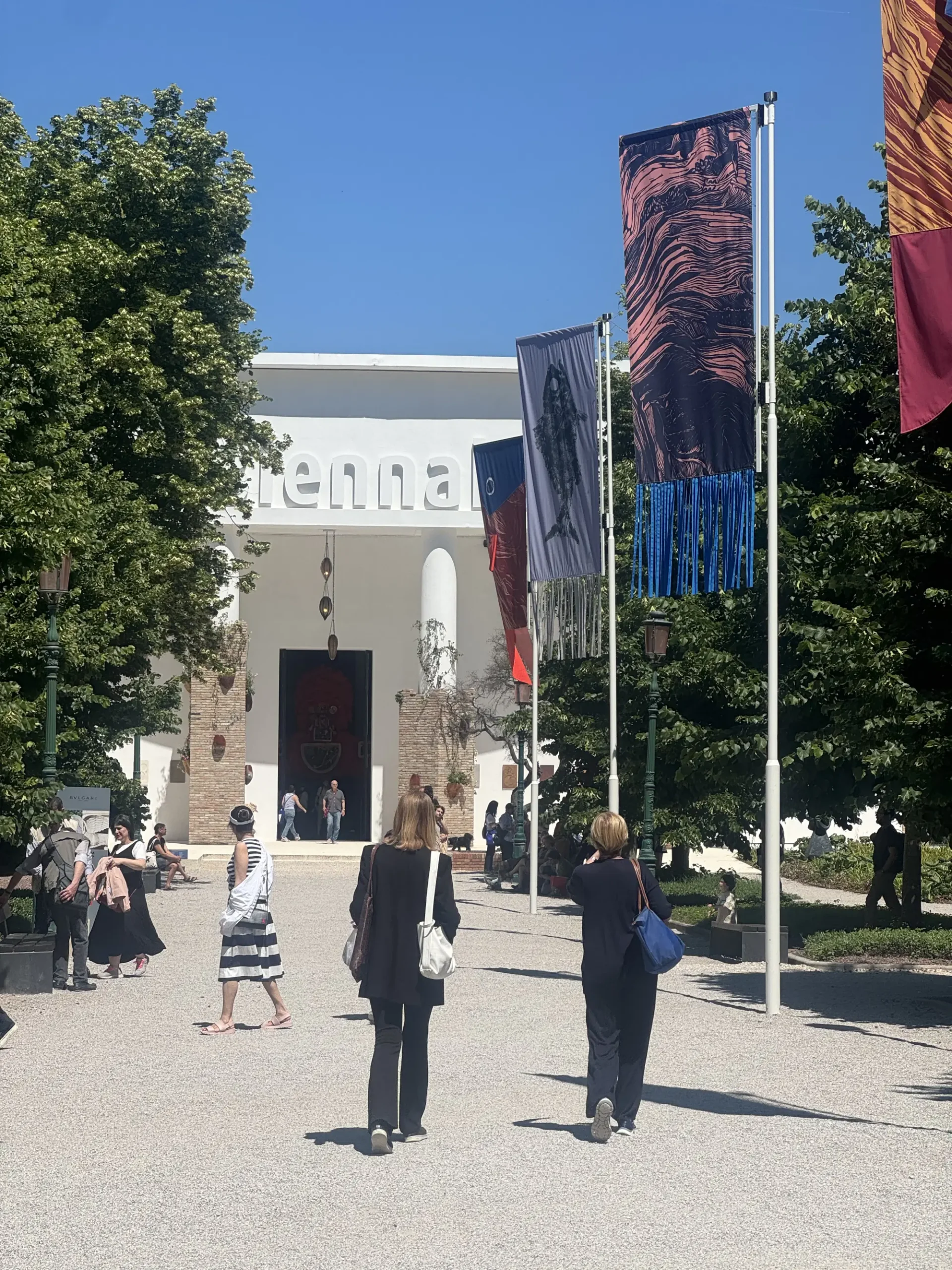
The Giardini is a park containing 29 permanent national pavilions, most built across the last century, several of them significant works of architecture in their own right. The Central Pavilion dates to 1894. You move between freestanding buildings under trees, which means shade, benches, and the option of sitting down — a genuine consideration over four hours. It is the more forgiving of the two.
The Arsenale is the former state shipyard: a linear procession through vast brick halls, largely given over to the curated exhibition rather than to national pavilions. It is architecturally overwhelming and physically the harder visit. There is little natural shade and the route does not double back conveniently, so you commit to the whole length once you begin.
Do the Arsenale first, and do it early. It rewards fresh attention, it is marginally quieter in the opening hour, and its scale is punishing on tired legs. Keep the Giardini for the afternoon, when you can sit under a tree between pavilions.
The Pavilions Across the City — and Why Most Visitors Miss Them
Roughly 46 national participations sit neither in the Giardini nor the Arsenale but scattered through palazzi, scuole and refectories across Venice. Most are free to enter. Your Biennale ticket is irrelevant to them.
This is where a disproportionate share of the interesting work sits this year, and it is precisely what the exhausted afternoon visitor never reaches. Several of the strongest African pavilions are out here — the Democratic Republic of Congo at the Scuola Grande di San Marco, Somalia at the Palazzo Caboto, Equatorial Guinea at the Palazzo Donà dalle Rose.
Give the city pavilions their own day and plan the route by sestiere rather than by country. Trying to visit them in the order you find them on a list will have you crossing the Grand Canal four times.
Getting There
Both principal venues are reached by vaporetto from Piazzale Roma or the railway station. For the Arsenale, ACTV lines 1 and 4.1. For the Giardini, lines 1, 2, 4.1 and 5.1, with line 6 running from Piazzale Roma only.
Line 1 stops everywhere and takes an age; line 2 is faster and skips a great deal. The two sites are about a twenty-minute walk apart along the Riva, which is pleasant in May and punishing in August. A daily or multi-day ACTV pass pays for itself the moment you make a third journey.
How Many Days You Actually Need
One day buys you one venue properly or both badly. If it is genuinely all you have, choose the Arsenale and accept that you are seeing half an exhibition.
Two days is the realistic minimum: one venue each, unhurried, with time to sit.
Three days is the right answer — Giardini, Arsenale, and a day for the city pavilions. This is what the €40 three-day ticket exists for.
What Nobody Tells You
Rest is built into the design. Kouoh’s exhibition includes deliberate spaces for pause, which are not an afterthought and not decoration. Use them. This is not a show that rewards a forced march, and treating it as an endurance event is the surest way to see nothing.
Eat before you arrive. Catering at both venues is limited, expensive and busy at exactly the hour you will want it.
Wear walking shoes. The Arsenale floors are unforgiving and the distances are longer than any map suggests.
Take the national pavilion booklet at the gate and mark what you want before you start, rather than deciding in front of each door.
Weekdays over weekends, always. Opening week, spring weekends, and September and October are the busiest periods of the run.
Frequently Asked Questions
How much are Venice Biennale 2026 tickets?
€30 full price for one access to both venues, €16 for students and under-26s, €20 reduced for over-65s and Venice residents. A three-day ticket is €40, weekly €50, and a full-season pass €80. A €0.50 presale fee applies.
What are the opening hours?
11:00 to 19:00 until 27 September, with the Arsenale open to 20:00 on Fridays and Saturdays. From 29 September to 22 November, 10:00 to 18:00. Last admission is fifteen minutes before closing.
Is the Venice Biennale closed on Mondays?
Yes, with four exceptions in 2026: 11 May, 1 June, 7 September and 16 November. Open Mondays are the least crowded days of the run.
Does one ticket cover both the Giardini and the Arsenale?
Yes. One access to each, and they need not be used on the same day.
Are the city pavilions free?
Most of the roughly 46 national participations outside the two main venues are free to enter and require no Biennale ticket.
How many days do I need?
Three is right: one for the Giardini, one for the Arsenale, one for the city pavilions. Two is workable. One means seeing half.
When does the Venice Biennale 2026 close?
Sunday 22 November 2026, which is also the date of the awards ceremony.
Prices and hours from La Biennale di Venezia, verified August 2026. Confirm on the official site before travelling. Further reading: the full guide to In Minor Keys, the thirteen African pavilions, and Koyo Kouoh, the curator behind it.
Read more from the original source
