




Local Voices. Statewide Impact. Stay Informed with North Florida News
- James Weldon Johnson, a key Jacksonville leader, penned "Lift Ev’ry Voice and Sing," a significant hymn celebrating Black identity and resilience.
- Jacksonville’s LaVilla neighborhood thrived as a cultural hub for Black-owned businesses and music during the early 20th century.
- The city's hip-hop scene, especially Miami bass, played a crucial role in defining Florida's unique sound in the late 80s and 90s.
Black Music Month was founded by a group of music industry luminaries to celebrate the contributions of Black music to American culture: songwriter and producer, Kenneth Gamble, journalist and community activist, Dyana Williams, and DJ Ed Wright. Gamble was inspired to create Black Music Month after witnessing the impact of Country Music Month, and formed the Black Music Association to lead the effort. In June 1979, President Jimmy Carter hosted the first Black Music Month celebration on the White House Lawn. Pathbreaking radio host Dyana Williams lobbied to senators and congress people for years before the observance was officially recognized by a proclamation by President Bill Clinton in 2000.
When we think about Black music — Blues, Jazz, Rock, Hip Hop, etc, metropolises with well known contributions like Detroit, Atlanta, Los Angeles, Philadelphia and New Orleans, naturally come to mind. Well, this bold southern city has its own history of musical influence, so perhaps it’s time we add Duval to the mix. In honor of Black Music Month, here’s a brief history of Black music making and memory from a local lens.
James Weldon Johnson (center) with friend Bob Cole (left) and brother Rosamond (right)
May we forever stand
True to our God
True to our native land
—James Weldon Johnson, Lift Ev’ry Voice and Sing (1900)
Following the abolishment of legalized slavery, Black communities sought advancement in the midst of the state violence and discrimination that defined the Jim Crow era. James Weldon Johnson was one of Jacksonville’s courageous leaders in the African American community who rose to national influence. A dynamic and multi-talented leader, Johnson served as both a field secretary and eventually executive secretary for the NAACP and principal at his alma mater, the Stanton School.
In February 1900, Johnson was approached by a group of community members who wanted to organize a celebration for Abraham Lincoln’s birthday. Johnson originally planned to write a poem about Lincoln, but the creative journey soon inspired something much broader and deeper: the famous hymn Lift Ev’ry Voice and Sing. Johnson penned the lyrics for the song and his brother, gifted composer John Rosamond Johnson, set the lyrics to music.

James Weldon Johnson at his writing desk. Image courtesy of the Alliance for Networking Visual Culture.
Johnson wrote about his experience creating the song in his autobiography Along This Way. The first line, “Lift ev’ry voice and sing,” came easily, and he then set to work finishing the stanza. When these lines came to him, he realized “the spirit of the poem had taken hold of me”:
Sing a song full of the faith that the dark past has taught us
Sing a song full of the hope that the present has brought us
By the third stanza, Johnson found himself in a poetic euphoria, weeping as he crafted the lines. “Feverish ecstasy was followed by that contentment – that sense of serene joy – which makes artistic creation the most complete of all human experiences,” he wrote. With vivid parallels to the Biblical story of Exodus, “Lift Ev’ry Voice and Sing,” tapped into the tradition and pathos of negro spirituals, which enslaved people used to express sorrow, hope, and faith in the future.
After its first performance by 500 school children at Stanton, Jacksonville’s Black children played a critical role in spreading the song across the country, a legacy Johnson treasured: “The schoolchildren of Jacksonville kept singing the song; some of them went on to other schools and kept singing it; some became school teachers and taught it to their pupils,” he wrote. “Nothing that I have done has paid me back so fully in satisfaction as being part creator of this song.”

The Johnson brothers’ hymn inspired Northeast Florida sculptor Augusta Savage’s masterpiece, The Harp, also known as Lift Every Voice and Sing. The plaster version of the piece was displayed at the New York World’s Fair in 1939, but Savage wasn’t able to raise funds to cast it in bronze and it was demolished at the end of the fair. Image courtesy of the New York Public Library.
The National Association of Club Women promoted the song and the NAACP adopted it as its official song in 1919. In her book May We Forever Stand scholar Imani Perry identifies “Lift Ev’ry Voice and Sing” as an instrument of Black identity, political consciousness, ritual making, community building and associational life. American history scholar and Occidental College professor Erica Ball illuminates Perry’s lessons in May We Forever Stand in noting the roles that members of Black associations and Black students in the segregated schools of the South played in cementing the song in memory. Black institutions, schools, and churches were the spaces that the Civil Rights Movement grew out of. Singing “Lift Ev’ry Voice and Sing” daily reminded both singers and listeners of their own historical strength, faith, and perseverance.

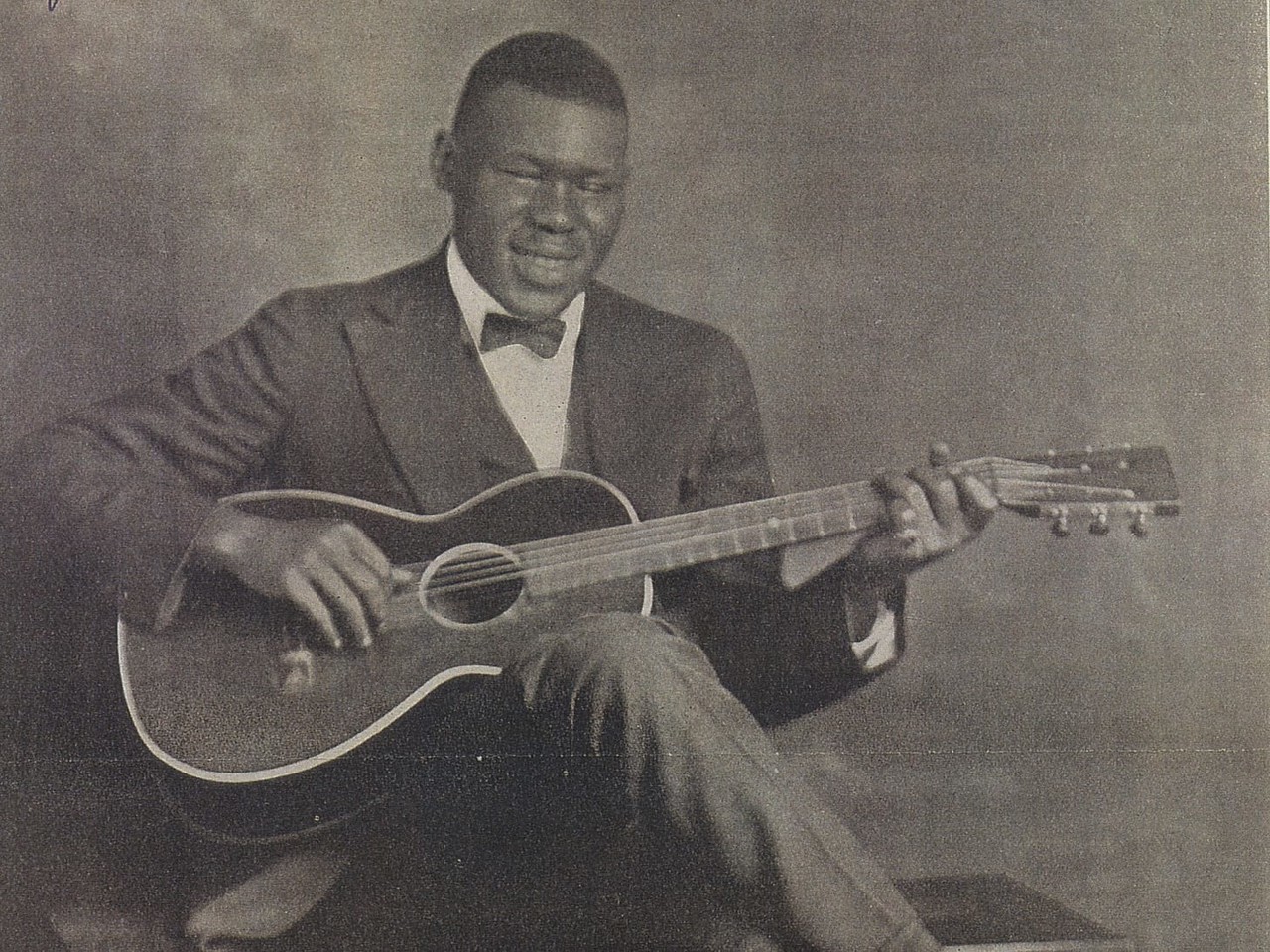
Arthur “Blind” Blake, blues and ragtime musician, was one of the prominent figures of early 20th century music with Jacksonville ties.
All my life I’ve been a travelin’ man,
Stayin’ alone and doin’ the best I can
—Arthur “Blind” Blake, Police Dog Blues (1929)
In the early 20th century, Jacksonville’s LaVilla neighborhood was burgeoning with creative and artistic life. With a roughly 70 percent Black population, LaVilla was home to thriving Black-owned businesses, numerous theaters, night clubs, and juke joints that would eventually become stops along the Chitlin’ Circuit and a rich music scene. Interestingly, LaVilla’s renaissance era predates and helped inspire Harlem’s, which is widely considered to have started in the 1920s. Several Jacksonville history makers, including the Johnson brothers, Zora Neale Hurston, and Augusta Savage, were also figures in the Harlem Renaissance after moving to New York City in 1901, 1925, and 1921, respectively.

Johnnie Woods and Little Henry from the Indianapolis Freeman, January 26, 1918.
Blues music originated in the late 19th century in the Mississippi Delta and as it spread across the American South it became a key part of the LaVilla scene. The first account of blues singing on a public stage took place in LaVilla, when Professor Johnnie Woods, a ventriloquist, tap dancer, and drag performer took the stage at the Colored Airdome Theatre, said to have been the largest theatres for African Americans in the South. Woods’ performance was reported by the Indianapolis Freeman: “[Woods] set the Airdome wild by making Little Henry drunk… he uses the ‘blues’ for Little Henry in this drunken act.”
Other Blues musicians with ties to Jacksonville include Gertrude “Ma” Rainey, Arthur “Blind” Blake, Ray Charles, and Jai Johanny “Jaimoe” Johanson of the Allman Brothers Band.

Hurston worked for the WPA, collecting folklife and folklore from Floridians throughout the state. She is pictured here in Eatonville with Rochelle French listening to Gabriel Brown playing guitar. Image Courtesy of Florida Memory.
The Blues was born out of earlier musical styles like work songs and field hollers. In 1939, Zora Neale Hurston worked for the Federal Writers Project to collect stories, songs, traditions, and folklore among Florida’s Black rural and working class communities. Hurston’s office was based at the Clara White Mission, a LaVilla landmark, where she organized a recording session with everyday community members to preserve the songs. You can listen to them here.
Blues music was recently spotlit in Ryan Coogler’s enthralling thriller Sinners, as a powerful storytelling device on a long continuum of musical traditions, remixes, and inventions within the African diaspora. As a type of folk music with a strong emphasis on storytelling, Blues is a progenitor to other genres like Hip Hop and R&B. Zora Neale Hurston scholar and author Rae Chesny makes a fascinating connection between the approach Hurston took while conducting her fieldwork and the power of music as a trust builder and unifying force, or in other words, a vibe check. According to Chesny, Zora knew how to be prepared to interview and record people. She didn’t just ask questions, she brought instruments and performed along with residents, earning their trust and their stories.

Cover of Quad City DJ’s’ 1996 album Get On Up and Dance.
If you feel like dancing, well come on, it’s up to you.
—Quad City DJs, C’Mon n’ Ride It (The Train) (1996)
Any time-traveling tour of Duval’s music scene would be incomplete without exploring the city’s contributions to hip-hop music and culture. For a genre with traditions of sampling and remixes, hip-hop is always in reflective conversation with history, even recent history. Widely considered to be hip-hop’s golden era, the late 1980s and ‘90s produced countless types of hip-hop music, highlighting the diversity in content, sound, and regional flavors within the genre. Florida’s most prominent regional sound in this period was the party-centric subgenre known as Miami bass, which came to nationwide attention in no small part thanks to Jacksonville’s hip-hop scene.
Miami bass originated in Miami’s Black neighborhoods in the mid-1980s due to pioneers like Uncle Luke and 2 Live Crew. Characterized by excessively low bass lines, dance-ready rhythms and lyrics mostly about sex and partying, by the late 80s the sound had caught on in Central Florida, Jacksonville and Atlanta. Jacksonville produced a series of interconnected groups, all involving the same production team of Johnny “Jay Ski” McGowan and Nathaniel “C.C. Lemonhead” Orange, who helped to solidify Florida’s place on hip-hop’s map.
Jay Ski and Lemonhead realized they could take Miami bass music to new heights of popularity if they toned down the vulgar lyrics and turned up the production values. Forming a partnership ultimately known as Quad City DJ’s (“quad” being 90s Florida slang for bass), they first made music together with the Chill Deal Boyz, who released one EP in 1991. In 1993, Jay Ski and Lemonhead assembled a new group, 95 South, who had a Top-10 single with “Whoot! There it Is”, which predated the similarly named “Whoomp! (There It Is)” by Atlanta group Tag Team, by a month. After the vocalists departed, Jay Ski and Lemonhead formed a new group, 69 Boyz, who had an even bigger hit in 1994 with “Tootsie Roll.” In 1995, the two produced the hit single “Freak Me Baby” for Dis-n-Dat, a sister duo from Atlanta.
In 1996, Jay Ski and Lemonhead added vocalist JeLana LeFleur to release music under their own Quad City DJ’s moniker. the Quad City DJ’s made their mark with the 1996 megahit “C’mon N Ride It (The Train)”, and their platinum album Get On Up and Dance featured other bangers like “Work Baby Work” and “Summer Jam.” Another hit followed that year when Quad City DJ’s created the theme song to the animated movie Space Jam.

Quad City DJ’s.
Groups like Quad City DJs and 69 Boyz made music that was high energy and danceable, with perhaps just enough edge to remain radio friendly. Their tracks could be heard at a cookout, school dance, or Skate Station. It was also around this time that Duval’s famous chant started to make waves. DJ Everette “Easy E” Eason is credited with popularizing the “Duuuval” chant by using it as a radio drop after hearing it in the streets. He and DJ Tee Roy also started using it at clubs and events around Florida. The trailblazing radio personalities of 92.7 FM The Beat (now 93.3) told ESPN about the chant’s origins in 2023, explaining that it was a way for them to tell people and celebrate where they were from. Using the chant on the radio allowed them to reach the entire state of Florida, spreading the chant beyond Jacksonville.
The sounds of Quad City DJs, 69 Boyz, and other Miami bass pioneers served as a precursor to the lighthearted, melodic jams delivered by Florida’s biggest rap stars in the early 2000s, from T-Pain to Plies. The legacy of those J-Ville forerunners has continued in artists like Trap Beckham, J-Dash, and Lil Duval.

Whole Wheat Bread band members pose in front of the downtown Jacksonville skyline. Image courtesy of Whole Wheat Bread.
The word’s on the street and it’s on the news,
I’m not gonna teach him how to dance with you.
—Black Kids, I’m Not Gonna Teach Your Boyfriend How To Dance With You (2007)
There was a time when the faces of rock music looked very homogeneous. This may still be the case in mainstream music industry and culture, but thanks to the work of educational and cultural organizations like Afro Punk, the understanding of rock music’s deep ties to Black communities is starting to grow.
One rock band with roots in Duval is Whole Wheat Bread. Formed in 2003 by Jacksonville natives Aaron Abraham, Nicholas Largen, and Joseph Largen, WWB has been influential in the city’s punk scene as “a dirty south punk rock band,” as they state on their Facebook page. Though WWB had not experienced the commercial success of other Jax Rock groups like Yellow Card or Red Jumpsuit Apparatus, a quick internet search uncovers an enduring fandom as folks on social media and other online forums reminisce over impressive live performances and early album jams. WWB released their debut album “Minority Rules” in 2005. The album’s tone is full of youthful, existential angst while exploring topics like substance abuse, mental health, and harrowing police encounters, which remain almost hauntingly relevant.
Some of Whole Wheat Bread’s most popular records embrace the relationship between Rock and Rap with mashups of raging guitar riffs and hypnotizing beats, like the early 2000s knocker “Killas,” which was a standout track on Lil Jon’s 2010 album Crunk Rock, and “Never Scared,” a bold cover of Master P’s classic. As WWB made their mark, the band was intentional in representing their hometown from the start. Abraham told The Florida Times-Union that they adopted the DUUUVAL chant and referenced Jacksonville in each album cover.

Black Kids band member Reggie Youngblood performing. Image courtesy of Jacksonville Music Experience
Another homegrown band has a name that may sound literal but likely has layers of meaning, is Black Kids. Though sometimes described as an indie rock or alternative band, Black Kids’ music doesn’t fit neatly into any traditional category. The multicultural band is made up of brother and sister Reggie and Ali Youngblood, Dawn Watley, Kevin Snow, and Owen Holmes, and gained a following in the early 2000s through impressive live shows and the buzz of early internet hubs like MySpace. In 2008 Black Kids dropped their album “Partie Traumatic,” which featured groovy melodies and witty, earnest lyrics.
The Jacksonville Music Experience notes that Pitchfork ranked BK’s standout single “I’m Not Going to Teach Your Boyfriend How to Dance With You” the 68th best song of 2007 (for context: M.I.A.’s “Paper Planes” landed at #4.) Though the band has gone through a long hiatus, BK has started releasing new music in recent years and performed in the 2023 Corona Capital annual music festival in Mexico City. BK dropped a new EP in April 2025 called Cemetery Lips.
Black musicians have continued making waves in Jacksonville’s indie rock scene. Other examples include LANNDS, an electro-pop duo made founded in Jacksonville by Rania Woodard and Brian Squillace, and Yuno, an eclectic indie pop songwriter who released his first full length album on Subpop in 2025.
Jacksonville’s Black history is a reminder of music’s profound power to bring people together, whether it’s to tell our stories, to fight for a common cause, to connect through shared memory and experience, or to just dance and have a good time. And talent continues to emerge from the city. More artists that call Jacksonville home include Jackie Moore, Marthaniel Roberts, Alja “KaMillion” Jackson, Glenn Jones, and Jahaan Sweet, among many others. Music has played a major role in helping Jacksonville shape and discover its identity. For Jax locals, the music also serves as a source of pride and inspiration and, like history, there’s always more to be uncovered.
Article by Sytonia Reid, Ennis Davis and Bill Delaney. Contact Ennis at edavis@moderncities.com and Bill at wdelaney@moderncities.com. Sytonia Reid is a very proud Jax native, Howard University alumna, time traveler, and storykeeper.
Read the full article on the original site
