




Global Black Voices: News from around the World
- Alparslan Bayraktar calls the situation 'the mother of all crises', warning of severe supply and price shocks from the Strait of Hormuz closure.
- Turkiye's infrastructure, including Blue Stream and TurkStream, and 72 percent gas storage reinforce its regional energy hub role.
- Crisis forces a new energy architecture: transit proposals include Turkmenistan Caspian route, Iraq-Turkiye Basra extension, and Qatar to Turkiye pipeline.
- Higher oil prices strain the budget; each $1 rise costs Ankara about $400 million, increasing recession and inflation risks.
Turkiye’s energy minister says the crisis in the Strait of Hormuz, due to the United States and Israel’s war on Iran, indicates the importance of diversifying energy routes and will force the world to move towards forming a new energy structure.
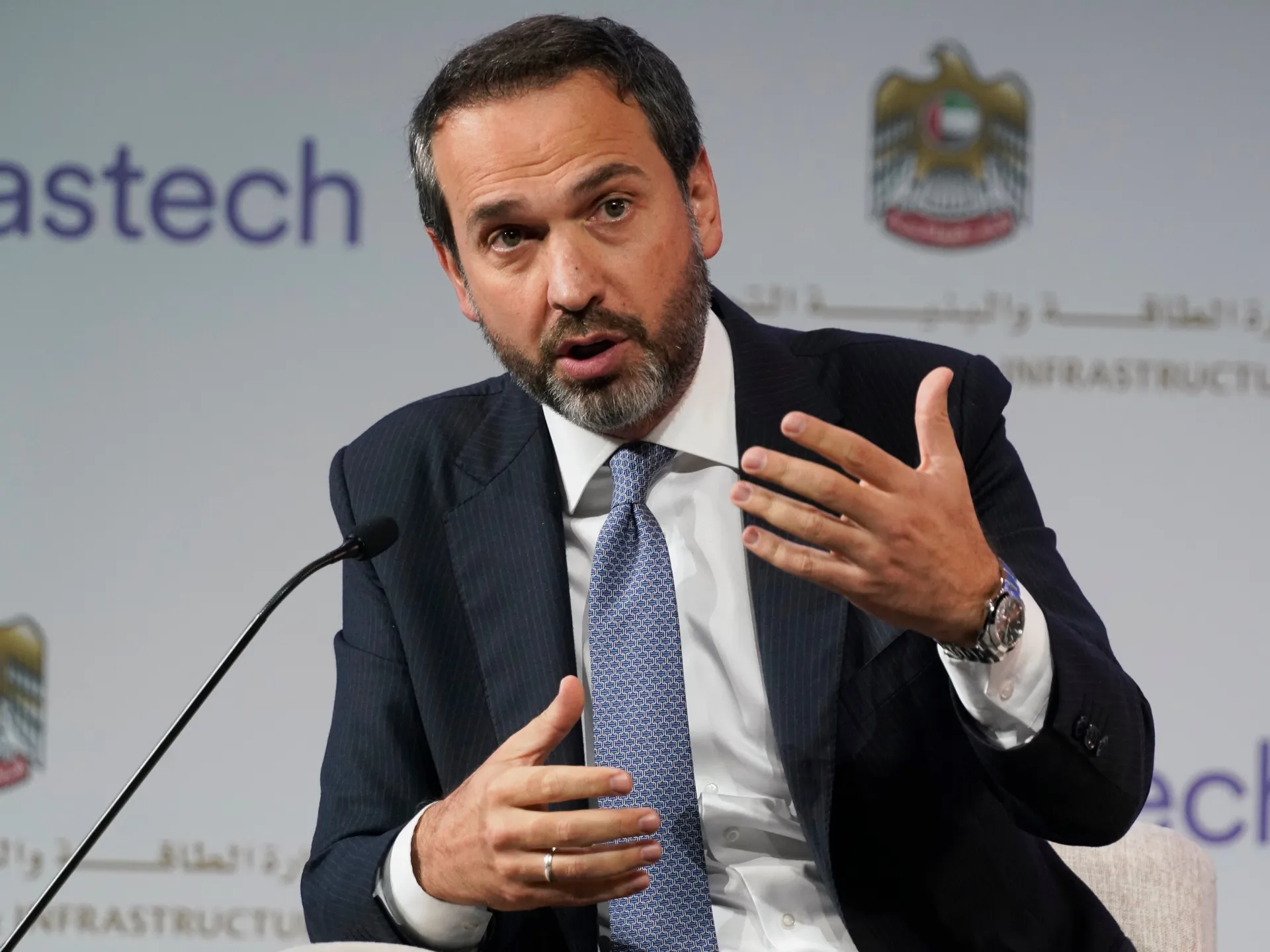
Turkish Energy and Natural Resources Minister Alparslan Bayraktar, in an exclusive interview with Al Jazeera Arabic, discussed the effects of the crisis caused by Iran’s retaliatory blocking of the strait, calling the current global energy crisis “the mother of all crises”.
Recommended Stories
list of 3 itemsend of list
Bayraktar argued that thanks to Turkiye’s extensive investments in energy and infrastructure, its geographical location between Asia and Europe, and the presence of oil and natural gas reserves in its region, it has become a pivotal country in the region in the field of energy, especially as it harbours two key pipelines, the “Blue Stream” and the “TurkStream”.
The minister also suggested Ankara is well-suited to weather the crisis, as it has sufficient strategic energy reserves, with gas storage facilities that are 72 percent full, compared with Europe’s at just 28 percent.
But Bayraktar said that the rising cost of oil and gas still burdens the state budget, as an increase in the price of a barrel of oil by $1 costs Ankara about $400m.
The following is a transcript of Al Jazeera’s interview with the Turkish minister discussing the global energy crisis. It has been edited for length and clarity:
Al Jazeera: The entire world has been suffering as a result of the tensions in the Gulf region and the Strait of Hormuz since February 28. How do you see the current situation with regard to energy supplies and security?
Bayraktar: We are going through what we might call the “mother of all crises”. The world has witnessed many oil crises in the past 50 years, such as the post-COVID-19 crisis and following the Ukrainian-Russian war, but this crisis seems to be the biggest of them all. Despite this, I would argue that the world has become immune to such crises. Looking back at the past 20 years, it seems that crises have become the new normal.
The current situation is as follows: the world needs 103 million barrels of oil per day, but supply is currently limited due to the closure of the Strait of Hormuz, the world’s most important oil transit route. There is a deficit of approximately 20 million barrels, and the world is searching for a solution.
With the ceasefire beginning today [Wednesday], our hope for an improvement in the situation has increased, as oil prices have begun to fall, and the situation is expected to improve further with the resumption of navigation in the strait. Our hope is to reach a lasting peace.
AJ: How might this crisis bring about a change in the energy supply map?
Bayraktar: The epicentre of the crisis is the Strait of Hormuz, and there are two things I would like to draw attention to in this area.
The first is the extremely important pipeline in Saudi Arabia that transports its oil from east to west. Thanks to it, the kingdom can transport a large part of its oil to the Red Sea and from there to global markets.
The second is the pipeline in the United Arab Emirates, which transports 1.8 million barrels of oil to the port of Fujairah.
Imagine what the situation would be like if these pipelines didn’t exist? I say this because diversification is more important than ever – without it, the world would have faced an even more devastating crisis. The important lesson we learn is that the crisis is forcing us to move towards a new energy architecture.
AJ: How do you see the current shock spreading, its speed, and its impact? Will it get worse?
Bayraktar: I hope the crisis does not get worse, and at the moment, everyone expects it to stop at some point, and the ceasefire has also reinforced this expectation.
The crisis is also reflected differently in the East and the West. In the West, an impact on prices is currently observed, while in the East, there are also problems with supply, meaning that there are problems with both supplies and prices.
The world is now beginning to feel the economic impact of the crisis. While there doesn’t seem to be a supply problem in the West at the moment, rising prices have affected everyone.
If you wanted to buy a shipment for physical delivery today, you would have to pay $140 per barrel, and this price could rise even further to $200. This is, of course, the worst-case scenario.
In such a scenario, the global economy could enter another recession, with national economies contracting and inflation soaring. Unfortunately, the end of this situation could be devastating for the entire world. Therefore, everyone desires an end to this situation as quickly as possible, and we hope that the ceasefire will lead to lasting peace.
AJ: Can it be said that Turkiye is rapidly progressing towards becoming an alternative energy corridor? And do you think it is strengthening its goal of becoming an energy hub?
Bayraktar: I would like to begin by pointing out that energy security encompasses three aspects: security of supply, security of demand, and security of transport. What do I mean by this? In a country like Turkiye, which, like Europe, relies on external energy sources, security of supply is a fundamental issue. For countries like Saudi Arabia, Qatar and the UAE, the priority is security of demand.
For example, this issue came to the fore during the coronavirus pandemic, when some countries announced that they would not buy oil, and the security of demand became vital to them.
Now, a very important issue arises concerning energy security. There is demand and there is supply, but is there security in transportation? The Strait of Hormuz is closed, and therefore, there is no transportation.
Countries like Saudi Arabia, Qatar and the UAE say, “We produce and supplies are ready,” while buyers in Asia wait, saying, “Send the gas,” but the supplies cannot leave the Strait of Hormuz. My point is that all dimensions of energy security are critically important.
In Turkiye, we have been making massive infrastructure investments for many years, including pipelines, storage facilities and diversification strategies. Our primary goal is to ensure energy security in our country, which has a population of 86 million and 34 million vehicles, all of which need electricity. Therefore, our investments are primarily directed towards meeting these needs.
Furthermore, thanks to these investments, our geographic location and the presence of world-class oil and natural gas reserves in our region, we have become a pivotal country in the region. We have two major pipelines, Blue Stream and TurkStream, coming from Russia, through which we receive natural gas. We also have two gas entry points into Turkiye, one from Azerbaijan and the other from Iran.
We have also established natural gas storage facilities in numerous locations, increased the capacity of our pipelines connecting to Europe, and recently begun supplying Syria with gas through the Kilis region. Thanks to our integrated partnerships, we have invested heavily with our neighbours in electricity, natural gas, and oil infrastructure.
Thanks to this infrastructure, around 80 billion cubic metres of natural gas can now be transported to Turkiye by sea or via pipelines.
We have an absorption capacity that exceeds our domestic consumption, and this surplus gives us the opportunity to sell it to our neighbours, and then to the whole of Europe via Bulgaria and Greece. Since this region is in dire need of gas, this situation automatically puts us in a central position in the energy system.
AJ: In light of this crisis, what are your proposals for the region?
Bayraktar: In light of this crisis, we emphasise to the region the need to formulate a new structure for the energy system. There must be new supply lines that are technically and commercially viable.
We have three proposals.
One, transporting Turkmen gas [from Turkmenistan] across the Caspian Sea to Turkiye and Europe is a proposal we have been discussing for years and an indispensable project.
Two, extending the [Iraq-Turkiye] oil pipeline to reach Basra, which is of vital importance to Turkiye, Iraq and global markets as well.
And third, the construction of a natural gas pipeline from Qatar to Turkiye, passing through Saudi Arabia, Jordan and Syria, is a huge, extremely necessary and technically and commercially viable project.
The most important thing the world and the region must do is diversify their energy infrastructure, and we need to implement various infrastructure projects. These are proposals for important projects that will alleviate the energy crisis we are currently experiencing globally.
AJ: How has Turkiye’s economy been affected by the recent energy crisis?
Bayraktar: An increase in the price of a barrel of oil by $1 costs us about $400m, and this means that the financial burden is very large, as we are a large country with huge consumption.
Financially speaking, if oil prices stabilise this year at an average of around $100, the additional cost of oil and fuel to us will likely be at least between $13bn and $14bn.
As for natural gas, the cost could reach between $7bn and $10bn. We are talking about an issue that will place an additional burden on Turkiye.
Currently, we do not see any risks in the short and medium term based on the current situation, but we do not know how long this situation will last or whether there will be different developments or further reductions in supply.
We believe that if the current ceasefire turns into a lasting peace and prices return to reasonable levels, the impact will be limited.
AJ: Do you have sufficient strategic reserves? And what is your emergency plan?
Bayraktar: For natural gas, our storage facilities are 72 percent full, compared with only 28 percent in Europe. We are continuing to fill them, taking into account both the security of supply and the cost and economic impact of pricing.
As for crude oil storage facilities, more than 50 percent are currently full. Only about 10 percent of our oil needs pass through the Strait of Hormuz, a manageable percentage.
Read the full story from the original publication
