Close Menu
Savannah HeraldSavannah Herald
    • Home
    • News
      • Local
      • State
      • National
      • World
      • HBCUs
    • Events
    • Directories
    • Weather
    • Traffic
    • Jobs
    • Sports
    • Politics
    • Lifestyle
      • Faith
      • Senior Living
      • Health
      • Travel
      • Beauty
      • Fashion
      • Food
      • Art & Literature
    • Business
      • Real Estate
      • Entertainment
      • Investing
      • Education
    • Guides
      • Back to School Savannah
      • Summer Camp Guide
      • Juneteenth Guide
      • Black History Savannah
      • MLK Guide Savannah
    We're Social
    • Twitter
    • Facebook
    • YouTube

    Subscribe to Updates

    Get the latest creative news from FooBar about art, design and business.

    Trending
    • The Innovation Strategy Most Companies Miss
    • Southern Turkey Neck and Giblet Gravy
    • A ‘Culinary Class Wars’ Alum Has Opened One of NYC’s Hottest New Restaurants
    • Thinking About DA-Link? – Anh Co Tran
    • Country diary: With parched fields all around, we say thank you for the water | Environment
    • I Walked 19,552 Steps in the NikeSkims Rift Satin
    • Wangechi Mutu at Venice 2026: SimbiSiren and the Rebuilt Eden
    • America: The Country We Were Promised vs. the One We Got
    Facebook X (Twitter) Instagram YouTube
    Login
    Savannah HeraldSavannah Herald
    Savannah HeraldSavannah Herald
    Home » Paleontologists Reconstruct Ecology of Archaeopteryx
    Local

    Paleontologists Reconstruct Ecology of Archaeopteryx

    Savannah HeraldBy Savannah HeraldJune 30, 20266 Mins Read
    Facebook Twitter Pinterest LinkedIn WhatsApp Reddit Tumblr Email
    Paleontologists Reconstruct Ecology of Archaeopteryx
    Share
    Facebook Twitter LinkedIn Pinterest Email

    Scientific research & Discovery: Explore the Globe Via Research and Development

    Key takeaways
    • Archaeopteryx used limited powered flight and occasional gliding, launching from elevated perches or into headwinds to generate lift.
    • The reversed hallux opposed other toes, enabling branch grasping and supporting an arboreal, flight-related perching adaptation.
    • Wing anatomy: curved primary feathers and large tertial feathers closed wing gaps, consistent with aerodynamic lift in flying birds.
    • Skull features (primitive bill-tip organ, mobile tongue, dental papillae) suggest an opportunistic omnivore eating insects, seeds, and seasonal resources.
    • Solnhofen archipelago: warm, seasonally dry islands; disruptive black-and-white plumage and scleral-ring evidence indicate a diurnal, multi-substrate lifestyle.

    A detailed new testimonial by Field Museum of Natural History paleontologists draws together the latest fossil evidence– including evaluation of five recently-described specimens, among them what the authors call arguably the best-preserved specimen yet– to use one of the most complete picture to date of Archaeopteryx ‘s ecology, behavior, and life. The scientists say that the famous feathered dinosaur was neither a simply ground-bound hunter nor a totally contemporary flier, yet an environmental generalist that scrambled, set down, glided and flapped its method through a patchwork of seaside forests and dry lagoons roughly 150 million years back.

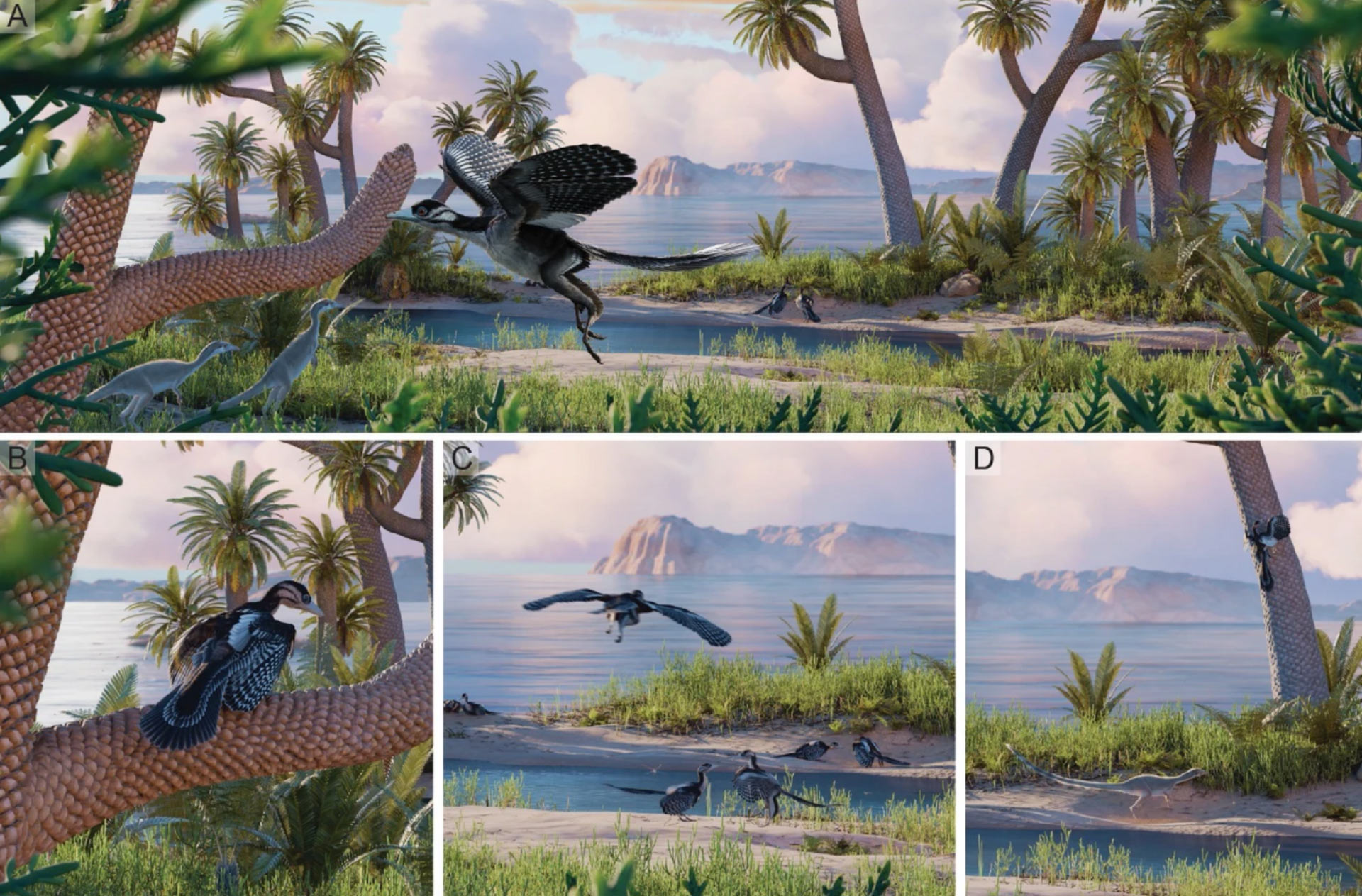
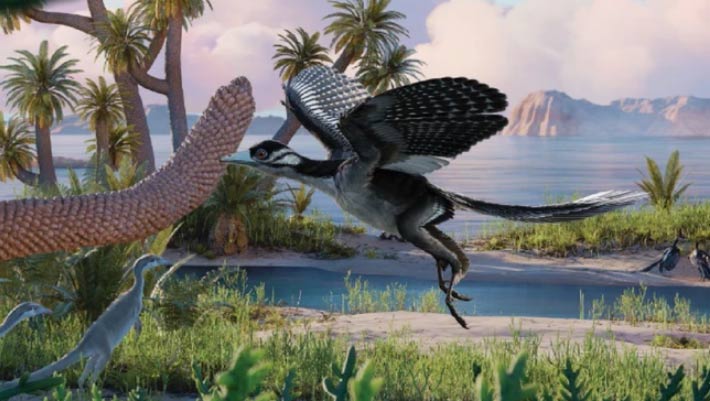
    Reconstruction of Archaeopteryx in its environment utilizing diverse forms of locomotion: (A) waving flight to elevated perches; (B) setting down; (C) moving flight from altitude and terrestrial way of life; (D) scansorial locomotion. Picture credit history: Field Gallery/ Great PaleoVisLab Studio/ Institute of Animal Paleontology and Paleoanthropology.

    About 150 million years earlier (Jurassic period), on a chain of low, semi-arid islands that would certainly one day become southerly Germany, a little animal picked its way across the scrub.

    It had the teeth of a reptile, the claws of a predator, and the feathered wings of something that had only simply found out to leave the ground.

    Paleontologists have invested more than 150 years suggesting concerning what, specifically, it might do.

    Archaeopteryx from the 150 -million-year-old Solnhofen plattenkalk in southerly Germany is the oldest recognized bird and the earliest well-known dinosaur to make use of airfoils created by plumes for volant locomotion,” Area Museum of Natural History paleontologists Jingmai O’Connor and Alexander Clark created in their paper.

    “Although now closely matched by the slightly younger Baminornis (149 – 148 million years ago) from Fujian district, China, the pectoral band in this taxon is far more innovative and therefore Archaeopteryx stays one of the most phylogenetically basic taxon pertinent for comprehending the terrestrial to volant shift.”

    In their paper, the researchers synthesize evidence from all recognized Archaeopteryx fossils, including five recently-described samplings, to reconstruct just how the pet lived.

    “The recent summaries of 5 new specimens of Archaeopteryx in the 21 st century has dramatically contributed to the information offered for this vital taxon,” they composed.

    “4 of these specimens are total or virtually so (Thermopolis, 11 th, 12 th, Chicago) and 2 are thought about amongst the best-preserved recognized specimens (Thermopolis, Chicago).”

    “In particular, the Chicago sampling was meticulously gotten ready for scientific research bring about the retention of unique soft cells that offer extra hints.”

    The new analysis says that Archaeopteryx was capable of at least restricted powered flight.

    The animal’s primary feathers reveal a level of crookedness that drops directly within the array seen in flying birds today, and is missing in its close non-flying family members.

    Large systems of supposed tertial feathers, which in modern-day birds link the void in between the body and the external wing, are likewise present, shutting off what would certainly or else be a wind resistant leakage that prevents lift in non-avian relatives.

    Rather than springing straight right into the air like a pigeon, the researchers recommend, Archaeopteryx most likely introduced from raised perches, ran into headwinds or climbed inclines while waving its wings for aid.

    “As the oldest recognized bird, the most significant concern is if and how Archaeopteryx can fly,” they wrote in the paper.

    “Evidence favors restricted powered trip in contrast to obligate sliding volant locomotion, although Archaeopteryx probably likewise utilized sliding flight when vigorously favorable, as observed in several living birds.”
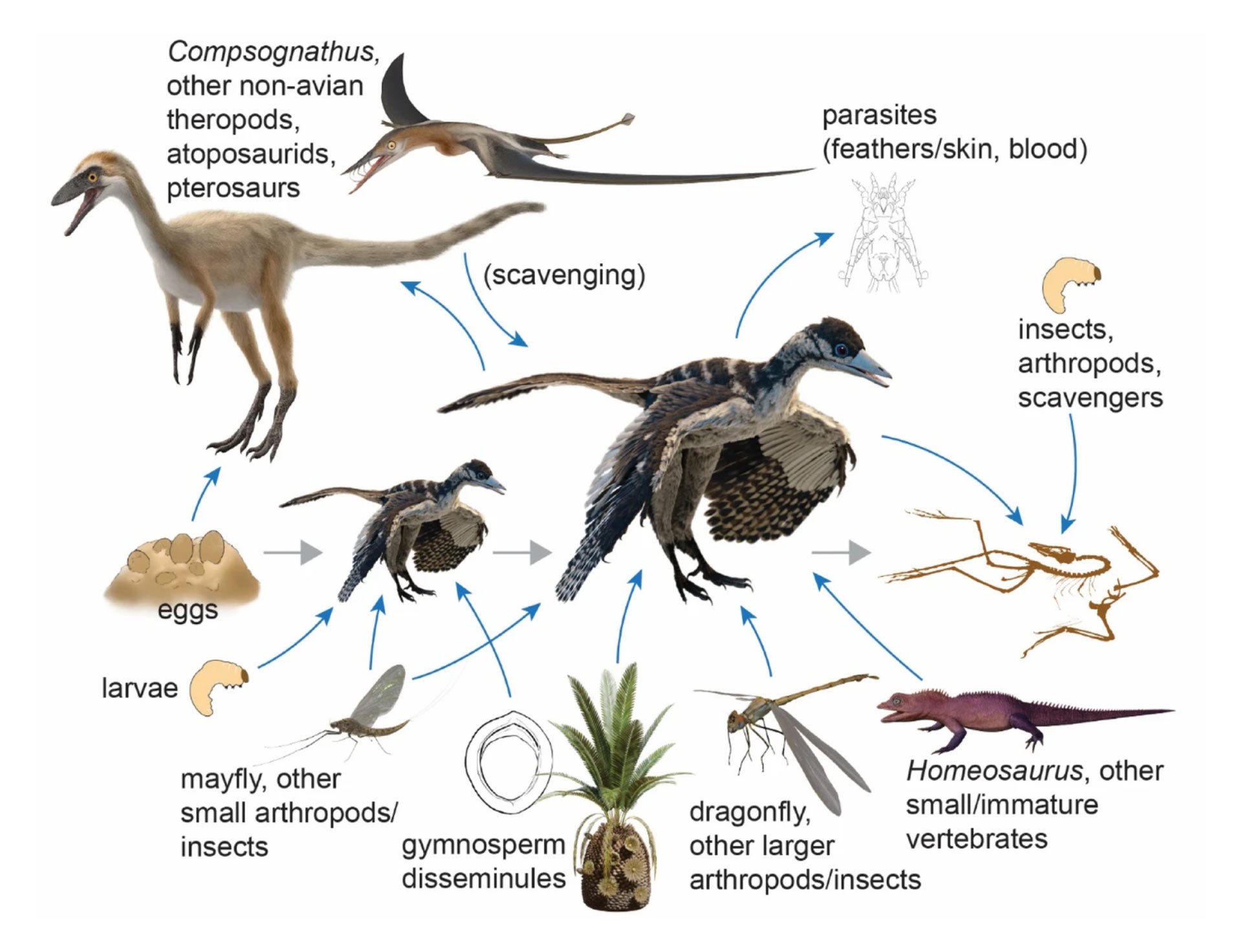
    Preliminary Archaeopteryx food web depicting probable omnivorous diet at various growth stages (eggs, immature, mature, and carcass) and how the animal would have provided trophic resources for other organisms as prey at all life stages including parasites and detritus feeders (scavengers). Image credit: Field Museum / NICE PaleoVisLab Studio / Institute of Vertebrate Paleontology and Paleoanthropology / Samantha Clark.

    Initial Archaeopteryx food web illustrating likely omnivorous diet plan at numerous growth stages (eggs, premature, mature, and carcass) and just how the animal would certainly have provided trophic sources for various other microorganisms as victim at all life stages including parasites and fragments feeders (scavengers). Image credit history: Area Gallery/ Good PaleoVisLab Workshop/ Institute of Vertebrate Paleontology and Paleoanthropology/ Samantha Clark.

    One of the group’s more striking searchings for concerns the first toe, or hallux.

    In non-flying theropod dinosaurs, the hallux points forward, rises above the ground, and is of restricted use for grasping.

    In Archaeopteryx , the hallux is turned around, aiming backward and opposing the other toes in a configuration that permits the foot to twist around a branch or a rock.

    “This suggests the reversed hallux progressed in feedback to trip as an adaptation for making use of elevated perches,” the writers created.

    Archaeopteryx ‘s diet plan stays extra mystical. No fossilized belly components have actually yet been discovered, yet the skull and mouth supply alluring hints.

    The animal possessed numerous birdlike feeding adaptations absent in many close dinosaur loved ones, consisting of structures interpreted as a primitive bill-tip organ– a sensory system that aids living birds manipulate food– along with proof for a mobile tongue and dental papillae made use of in food handling.

    Those attributes suggest Archaeopteryx might have targeted little, energy-rich foods such as insects and seeds, probably mirroring the greater power demands connected with flight.

    The warm, seasonally dry atmosphere of the Solnhofen island chain, where it lived, would have preferred an opportunistic omnivore able to manipulate altering food materials throughout the year.

    “The Solnhofen environment was predominantly warm and dry with the vegetation being xeromorphic,” the paleontologists composed in the paper.

    “Fossils indicate the existence of periodic rainfall (wet season) producing short-lived bodies of water.”

    “This type of seasonal climate lived in by Archaeopteryx might suggest an omnivorous diet regimen, with variants in food resources throughout the year related to weather changes.”

    On the inquiry of shade, chemical evaluation of the separated holotype feather– interpreted as a dorsal wing concealed– suggests it was black and white.

    The whole plumage might have followed suit, developing a disruptive pattern that would have helped separate the animal’s rundown versus the open, scrubby landscape of the Solnhofen archipelago, confusing the gaze of predators.

    An analysis of the eye’s scleral ring validates Archaeopteryx was diurnal, energetic in intense light.

    “As an outcome of its diverse locomotor actions Archaeopteryx would certainly have engaged with numerous substratums in its environment, hanging out on the ground, raised on medium to huge plants, and airborne,” the researchers wrapped up.

    Throughout its life history Archaeopteryx would have used differing food resources spanning the plant and animal kingdoms as well as offered trophic resources to a variety of microorganisms from keratinophagous bloodsuckers to peak killers.

    “Trick differences, discovered in an ecological context, reveal how the appearance of trip in birds affected both skeletal and soft tissue anatomy.”

    The group’s paper was released on April 21, 2026 in the journal Discover Ecology

    _____

    J.K. O’Connor & & A.D. Clark. 2026 The ecology of Archaeopteryx Discov. Ecol 2, 12; doi: 10 1007/ s 44396 – 026 – 00026 -z

    Check out the full article from the initial resource

    Related Posts

    • Your It Girl Style Guide » coco bassey
    • Flau’Jae Johnson Hosts 3rd Back2School Giveaway In Hometown
    • The Greatest Candy Chili Salmon, an Straightforward 20 Minute Dinner
    • Read United Day to Kick Off February Reading Challenge
    • Hair Tea For Growth, Shedding & Scalp Ailments
    • PlanetPlay’s Play2Act survey locates 79% make favorable modification after playing environment-friendly video games
    • Tina Turner Wig Gets Removed from Her Site as Backlash Erupts Online
    • How to sign up for Medicare for the first time
    Archaeopteryx Bird Breakthrough Discoveries climate change diet Dinosaur Earth and Planetary Science Environmental Policy Environmental Updates Europe Feather flight Fossil Germany Global Warming Hallux Health & Science Jurassic Locomotion medical research NASA Updates Nature & Wildlife Omnivory Renewable Energy Science and Innovation Science in the News Science news Scientific Community Scientific Research Solnhofen Solnhofen Archipelago Space Exploration STEM Education Sustainable Future Technology and Science Wing
    Share. Facebook Twitter Pinterest LinkedIn WhatsApp Reddit Tumblr Email
    Savannah Herald
    • Website

    Related Posts

    Local August 11, 2026

    SCCPSS Launches New K-12 Mathematics Curriculum for 2026-27 School Year

    August 10, 2026

    NASA unveils first new wind tunnel in over 80 years

    Health August 10, 2026

    What to Know About the Earthquake in Colombia

    August 10, 2026

    West Virginia University turning polluted mine water into rare earth minerals

    Health August 10, 2026

    This Olympian curbed his unhealthy porn habit – here are the signs and steps to recovery

    August 9, 2026

    Grab rare deals on Patagonia apparel, outerwear, and bags during this massive site-wide summer sale

    Comments are closed.

    Don't Miss
    Local June 26, 2026By Savannah Herald09 Mins Read

    Spatially resolved profiling of extracellular vesicles in tissues with Spatial-EV-seq

    June 26, 2026

    Science & Exploration: Discover the World Through Research Study and Innovation Buzas, E. I. Opportunities…

    Modern French Twist Updo

    November 25, 2025

    NABA Convention Suffers Sponsor Loss Due To Anti-DEI Policies

    August 28, 2025

    No Kings Rally held in Selma

    June 29, 2026

    The Computer That Helped Win World War II

    July 27, 2026
    Archives
    • August 2026
    • July 2026
    • June 2026
    • May 2026
    • April 2026
    • March 2026
    • February 2026
    • January 2026
    • December 2025
    • November 2025
    • October 2025
    • September 2025
    • August 2025
    • July 2025
    • June 2025
    • May 2025
    • April 2025
    • March 2025
    • February 2025
    Categories
    • Art & Literature
    • Beauty
    • Black History
    • Business
    • Climate
    • Culture
    • Education
    • Employment
    • Entertainment
    • Faith
    • Fashion
    • Food
    • Gaming
    • Georgia Politics
    • HBCUs
    • Health
    • Health Inspections
    • Investing
    • Lifestyle
    • Local
    • Lowcountry News
    • National
    • National Opinion
    • News
    • Politics
    • Real Estate
    • Senior Living
    • Sports
    • State
    • Tech
    • Traffic
    • Transportation
    • Travel
    • Weather
    • World
    Savannah Herald Newsletter

    Subscribe to Updates

    A round up interesting pic’s, post and articles in the C-Port and around the world.

    About Us
    About Us

    The Savannah Herald is your trusted source for the pulse of Coastal Georgia and the Low County of South Carolina. We're committed to delivering timely news that resonates with the African American community.

    From local politics to business developments, we're here to keep you informed and engaged. Our mission is to amplify the voices and stories that matter, shining a light on our collective experiences and achievements.
    We cover:
    🏛️ Politics
    💼 Business
    🎭 Entertainment
    🏀 Sports
    🩺 Health
    💻 Technology
    Savannah Herald: Savannah's Black Voice 💪🏾

    Our Picks

    You Can Adopt Inspires Black Families for Adoption

    June 30, 2026

    Hero shooter Last Flag halts production just 2 weeks after launch, but vows to “make sure that the game doesn’t disappear”

    May 3, 2026

    Are minimalist diets redefining everyday health choices?

    November 16, 2025

    Predicting the 2028 USA Olympic basketball roster: Top 12 players

    July 3, 2026

    The Worry of Having Black DNA

    January 9, 2026
    Categories
    • Art & Literature
    • Beauty
    • Black History
    • Business
    • Climate
    • Culture
    • Education
    • Employment
    • Entertainment
    • Faith
    • Fashion
    • Food
    • Gaming
    • Georgia Politics
    • HBCUs
    • Health
    • Health Inspections
    • Investing
    • Lifestyle
    • Local
    • Lowcountry News
    • National
    • National Opinion
    • News
    • Politics
    • Real Estate
    • Senior Living
    • Sports
    • State
    • Tech
    • Traffic
    • Transportation
    • Travel
    • Weather
    • World
    Copyright © 2002-2026 Savannahherald.com All Rights Reserved. A Veteran-Owned Business

    Type above and press Enter to search. Press Esc to cancel.

    Manage Consent
    To provide the best experiences, we use technologies like cookies to store and/or access device information. Consenting to these technologies will allow us to process data such as browsing behavior or unique IDs on this site. Not consenting or withdrawing consent, may adversely affect certain features and functions.
    Functional Always active
    The technical storage or access is strictly necessary for the legitimate purpose of enabling the use of a specific service explicitly requested by the subscriber or user, or for the sole purpose of carrying out the transmission of a communication over an electronic communications network.
    Preferences
    The technical storage or access is necessary for the legitimate purpose of storing preferences that are not requested by the subscriber or user.
    Statistics
    The technical storage or access that is used exclusively for statistical purposes. The technical storage or access that is used exclusively for anonymous statistical purposes. Without a subpoena, voluntary compliance on the part of your Internet Service Provider, or additional records from a third party, information stored or retrieved for this purpose alone cannot usually be used to identify you.
    Marketing
    The technical storage or access is required to create user profiles to send advertising, or to track the user on a website or across several websites for similar marketing purposes.
    • Manage options
    • Manage services
    • Manage {vendor_count} vendors
    • Read more about these purposes
    View preferences
    • {title}
    • {title}
    • {title}
    Ad Blocker Enabled!
    Ad Blocker Enabled!
    Our website is made possible by displaying online advertisements to our visitors. Please support us by disabling your Ad Blocker.

    Sign In or Register

    Welcome Back!

    Login below or Register Now.

    Lost password?

    Register Now!

    Already registered? Login.

    A password will be e-mailed to you.