



Close Menu
Savannah HeraldSavannah Herald
    • Home
    • News
      • Local
      • State
      • National
      • World
      • HBCUs
    • Events
    • Directories
    • Weather
    • Traffic
    • Jobs
    • Sports
    • Politics
    • Lifestyle
      • Faith
      • Senior Living
      • Health
      • Travel
      • Beauty
      • Fashion
      • Food
      • Art & Literature
    • Business
      • Real Estate
      • Entertainment
      • Investing
      • Education
    • Guides
      • Summer Camp Guide
      • Juneteenth Guide
      • Black History Savannah
      • MLK Guide Savannah
    We're Social
    • Twitter
    • Facebook
    • YouTube

    Subscribe to Updates

    Get the latest creative news from FooBar about art, design and business.

    Trending
    • Body-Baring Bardi Goes Ballistic Over Knicks Win With Quavo
    • HBCU stars contributed to New York Knicks championship history
    • Understanding Bipolar I in Black Communities
    • This Ultra-Thin Inspection Borescope With iPhone & Android Support Is 50% Off For Limited Time
    • Choosing the Right Place for Care Can Save Time, Stress, and Money
    • Kemp endorses Burt Jones in GOP primary runoff
    • Barcelona Cruise Passengers Could Face Higher Fees Under New City Proposal
    • New Goodwill Secondary School on track for November 2026 completion: PM Skerrit
    Facebook X (Twitter) Instagram YouTube
    Login
    Savannah HeraldSavannah Herald
    Savannah HeraldSavannah Herald
    Home » A history of the Internet, part 2: The high-tech gold rush begins
    Tech

    A history of the Internet, part 2: The high-tech gold rush begins

    Savannah HeraldBy Savannah HeraldNovember 1, 20255 Mins Read
    Facebook Twitter Pinterest LinkedIn WhatsApp Reddit Tumblr Email
    A history of the Internet, part 2: The high-tech gold rush begins
    Share
    Facebook Twitter LinkedIn Pinterest Email

    Tech Trends & Innovation: The Latest in Tech News

    Welcome to the second article in our three-part series on the history of the Internet. If you haven’t already, read part one here.

    As a refresher, here’s the story so far:

    The ARPANET was a project started by the Defense Department’s Advanced Research Project Agency in 1969 to network different mainframe computers together across the country.  Later, it evolved into the Internet, connecting multiple global networks together using a common TCP/IP protocol.

    By the late 1980s, investments from the National Science Foundation (NSF) had established an “Internet backbone” supporting hundreds of thousands of users worldwide. These users were mostly professors, researchers, and graduate students.

    In the meantime, commercial online services like CompuServe were growing rapidly. These systems connected personal computer users, using dial-up modems, to a mainframe running proprietary software. Once online, people could read news articles and message other users. In 1989, CompuServe added the ability to send email to anyone on the Internet.

    In 1965, Ted Nelson submitted a paper to the Association for Computing Machinery. He wrote: “Let me introduce the word ‘hypertext’ to mean a body of written or pictorial material interconnected in such a complex way that it could not conveniently be presented or represented on paper.” The paper was part of a grand vision he called Xanadu, after the poem by Samuel Coleridge.

    A decade later, in his book “Dream Machines/Computer Lib,” he described Xanadu thusly: “To give you a screen in your home from which you can see into the world’s hypertext libraries.” He admitted that the world didn’t have any hypertext libraries yet, but that wasn’t the point. One day, maybe soon, it would. And he was going to dedicate his life to making it happen.

    As the Internet grew, it became more and more difficult to find things on it. There were lots of cool documents like the Hitchhiker’s Guide To The Internet, but to read them, you first had to know where they were.

    The community of helpful programmers on the Internet leapt to the challenge. Alan Emtage at McGill University in Montreal wrote a tool called Archie. It searched a list of public file transfer protocol (FTP) servers. You still had to know the file name you were looking for, but Archie would let you download it no matter what server it was on.

    An improved search engine was Gopher, written by a team headed by Mark McCahill at the University of Minnesota. It used a text-based menu system so that users didn’t have to remember file names or locations. Gopher servers could display a customized collection of links inside nested menus, and they integrated with other services like Archie and Veronica to help users search for more resources.


    Gopher is a text-based Internet search and retrieval system. It’s still running in 2025!

    Jeremy Reimer
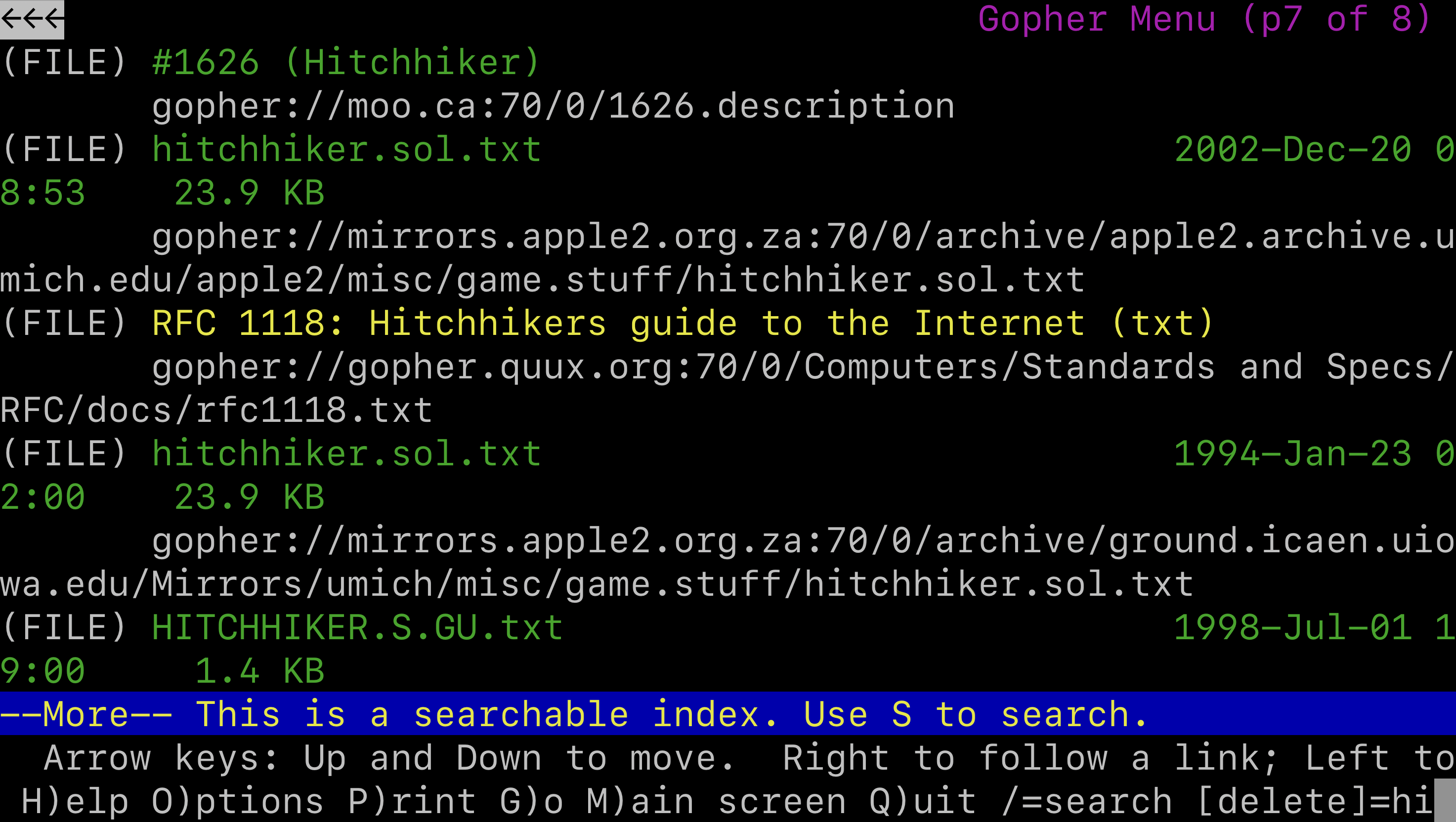
    Gopher is a text-based Internet search and retrieval system. It’s still running in 2025!

    Jeremy Reimer


    Here is the multi-page result of searching for “Hitchhiker” on Gopher.

    Jeremy Reimer
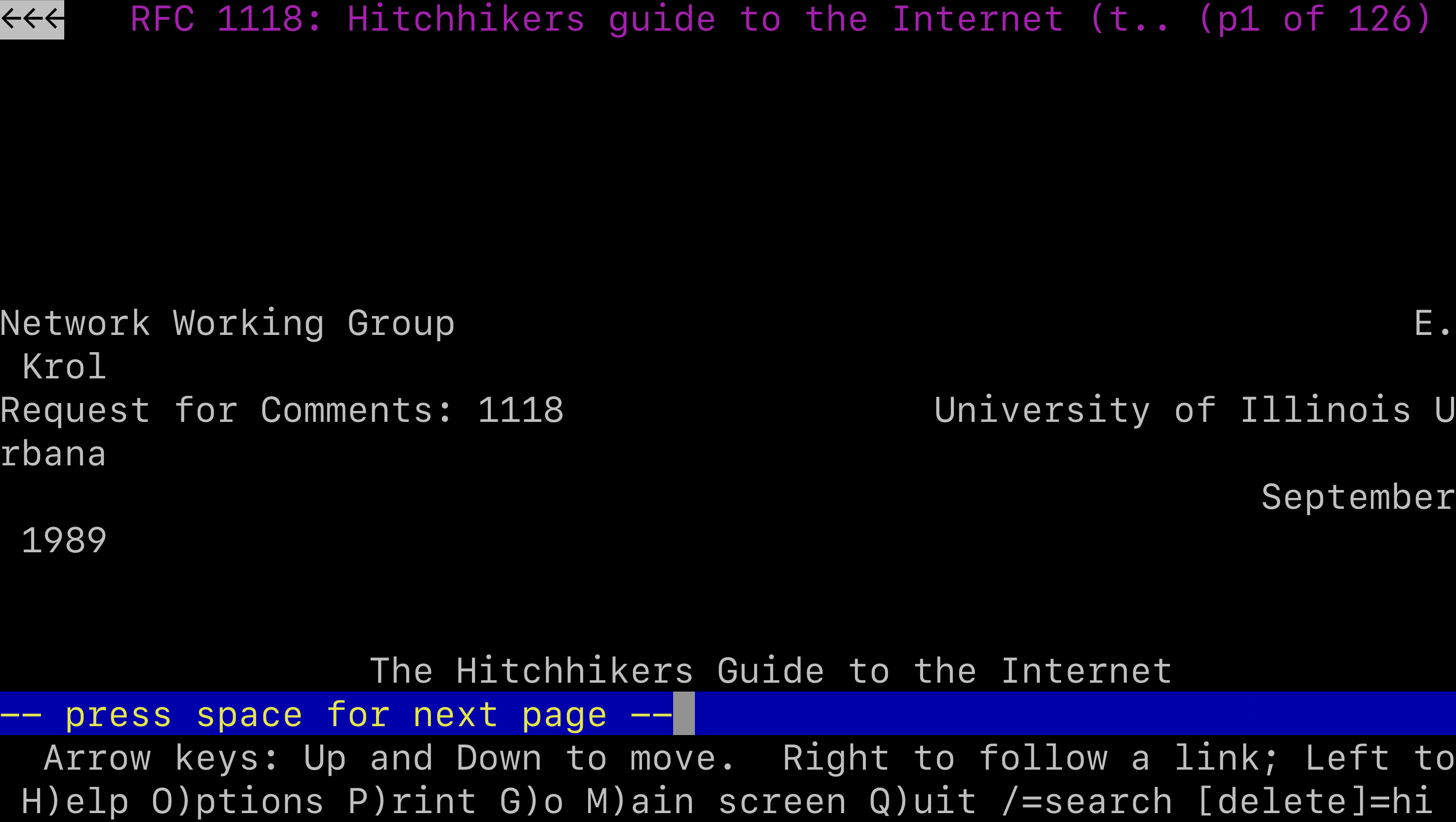
    Here is the multi-page result of searching for “Hitchhiker” on Gopher.

    Jeremy Reimer


    By hitting the Enter key, you can view the document you were looking for.

    Jeremy Reimer

    By hitting the Enter key, you can view the document you were looking for.

    Jeremy Reimer

    Here is the multi-page result of searching for “Hitchhiker” on Gopher.

    Jeremy Reimer

    By hitting the Enter key, you can view the document you were looking for.

    Jeremy Reimer

    A Gopher server could provide many of the things we take for granted today: search engines, personal pages that could contain links, and downloadable files. But this wasn’t enough for a British computer scientist who was working at CERN, an intergovernmental institute that operated the world’s largest particle physics lab.

    The World Wide Web

    Hypertext had come a long way since Ted Nelson had coined the word in 1965. Bill Atkinson, a member of the original Macintosh development team, released HyperCard in 1987. It used the Mac’s graphical interface to let anyone develop “stacks,” collections of text, graphics, and sounds that could be connected together with clickable links. There was no networking, but stacks could be shared with other users by sending the files on a floppy disk.
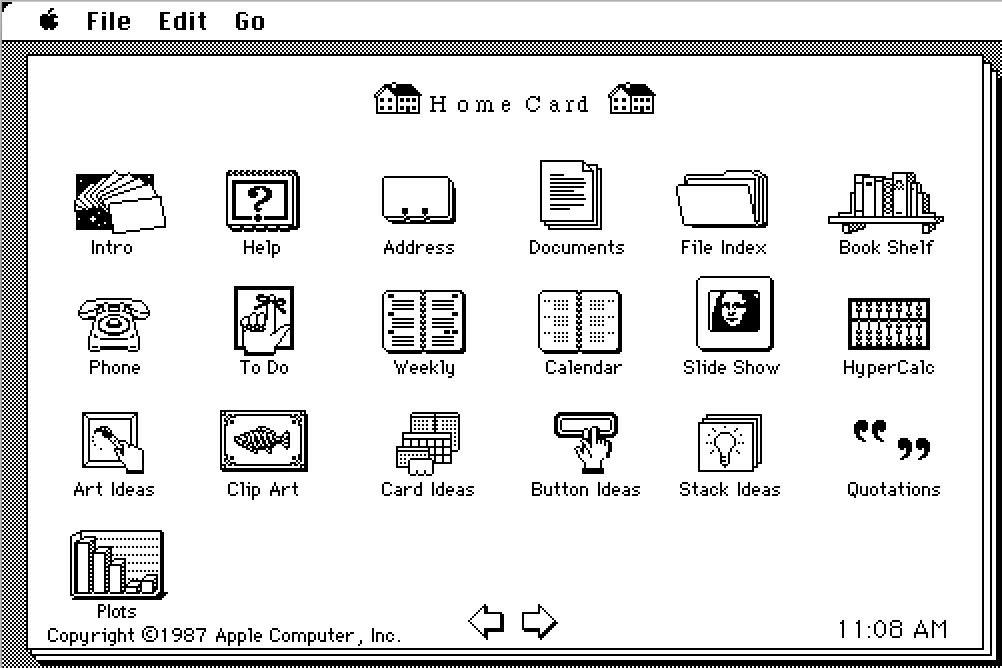


    The home screen of HyperCard 1.0 for Macintosh.

    Jeremy Reimer
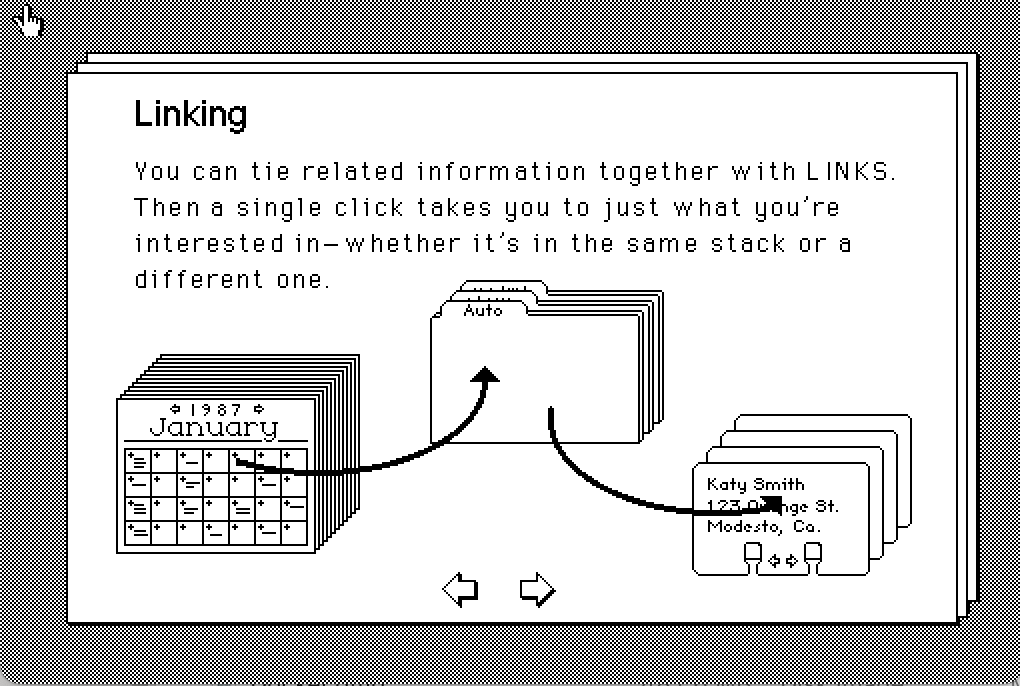
    The home screen of HyperCard 1.0 for Macintosh.

    Jeremy Reimer


    Hypercard came with a tutorial, written in Hypercard, explaining how it worked.

    Jeremy Reimer
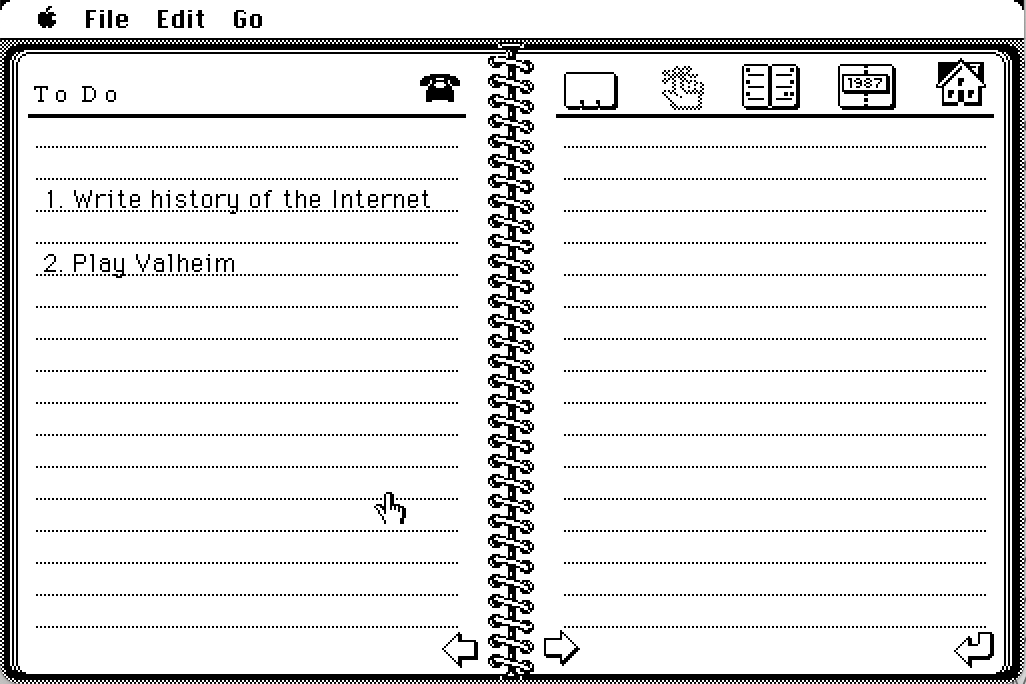
    Hypercard came with a tutorial, written in Hypercard, explaining how it worked.

    Jeremy Reimer


    There were also sample applications, like this address book.

    Jeremy Reimer

    There were also sample applications, like this address book.

    Jeremy Reimer

    Hypercard came with a tutorial, written in Hypercard, explaining how it worked.

    Jeremy Reimer

    There were also sample applications, like this address book.

    Jeremy Reimer

    Hypertext was so big that conferences were held just to discuss it in 1987 and 1988. Even Ted Nelson had finally found a sponsor for his personal dream: Autodesk founder John Walker had agreed to spin up a subsidiary to create a commercial version of Xanadu.

    Read the full article from the original source


    AI and Machine Learning artificial intelligence Consumer Electronics Cybersecurity Updates Data Privacy Digital Trends Enterprise Technology Future of Work Gadget Reviews Green Tech Mobile Tech Robotics News Science and Technology Silicon Valley News Software Development Startups and Tech Tech Industry Insights Tech Innovation Tech Policy Technology News
    Share. Facebook Twitter Pinterest LinkedIn WhatsApp Reddit Tumblr Email
    Savannah Herald
    • Website

    Related Posts

    Tech June 15, 2026

    This Ultra-Thin Inspection Borescope With iPhone & Android Support Is 50% Off For Limited Time

    Tech June 15, 2026

    Cameras, sensors, and 3D body scans: All the tech helping eliminate blown calls

    Tech June 14, 2026

    MacBook Neo review: This laptop is even better 3 months later

    Tech June 13, 2026

    Latest Best Buy Canada sales discount phones, air conditioners, and more

    June 13, 2026

    Heat-surviving cyanobacteria switch to respiration when photosynthesis falters, 48-hour test reveals

    Tech June 13, 2026

    Justice Department seizes websites that published deepfake nudes of famous women

    Comments are closed.

    Don't Miss
    Art & Literature August 29, 2025By Savannah Herald05 Mins Read

    Exactly how the “Mona Lisa” advanced from art work to social sign, forming modern-day songs and food with its coded organizations with aura, credibility, and mass-market worth. – MoMAA

    August 29, 2025

    Black Magics & Society Attribute: The Mona Lisa in Modern Songs: Importance, Condition, and Subversion…

    Neighbors in an Uproar as Historic Missouri Home Appears Set To Be Demolished

    April 19, 2026

    Kendrick Lamar’s Boxing Hand Wrap at Grammys Could Mean a New Era

    May 5, 2026

    Glueless Wig Brands You Can Trust (and Some to Approach With Caution)

    December 1, 2025

    Political anger affects the body differently to other forms of anger

    May 22, 2026
    Archives
    • June 2026
    • May 2026
    • April 2026
    • March 2026
    • February 2026
    • January 2026
    • December 2025
    • November 2025
    • October 2025
    • September 2025
    • August 2025
    • July 2025
    • June 2025
    • May 2025
    • April 2025
    • March 2025
    • February 2025
    Categories
    • Art & Literature
    • Beauty
    • Black History
    • Business
    • Climate
    • Culture
    • Education
    • Employment
    • Entertainment
    • Faith
    • Fashion
    • Food
    • Gaming
    • Georgia Politics
    • HBCUs
    • Health
    • Health Inspections
    • Investing
    • Lifestyle
    • Local
    • Lowcountry News
    • National
    • National Opinion
    • News
    • Politics
    • Real Estate
    • Senior Living
    • Sports
    • State
    • Tech
    • Traffic
    • Transportation
    • Travel
    • World
    Savannah Herald Newsletter

    Subscribe to Updates

    A round up interesting pic’s, post and articles in the C-Port and around the world.

    About Us
    About Us

    The Savannah Herald is your trusted source for the pulse of Coastal Georgia and the Low County of South Carolina. We're committed to delivering timely news that resonates with the African American community.

    From local politics to business developments, we're here to keep you informed and engaged. Our mission is to amplify the voices and stories that matter, shining a light on our collective experiences and achievements.
    We cover:
    🏛️ Politics
    💼 Business
    🎭 Entertainment
    🏀 Sports
    🩺 Health
    💻 Technology
    Savannah Herald: Savannah's Black Voice 💪🏾

    Our Picks

    How Do I Take care of a Aggressive Peer?

    May 23, 2026

    Most Overweight & Obese Cities in the U.S. 2025

    August 28, 2025

    Victoria Reese Brathwaite Is Reshaping Ideas About Chronic Illnesses

    December 15, 2025

    21 French-Inspired Nordstrom Spring Savings Event Sale Finds

    May 7, 2026

    New Android 16 QPR1 Beta Update is a Bug Fixing Monster

    September 3, 2025
    Categories
    • Art & Literature
    • Beauty
    • Black History
    • Business
    • Climate
    • Culture
    • Education
    • Employment
    • Entertainment
    • Faith
    • Fashion
    • Food
    • Gaming
    • Georgia Politics
    • HBCUs
    • Health
    • Health Inspections
    • Investing
    • Lifestyle
    • Local
    • Lowcountry News
    • National
    • National Opinion
    • News
    • Politics
    • Real Estate
    • Senior Living
    • Sports
    • State
    • Tech
    • Traffic
    • Transportation
    • Travel
    • World
    Copyright © 2002-2026 Savannahherald.com All Rights Reserved. A Veteran-Owned Business

    Type above and press Enter to search. Press Esc to cancel.

    Manage Consent
    To provide the best experiences, we use technologies like cookies to store and/or access device information. Consenting to these technologies will allow us to process data such as browsing behavior or unique IDs on this site. Not consenting or withdrawing consent, may adversely affect certain features and functions.
    Functional Always active
    The technical storage or access is strictly necessary for the legitimate purpose of enabling the use of a specific service explicitly requested by the subscriber or user, or for the sole purpose of carrying out the transmission of a communication over an electronic communications network.
    Preferences
    The technical storage or access is necessary for the legitimate purpose of storing preferences that are not requested by the subscriber or user.
    Statistics
    The technical storage or access that is used exclusively for statistical purposes. The technical storage or access that is used exclusively for anonymous statistical purposes. Without a subpoena, voluntary compliance on the part of your Internet Service Provider, or additional records from a third party, information stored or retrieved for this purpose alone cannot usually be used to identify you.
    Marketing
    The technical storage or access is required to create user profiles to send advertising, or to track the user on a website or across several websites for similar marketing purposes.
    • Manage options
    • Manage services
    • Manage {vendor_count} vendors
    • Read more about these purposes
    View preferences
    • {title}
    • {title}
    • {title}
    Ad Blocker Enabled!
    Ad Blocker Enabled!
    Our website is made possible by displaying online advertisements to our visitors. Please support us by disabling your Ad Blocker.

    Sign In or Register

    Welcome Back!

    Login below or Register Now.

    Lost password?

    Register Now!

    Already registered? Login.

    A password will be e-mailed to you.