




Global Black Voices: News from around the World
- Africa has large domestic savings, but financial systems fail to channel them into infrastructure and productive firms because investable structures are lacking.
- The central barrier is financial architecture: rules, institutions, products and credible risk allocation to move savings into the real economy.
- Rwanda and East Africa examples show repeatable structures, including local-currency evergreen funds, risk sharing and securitisation, make SMEs investable.
- Morocco's certified green-bond framework shows how standardization attracts long-term domestic investors and reduces repeated issuance costs.
- Ethiopia shows market institutions and transparent metrics are needed to mobilize capital sustainably and avoid perpetual external support.
Africa holds vast pools of domestic financial assets, but only a small share reaches infrastructure and productive businesses. New case studies show that the missing link is not money alone, but investable structures, credible risk allocation and functioning markets.
Africa’s development-finance debate is increasingly being reframed. The continent is still short of infrastructure, long-term business finance and climate-resilience investment, but it is not devoid of domestic savings. The more difficult question is why so little of that capital reaches projects and companies capable of supporting economic growth.
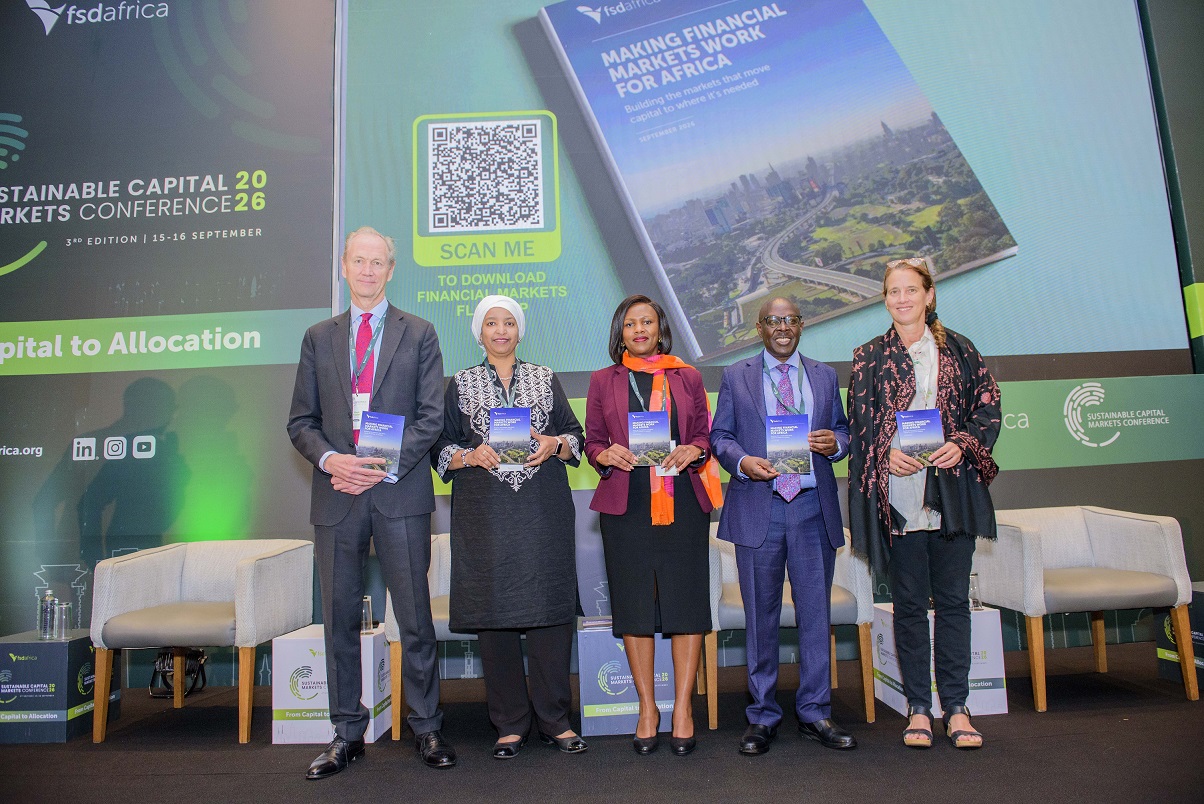
That question was central to the third Sustainable Capital Markets Conference in Nairobi and to a new FSD Africa report, Making Financial Markets Work for Africa. The report argues that the continent’s central constraint is financial architecture: the rules, institutions, products and risk-sharing mechanisms required to move savings into the real economy.
The headline figure is striking. Africa’s domestic financial pools exceed US$4 trillion. But it is also easy to misinterpret. This is not a single pot of pension money waiting to be allocated, nor is all of it suitable for long-term investment. Africa Finance Corporation’s 2025 breakdown included about US$2.5 trillion in commercial-bank assets, more than US$1.1 trillion in long-term institutional capital and over US$470 billion in external reserves. Its 2026 assessment again puts the total above US$4 trillion, including more than US$1 trillion in pension and life-insurance assets.
Commercial-bank assets are supported largely by deposits and cannot simply be locked into illiquid projects for decades. Central-bank reserves serve monetary and external-stability purposes. Pension funds and insurers have long-dated liabilities, but their investment choices are constrained by fiduciary duties, regulation, liquidity requirements and the availability of assets that meet their risk and return thresholds. The US$4 trillion figure therefore measures financial capacity, not immediately deployable cash.
The gap is in intermediation
The scale of Africa’s infrastructure requirement makes this distinction important. The African Union Commission and OECD estimate that annual infrastructure investment would need to rise from about US$83 billion to US$155 billion for the continent to close key gaps and potentially double GDP by 2040. Yet less than 3% of African institutional-investor assets are allocated to infrastructure, according to the same report.
Capital often remains concentrated in government securities, cash, property and listed shares because these assets are familiar, easier to value and usually treated more favourably under investment rules. Infrastructure and private-sector projects can involve construction risk, uncertain revenue, weak counterparties, political or regulatory changes, currency mismatches and long periods before repayment.
Smaller businesses face an additional problem. Their individual financing needs may be too small for institutional investors, while their financial records, credit ratings and governance systems may not satisfy investment mandates. Even commercially promising enterprises can therefore remain outside the investable universe.
The practical challenge is to convert scattered projects and loans into instruments that investors can assess, price and hold. The latest examples suggest that this requires more than exhorting pension funds to invest in development. It requires structures that change the risk presented to investors.
Rwanda combines local capital with risk sharing
Rwanda’s SME financing market illustrates the problem commonly described as the missing middle. Many companies are too large for microfinance and short-term working-capital products, but too small or insufficiently established for conventional private equity and development-finance transactions. Average bank-loan tenures of less than 24 months are poorly matched to investment in machinery, facilities and expansion.
The Rwanda SME Growth Fund reached its first close in April 2026 with a US$30 million commitment from the Rwanda Social Security Board, according to FSD Africa. The private-credit vehicle is denominated in local currency and designed as an evergreen fund rather than a vehicle with a fixed termination date. It is accompanied by a US$3 million technical-assistance facility and a risk-sharing mechanism intended to make smaller, rural, agricultural and women-led businesses more investable.
The design matters as much as the initial commitment. Technical assistance is intended to improve the quality of the investment pipeline, while risk sharing gives the fund manager more room to consider businesses that would otherwise fall outside its mandate. But the distinction between mobilisation and deployment must remain clear: the fund had reached first close, while confirmed data on individual investments was still expected later in 2026.
Securitisation can turn small loans into an investable asset
In East Africa, the obstacle is often transaction size. Agricultural and MSME lenders originate thousands of relatively small loans, but their balance sheets limit how much they can lend. Individual loan books can also be too small to justify the legal, rating and structuring costs of a standalone capital-markets transaction.
FSD Africa and financial-technology company Kaleidofin addressed that constraint through a reusable special-purpose vehicle in Mauritius. Structured as a protected-cell company, it allows different lenders to securitise loan portfolios while keeping each originator’s risks legally separated. The expensive documentation and operating infrastructure can be established once rather than recreated for every transaction. FSD Africa estimates that the variable cost of subsequent transactions could be roughly one-tenth of the cost of a first bespoke deal.
The first transaction closed in April 2026. Apollo Agriculture securitised KES276 million, approximately US$2.5 million, of agricultural loans. According to the FSD Africa report, the portfolio financed 23,839 smallholder farmers; 51% were women and 22% were borrowing for the first time. Investor protection included a junior tranche retained by Apollo and collateral worth 22.7% more than the notes sold. An independent rating funded by FSD Africa gave the transaction a BBB investment-grade rating.
A second cell was used for IDH FarmFit, and a similar transaction involving solar-irrigation company SunCulture closed in August 2026. A reported pipeline exceeding US$100 million suggests that the structure may be repeatable. It is nevertheless an early-stage model. Wider adoption will depend on local expertise, reliable loan-level data, consistent underwriting and investors learning to evaluate the underlying portfolios rather than relying mainly on the originator’s balance sheet.
Morocco shows the value of repeatable green bond frameworks
Morocco offers a different lesson: investors may be willing to provide long-term capital, but suitable instruments may be scarce. National railway operator ONCF requires an estimated MAD53 billion, approximately US$5.7 billion, to expand and electrify its network. Domestic pension funds, insurers and mutual funds have the capital, but the market has lacked a sufficient pipeline of long-dated, labelled securities.
Instead of preparing a completely new certification process for each issuance, ONCF, CDG Capital and FSD Africa developed a certified framework covering an MAD8 billion green-bond programme through 2030. The framework allows individual tranches to undergo a more limited issuance-specific review.
Demand for the March 2026 tranche provides evidence of investor appetite. ONCF sought MAD2 billion and received orders for MAD9.65 billion. The 30-year, fixed-rate bond was denominated in Moroccan dirham and bought entirely by domestic investors, including pension funds, mutual funds, insurers and the state deposit fund. Together with the February 2025 tranche, the programme had raised MAD4 billion, around US$430 million.
The model is not automatically transferable. ONCF is a large repeat issuer with domestic credibility, Morocco has an established capital market, and the regulator accepted recognised external certification. Those conditions reduced uncertainty. The broader lesson is that standardisation can lower repeated transaction costs and create a dependable pipeline of assets rather than a series of isolated deals.
Financial-market infrastructure is part of the investment case
Products alone cannot compensate for weak market institutions. Investors also need securities laws, regulators, exchanges, custodians, settlement systems, credit information and professionals capable of evaluating unfamiliar instruments. Ethiopia’s recent market-building effort demonstrates the scale of that institutional task.
The Ethiopian Securities Exchange opened in January 2025 after the creation of a regulatory framework, a capital-markets authority and new trading infrastructure. FSD Africa reports that the exchange raised US$26 million against an initial target of US$11 million and had six listed companies by August 2026. The numbers remain modest compared with mature exchanges, but the project shows that mobilising capital may first require building the market through which it can move.
What investors and policymakers should measure
The next test is not whether more funds, bonds and platforms can be announced. It is whether they produce sustained capital deployment on commercially credible terms. Useful measures include the amount actually disbursed, the proportion supplied by domestic private investors, the tenor and currency of finance, default and loss performance, transaction costs, refinancing activity and the amount of additional lending created.
For SME vehicles, reporting should show which companies received finance, where they operate, how much private capital followed and whether the businesses expanded employment or productive capacity. For infrastructure, reporting should distinguish capital committed from projects reaching financial close, construction and operation. Risk-sharing arrangements should also disclose who absorbs losses and under what conditions; otherwise, de-risking can conceal the transfer of excessive downside risk to public or development institutions.
Africa’s domestic capital is real, but the headline number should not become a slogan. Capital moves when financial products match investors’ liabilities, risks are visible and allocated credibly, transaction costs are proportionate and issuers can demonstrate dependable cash flows. The emerging models in Rwanda, East Africa and Morocco show how those conditions can be created. Their long-term significance will depend on whether they can progress from promising transactions to markets that function without permanent external support.
Sources
Read the full story from the original publication
