




Global Black Voices: News from around the World
- Chief Chuck Hoskin Jr. demands an honest, public reckoning with the Cherokee Nation’s role in the enslavement of Black people.
- Task force report documents that enslaved labor was pivotal to the Cherokee economy and infrastructure in the 19th century.
- New executive order requires Cherokee museums and historic sites to fully reflect the history and rights of the Cherokee Freedmen.
*In a powerful Black History Month message reported by Richard Prince’s Journal-isms, Cherokee Nation Principal Chief Chuck Hoskin Jr. has committed the tribe to an unflinching examination of its own history—including the Cherokees’ role in the enslavement of Black people and the long struggle of the Cherokee Freedmen.
Writing Monday for indianz.com – as highlighted in the Feb. 26, 2026, edition of Journal-isms—Chief Hoskin announced the findings of a landmark task force report. It issued a direct call for honesty and accountability.
“Each February, we pause to honor the achievements and contributions of Black Americans,” Hoskin wrote. “At the Cherokee Nation, Black History Month also calls us to examine our own history honestly and to commit ourselves to telling the full truth about who we are.”
A Reckoning with Hard Truths
The report, compiled by the Task Force to Examine the Impact of Enslavement on the Cherokee Nation’s 19th Century Economy and Infrastructure, presents what Hoskin describes as “clear and sobering historical facts.”
Among the findings highlighted by Journal-isms:
-
Prior to the Trail of Tears, approximately 6.74% of Cherokee households comprised an enslaver class, largely mixed-blood families with ties to white ancestors.
-
Prominent Cherokees were among them, including 11 of the 12 signers of the 1827 Cherokee Constitution.
-
By 1835, Cherokees owned nearly 1,600 enslaved people.
-
Enslaved labor was “pivotal” to the tribe’s economy, operating plantations, building roads and public buildings, and playing a central role in rebuilding the Cherokee Nation following the forced removal of 1838–1839.
“These are difficult truths,” Hoskin acknowledged. “But they are truths, nonetheless.”
The Long Struggle of the Cherokee Freedmen
Central to the chief’s message was a recognition of the Cherokee Freedmen—the descendants of formerly enslaved people held by Cherokee owners. The Treaty of 1866 guaranteed them citizenship rights “in perpetuity.” Yet for more than 150 years, those rights have been contested.
“Freedmen should not have needed to struggle for more than 150 years for their rights or be told to go beg for their rights at the ballot box,” Hoskin wrote.
The struggle has been deeply personal for descendants like Kenneth Cooper, a Boston journalist, and Sam Ford, a retired WJLA-TV reporter, both of whom have been active in fighting for the rights of Cherokee Freedmen descendants.
Museums, Monuments, and a New Mandate
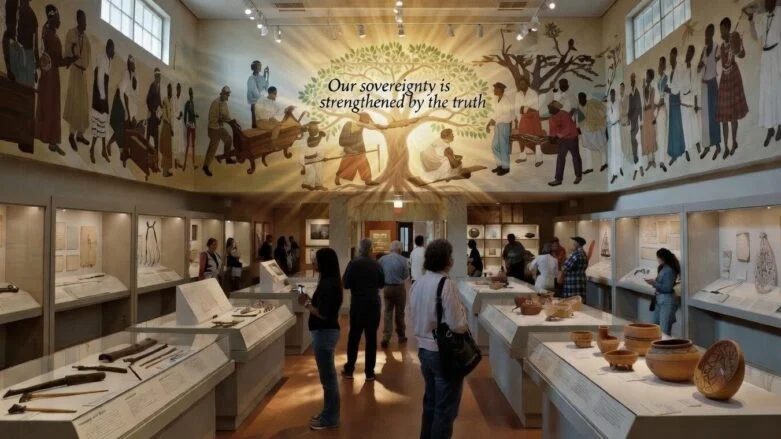
To ensure this history is no longer hidden, Chief Hoskin announced a new executive order requiring all Cherokee Nation museums and historic sites to “comprehensively reflect the history of Cherokee Freedmen.”
“We cannot celebrate Cherokee self-determination while ignoring its complexity,” Hoskin said. “We cannot champion justice today, without acknowledging where we fell short in the past. Our sovereignty is not diminished by the truth. It is strengthened by it.”
A Shared History, A Shared Future
Hoskin pointed to Black History Month events across the Cherokee Nation Reservation—which includes the historic Greenwood District in Tulsa, site of the 1921 Tulsa Race Massacre—as reminders that “our history is deeply intertwined with many communities.”
As Journal-isms regularly documents, issues of historical recognition and media representation are intertwined. The same Feb. 26 edition that reported on the Cherokee Nation also covered Jeffrey Epstein’s crimes in Africa and evolving Black media coverage of the State of the Union—all underscoring the importance of telling full, unvarnished stories.
For Freedmen descendants and their allies, the chief’s words signal a potential shift in how one of the largest Native American nations understands itself—and whom it includes in that understanding.
As Cooper and Ford have long argued, recognition is not charity. It is justice.
(If You Like/Appreciate This EURweb Story, Please SHARE it!)
Read the full story from the original publication
