




Black Arts & Culture Feature:
- Julie Mehretu created an 83-foot, 35-panel glass installation titled Uprising of the Sun for the Obama Presidential Center.
- The work marks a landmark public artwork by an African-born artist, permanently shaping visitors’ understanding of American history.
- Mehretu’s first major glass commission involved years of collaboration with fabricators and engineers, blending art and architecture.
Julie Mehretu’s “Uprising of the Sun”: Ethiopian-Born Artist Creates 83-Foot Masterpiece for Obama Presidential Center
The abstract painter from Addis Ababa delivers what may be the most significant public artwork by an African-born artist in American history.
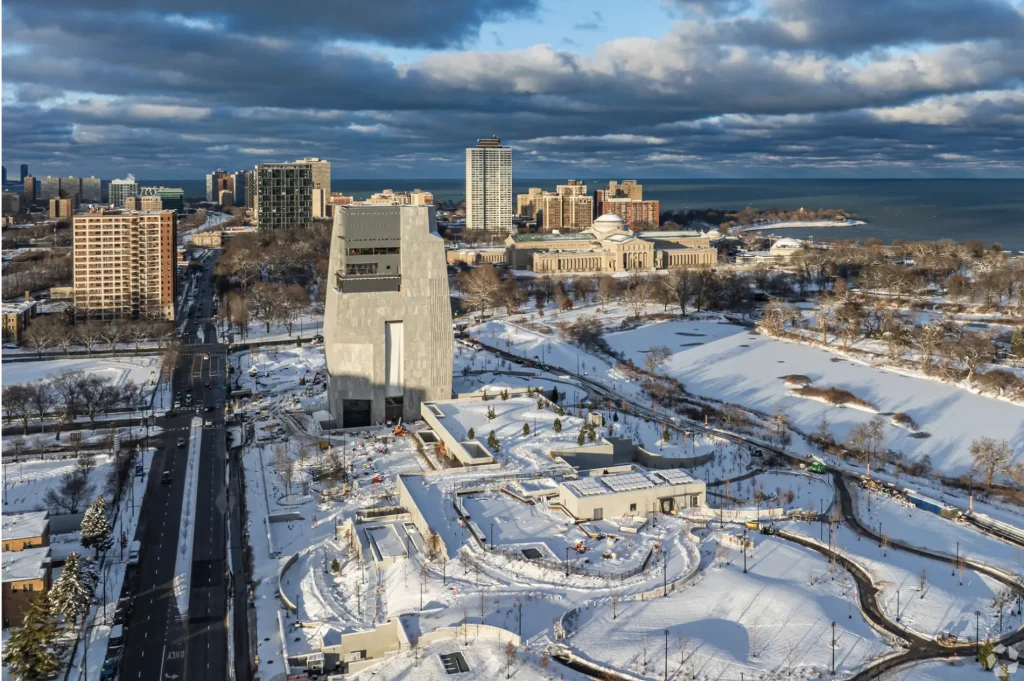
Julie Mehretu doesn’t do small. The Ethiopian-born, New York-based artist has spent three decades building a reputation for monumental abstractions that pulse with the chaos and beauty of urban life. But nothing in her celebrated career quite prepared the art world for this: an 83-foot glass installation rising from the north façade of the Obama Presidential Center in Chicago.
When the center opens to the public in June 2026, millions of visitors will encounter “Uprising of the Sun”—35 painted glass panels spanning 25 feet wide and nearly nine stories tall. It is, by any measure, a landmark moment: one of the most prominent public artworks ever created by an African-born artist, permanently installed at a site that will shape how future generations understand American history.
For Mehretu, the project represents both a creative leap and a homecoming of sorts. Born in Addis Ababa in 1970, she immigrated to the United States as a child when her father joined the faculty at Michigan State University. Chicago—just a few hours from her childhood home in East Lansing—was where her family went to experience culture, to see art, to feel the pulse of urban life that would later define her work.
Now, decades later, she’s leaving a permanent mark on that city’s skyline.
From Addis Ababa to the World Stage
Mehretu’s trajectory from Ethiopia to global art stardom is remarkable but not accidental. Her work has always grappled with the forces that shape cities and civilizations—migration, revolution, erasure, rebuilding. These aren’t abstract concepts for someone who left one continent for another at age seven.
After studying at Kalamazoo College in Michigan and the Rhode Island School of Design, Mehretu developed a signature style that layers architectural drawings, maps, and gestural marks into dense, explosive compositions. Her canvases feel like aerial views of cities mid-transformation—or mid-collapse. They vibrate with movement and history.
The art world took notice. Major museums acquired her work. Retrospectives followed at institutions including the Whitney Museum of American Art, the Los Angeles County Museum of Art, and the Walker Art Center. In 2023, her painting “Walkers With the Dawn and Morning” sold for $10.7 million at auction—accounting for nearly 60% of all auction sales by African-born artists that year.
MoMAA has previously recognized Mehretu among the Icons of African Art and as one of the 25 Most Influential Black Female Artists Shaping Contemporary Art. The Obama commission confirms what her admirers have long known: she operates at the highest tier of global contemporary art.
A Medium She’d Never Touched
Here’s what makes the Obama commission extraordinary: Mehretu had never worked with glass.
When Virginia Shore, the project’s curator, first approached her about creating a monumental window for the presidential center, Mehretu was intrigued but uncertain. Painting on canvas is one thing. Translating her layered, gestural approach to architectural glass—at a scale visible from blocks away—was something else entirely.
She asked Shore about alternatives. Were there other sites where she might propose something more familiar? Shore showed her options that aligned with her usual practice: large-scale paintings, perhaps. But the glass idea wouldn’t let go.
Mehretu took the leap. The result required years of collaboration with fabricators, engineers, and the Obama Foundation’s design team. Each of the 35 panels had to balance structural integrity with artistic vision. Unpainted sections allow glimpses of the Chicago skyline from inside the building—a deliberate choice that connects the artwork to its urban context.
The installation was completed in 2025. When it’s unveiled to the public this summer, it will function both as art and as architecture: a membrane between interior and exterior, between history and horizon.
What “Uprising of the Sun” Means
Mehretu chose her title carefully. She wanted something that would resonate beyond the immediate moment—something that could speak to future visitors navigating circumstances we can’t yet imagine.
The sun rises every day. That’s the simple fact at the title’s core. But within that daily certainty, Mehretu sees possibility: the uprising that can happen when light returns, when a new cycle begins, when yesterday’s darkness gives way to whatever comes next.
For a presidential center dedicated to a historic administration—one that carried its own freight of hope and complexity—the title feels apt. It doesn’t celebrate or critique. It observes a rhythm and suggests that within that rhythm, transformation remains possible.
Former President Barack Obama, in a video released by the Obama Foundation, called the design “on point” and predicted it would become “one of the most important aspects of this center” and “an iconic contribution to the South Side and the city of Chicago.”
Mehretu herself acknowledges the weight of the commission. The Obamas’ legacy, the site’s significance to Chicago’s South Side, the millions who will pass through—all of it embeds the artwork in contexts that extend far beyond the art world. She has described it as possibly the most important piece she’ll ever have the opportunity to make.
Read more from the original source
