




Global Black Voices: News from around the World
- Secured 130 of 169 votes at the 36th Meeting of States Parties, underscoring broad confidence and Ghana's diplomatic lobbying.
- Played a key role in Ghana's maritime boundary case against Côte d’Ivoire, protecting offshore petroleum interests and reinforcing maritime law.
- Brought firsthand ITLOS litigation experience, including participation in the ARA Libertad case against Argentina in 2012.
- Career spans treaty negotiations, arbitration, human rights reporting, climate law, and appearances before the International Court of Justice and Permanent Court of Arbitration.
- As Chief State Attorney she led the International Division, coordinated treaty obligations, and shaped Ghana's legal diplomacy and policy reforms.
Pioneering Legacy
Her election as the first African woman to the International Tribunal for the Law of the Sea is a landmark moment for her native Ghana and for the continent’s voice in global justice.
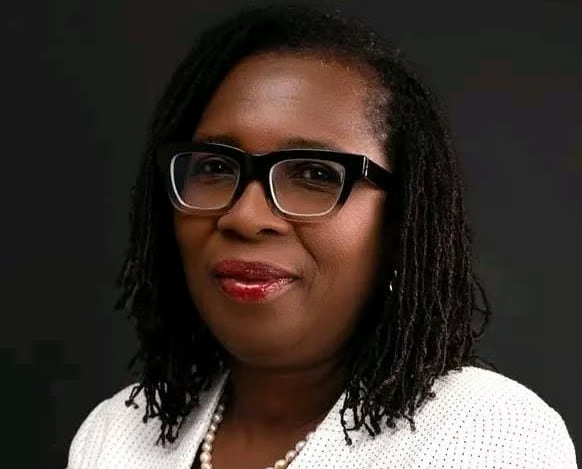
For decades, African countries have sought greater representation in the institutions that interpret international law. That changed with the election of Ghanaian lawyer Sylvia Ama Adusu as the first African woman to the International Tribunal for the Law of the Sea (ITLOS).
She will serve on the Hamburg-based tribunal from 2026 to 2035, marking a milestone for Ghana and for Africa’s role in international maritime justice.
Her election is a breakthrough that reflects both Ghana’s diplomatic success and Africa’s growing role in shaping the law governing the world’s oceans.
Here are 10 things to know about Adusu:
1. Breaking a 30-year continental barrier
Adusu is the first Ghanaian to serve on the International Tribunal for the Law of the Sea. Her election also makes her the first African woman on the 21-member court since it was established under the United Nations Convention on the Law of the Sea (UNCLOS) in 1996.
Her election ends a three-decade absence of African women on the tribunal and marks a significant step towards a more representative international judiciary.
2. Winning by a commanding margin
Adusu secured 130 of the 169 votes cast during the 36th Meeting of States Parties to UNCLOS at UN headquarters in New York.
She comfortably surpassed the two-thirds threshold of 113 votes, giving her one of the strongest mandates in the election. It also demonstrated broad international confidence in her expertise and underscored the effectiveness of Ghana’s diplomatic lobbying ahead of the vote.
3. Stepping into the shoes of an ITLOS pioneer
Ghana has played an outsized role in the tribunal’s history. Judge Thomas Aboagye Mensah was among the first 21 judges elected when ITLOS was established in 1996 and later became its inaugural president. Nearly three decades later, Adusu extends that legacy while opening an entirely new chapter as the first African woman to sit on the bench.
4. Crucial role in one of Africa’s maritime disputes
Among Adusu’s defining achievements was her role in Ghana’s successful maritime boundary delimitation case against Côte d’Ivoire before ITLOS.
The landmark judgment protected Ghana’s offshore petroleum interests while reinforcing international legal principles governing maritime boundaries. Her contribution earned her Ghana’s Companion of the Order of the Volta, one of the country’s highest national honours.
5. She knows ITLOS from both sides of the courtroom
Unlike many international judges, Adusu arrives with direct experience appearing before the very tribunal she now joins. She was part of Ghana’s legal team during the high-profile ARA Libertad case between Argentina and Ghana in 2012 and later participated in proceedings involving Ghana’s maritime boundary case. Few judges join ITLOS already familiar with its procedures from active litigation.
6. Career extends far beyond maritime law
Although internationally recognised for expertise in the law of the sea, her work spans treaty negotiations, international arbitration, litigation before foreign courts, human rights reporting, climate law and regional dispute settlement. She has represented Ghana before bodies including the International Court of Justice, the Permanent Court of Arbitration, the ECOWAS Court of Justice, and other international legal forums.
7. Shaping Ghana’s international legal diplomacy
As Chief State Attorney and head of the International Division at Ghana’s Attorney-General’s Department, Adusu became one of the government’s principal legal advisers on international affairs.
She coordinated treaty obligations, collaborated closely with the ministry of foreign affairs and led Ghana’s reporting to United Nations and African human rights bodies, placing her at the centre of the country’s legal diplomacy for decades.
8. Oceans should unite, not divide
Adusu has repeatedly described international law as a tool for peaceful cooperation rather than confrontation. In her official candidature statement, she said her experience before ITLOS strengthened her ambition to support “the peaceful settlement of disputes” while promoting sustainable use of marine resources, conservation of the marine environment and equitable access to ocean wealth under UNCLOS.
9. Policy influencer
Much of Adusu’s impact has come outside courtrooms. She has served on the Ghana Boundary Commission, co-chaired Ghana’s Steering Committee on Business and Human Rights, coordinated the country’s National Mechanism for Reporting and Follow-ups and contributed to national asset management reforms.
Her career reflects a rare combination of legal advocacy, institutional development and public policy.
10. Oceans are the new frontier
Adusu joins ITLOS at a time when disputes over offshore energy, maritime boundaries, deep-sea mining, climate change, fisheries and marine conservation are becoming increasingly complex. The tribunal’s growing caseload reflects the strategic importance of oceans to global security and economic development.
Read the full story from the original publication
