


Close Menu
Savannah HeraldSavannah Herald
    • Home
    • News
      • Local
      • State
      • National
      • World
      • HBCUs
    • Events
    • Directories
    • Weather
    • Traffic
    • Jobs
    • Sports
    • Politics
    • Lifestyle
      • Faith
      • Senior Living
      • Health
      • Travel
      • Beauty
      • Fashion
      • Food
      • Art & Literature
    • Business
      • Real Estate
      • Entertainment
      • Investing
      • Education
    • Guides
      • Back to School Savannah
      • Summer Camp Guide
      • Juneteenth Guide
      • Black History Savannah
      • MLK Guide Savannah
    We're Social
    • Twitter
    • Facebook
    • YouTube

    Subscribe to Updates

    Get the latest creative news from FooBar about art, design and business.

    Trending
    • HBCU News – DeSean Jackson’s Delaware State to play Michael Vick’s Norfolk State in Philly
    • Eden Fresh Market Fayetteville to Close by Labor Day Weekend
    • 4 Black Camping Groups Making It Easier To Find Community Outdoors
    • PM Browne orders C.O. Williams to fix defective roads
    • Researchers create early warning system to monitor housing evictions
    • Former Secret Service Agents: Trump’s Secret Plane Swap Unusual, Not Unprecedented
    • Luis Enrique tight-lipped on Bradley Barcola future amid Liverpool transfer interest
    • The AI Bubble Debate: Can Both Bulls and Bears Be Right?
    Facebook X (Twitter) Instagram YouTube
    Login
    Savannah HeraldSavannah Herald
    Savannah HeraldSavannah Herald
    Home » Everything You Should Know About Bloody Sunday
    Education

    Everything You Should Know About Bloody Sunday

    Savannah HeraldBy Savannah HeraldJuly 3, 202610 Mins Read
    Facebook Twitter Pinterest LinkedIn WhatsApp Reddit Tumblr Email
    Everything You Should Know About Bloody Sunday
    Share
    Facebook Twitter LinkedIn Pinterest Email

    From Campus to Classroom: Stories That Shape Education

    Key takeaways
    • Peaceful voting-rights marchers faced violent repression by Alabama state troopers at the Edmund Pettus Bridge.
    • The fatal shooting of Jimmie Lee Jackson intensified calls for the Selma to Montgomery march demanding voting rights.
    • Televised violence sparked national outrage and led President Lyndon B. Johnson to propose the Voting Rights Act.
    • Subsequent protected marches, including Turnaround Tuesday and the full Selma to Montgomery march, completed the 50-mile protest.
    • Bloody Sunday's legacy expanded Black voter registration and remains central to ongoing voting-rights struggles.

    African American Demonstrators outside White House, with signs “We demand the right to vote, everywhere” and Signs Protesting Police Brutality against Civil Rights Demonstrators in Selma, Alabama, Washington, D.C., USA, Warren K. Leffler, US News & World Report Magazine Collection, March 12, 1965. (Photo by: Universal History Archive/Universal Images Group via Getty Images)

    This weekend marks the 61st anniversary of the march on Selma, otherwise known as “Bloody Sunday.” One of the most violent marches of the Civil Rights Movement, the protest took place on March 7, 1965. It was sparked by the killing of farmer and civil rights protester Jimmie Lee Jackson. In remembrance of the brave protesters who fought for our civil rights, we are taking a look back at what Bloody Sunday was about.

    What The Selma Marches Fought For

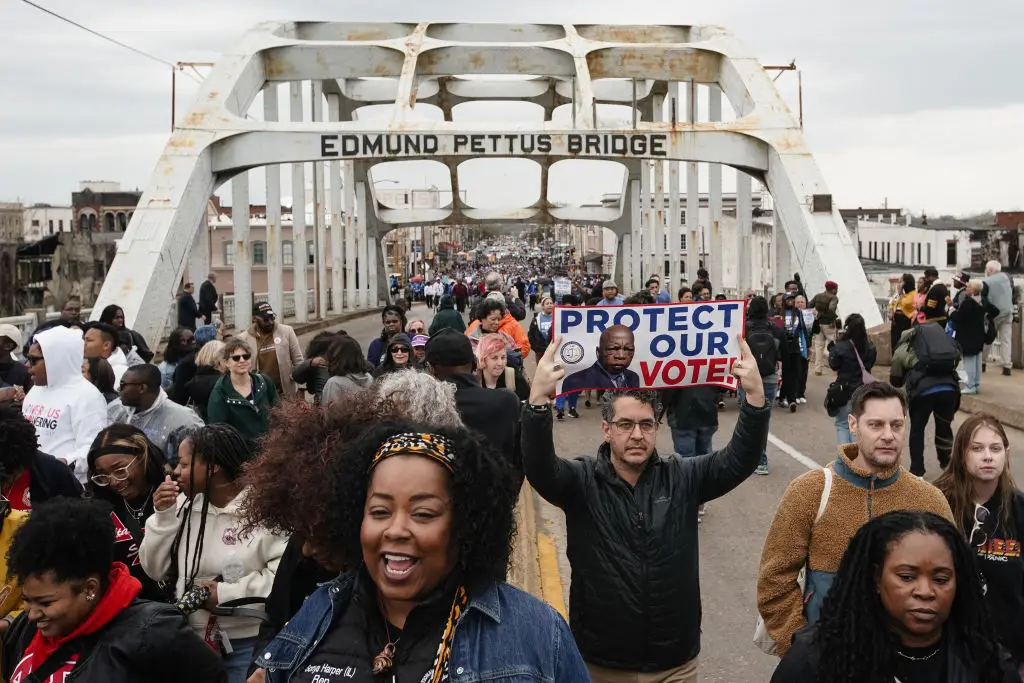
    People march across the Edmund Pettus Bridge during commemorations of the 60th anniversary of ‘Bloody Sunday’ on March 9, 2025 in Selma, Alabama. (Photo by Elijah Nouvelage / AFP) (Photo by ELIJAH NOUVELAGE/AFP via Getty Images)

    While Bloody Sunday is one of the most famous Selma marches in American history, there were peaceful protests before it, fighting for the same cause: voting rights. According to the research database EBSCO, local leaders organized the marches before receiving support from the Student Nonviolent Coordinating Committee (SNCC) and the Southern Christian Leadership Conference (SCLC). Protesters planned to walk from Selma, Alabama, to the state capital in Montgomery, calling for reform of the blocking of Black citizens’ rights to vote under Jim Crow laws.

    Met With Violence

    (Original Caption) March Halted. Selma, Ala.: Club-swinging Alabama state troopers move in on civil rights marchers to disperse them in Selma. The march, by demonstrators bound for Montgomery to “see the governor,” was broken up by state troopers and sherrif’s deputies.

    Following Martin Luther King Jr.’s philosophy of nonviolence, the protests were peaceful. However, they were often met with violence from Alabama state troopers, who would often arrest, beat, and even kill the protesters. One of these deaths sparked the march that would later become known as Bloody Sunday.

    Murder of Jimmie Lee Jackson

    SELMA, AL – MARCH 08: A marcher holds a poster of Jimmie Lee Jackson, a civil rights activist who was beaten and shot by Alabama State troopers in 1965, during the 50th anniversary commemoration of the Selma to Montgomery civil rights march on March 8, 2015 in Selma, Alabama. Tens of thousands of people gathered in Selma to commemorate the 50th anniversary of the famed civil rights march from Selma to Montgomery that resulted in a violent confrontation with Selma police and State Troopers on the Edmund Pettus Bridge on March 7, 1965. (Photo by Justin Sullivan/Getty Images)

    As we previously told you, the killing of 26-year-old farmer and logger Jimmie Lee Jackson sparked the protests on March 7, 1965. While taking part in a demonstration on the evening of Feb. 18, 1965, Jackson was shot in the stomach by trooper James Bonard Fowler as he attempted to protect his mother from being beaten by another trooper. Even though he was taken to the hospital that same night, he died eight days later, per The Root.

    Jimmie Lee Jackson’s Death Sparks A Call To Action

    Civil rights protesters, demonstrating against voter registration laws in the state of Alabama, at the conclusion of the third leg of their march from Selma to Montgomery, Alabama, 26th March 1965. (Photo by Archive Photos/Hulton Archive/Getty Images)

    After Jackson’s death, protesters felt even more emboldened to fight for the voting rights of Black Americans and to call for justice for Jackson. According to the Zinn Education Project, on March 7, 1965, 600 protesters began the journey from Selma to Montgomery, Alabama, led by SCLC leader Hosea Williams and SNCC leader John Lewis, but they only made it to the Edmund Pettus Bridge before they were met by a wall of state troopers.

    Protest Becomes Violent

    SELMA, ALABAMA — 7 March, 1965: Scene Bloody Sunday” march, during which civil rights demonstrators attempting to begin a 50 mile march to Montgomery, Alabama, to protest race discrimination in voter registration, were beaten and attacked by law enforcement after crossing the Edmund Pettus Bridge.

    As they faced Alabama state troopers, protesters were severely beaten. Troopers sprayed tear gas on the marchers, according to the National Archives. Over 50 people were injured and treated at the hospital, including Activist Amelia Boynton Robinson and SNCC leader John lewis who suffered a fractured skull, according to the National Archives.

    According to NBC News, Lewis said he doesn’t remember how he made it back to safety that night. “I was hit in the head by a state trooper with a nightstick. I lost consciousness. 50 years later, I don’t recall how I made it back across that bridge to the little church that we had left from. Apparently, a group literally carried me back to the church,” he stated.

    Bloody Sunday Almost Didn’t Happen

    Civil Rights Ldr. Rev. Martin Luther King Jr. speaking into mike after being released fr. prison for leading boycott. (Photo by Donald Uhrbrock/Getty Images)

    While the horrifying events that took place March 7, 1965, are now seen as a catalyst for Black Americans gaining voting rights, the march almost did not occur as planned. Martin Luther King Jr., who was in Atlanta at the time, called for the protest to be rescheduled for Monday, March 8, to ensure he could attend. However, to avoid discouraging protesters, King allowed the march to proceed as scheduled.

    The Aftermath

    Demonstrators, many with signs, protest outside the White House, Washington DC, March 12, 1965. The signs reference voting rights and ongoing police brutality against Civil Rights activists in Selma, Alabama. (Photo by Warren K Leffler/PhotoQuest/Getty Images)

    The violence shown to protesters on Bloody Sunday was witnessed across the country as the event was televised, causing national outrage, according to Stanford University. That same night, Martin Luther King Jr. sent telegrams and made public statements asking religious leaders across the country to join a peaceful protest he was planning for March 9 in response to the events of March 7, per Stanford University.

    Turnaround Tuesday and More Protests

    Civil rights marchers arrive at the Alabama State Capitol in Montgomery, Alabama after a 50 mile march from Selma to protest race discrimination in voter registration, 23rd March 1965.

    On Tuesday, March 9, 1965, Martin Luther King Jr. led close to 2,000 people on another peaceful demonstration across the Edmund Pettus Bridge, according to the National Archives. However, rather than being met by immediate violence, King led the protesters back to Selma after leading a prayer at the end of the bridge.

    They held another demonstration on later that month on March 21, where they did the full journey from Selma to Alabama. That time, the crowd of thousands was protected by Alabama National Guardsmen and the Federal Bureau of Investigation. At night, they camped in the yards of those who supported the cause and were joined by celebrities such as actor Harry Belafonte and actress Lena Horne, according to Stanford University.

    Sit In at The White House

    Civil Rights Demonstrators Maintain All-Night Vigil at White House, Washington DC, USA, March 18, 1965. (Photo by: Universal History Archive/Universal Images Group via Getty Images)

    After Turnaround Tuesday, President Lyndon B. Johnson promised to draft federal legislation to protect voting rights, according to the White House. During this same time, more civil rights demonstrators were organizing sit-ins at the White House to draw attention to what was happening in Alabama.

    We Shall Overcome

    Lyndon B. Johnson at Press Conference

    On March 15, Johnson gave his famous “We Shall Overcome” speech calling for voting rights, according to the White House.

    “It is the effort of American Negroes to secure for themselves the full blessings of American life. Their cause must be our cause too. Because it is not just Negroes, but really it is all of us, who must overcome the crippling legacy of bigotry and injustice. And we shall overcome,” he stated.

    Finally, March 17, the Voting Rights Act was presented to Congress, but it would be many months before it was signed, according to the National Archives.

    Signing of The Voting Rights Act

    President Lyndon Johnson hands one of the pens used in the signing of the Voting Rights Bill August 6th to the Rev. Martin Luther King at the Capital. The Chief Executive signed the bill 104 years to the day after President Abraham Lincoln travelled to the Capitol to sign a bill freeing Negro slaves who were used to aid the Southern rebellion. In the center are: Representative Claude Pepper (with glasses, D-Fla.) and Rev. Ralph David Abernathy, Dr. King’s chief aide.

    That summer, Aug. 6, Martin Luther King Jr., Rosa Parks and other civil rights activists were witnesses as President Johnson signed the Voting Rights Act in the Senate Chamber, according to the United States Senate. Johnson was quoted as saying the act was “a triumph for freedom as huge as any victory won on any battlefield,” per the U.S. Senate.

    Details of the Act

    A young Civil Rights activist holds a flag (‘One Man, One Vote’) on the steps of the Dexter Avenue Baptist Church on the day before the Selma to Montogmery March arrived at the Alabama State Capitol (one block away), Montgomery, Alabama, March 24, 1965. The church basement had served as the headquarters for Martin Luther King Jr during the Montgomery Bus Boycott (1955 – 1956); King had been Pastor of the church between 1954 to 1960. The photographer’s son, Kip Shaw, is sitting in the foreground. (Photo by Charles Shaw/Getty Images)

    The Voting Rights Act outlawed discriminatory practices such as literacy tests and refusing to register voters on account of their race. This had a massive impact on the number of Black voters in the United States; by the end of that same year, close to 250,000 new Black voters were registered, per the National Archives.

    Bloody Sunday Legacy

    SELMA, ALABAMA – MARCH 09: U.S. House Minority Leader Hakeem Jeffries (D-NY), Rep. Maxine Waters (D-CA), Rev. Al Sharpton, Rep. Jonathan Jackson (D-IL) walk across Edmund Pettus Bridge as they commemorate the 60th anniversary of “Bloody Sunday” on March 09, 2025 in Selma, Alabama. Community members and Democratic Congressional leadership mark the day on March 7, 1965 when a group of about 525 mostly African-American demonstrators gathered at Brown Chapel A.M.E. Church and attempted to march to Montgomery to demand the right to vote. The group was met by state troopers and were brutally beaten when they refused to turn back leaving at least 17 hospitalized and 40 others who received treatment for injuries and the effects of tear gas. The annual event which has been dubbed “The Annual Pilgrimage to Selma,” is held the second weekend of every March, consisting of a festival of music, art and historical remembrance leading up to the “March to Restore Voting Rights” across the Edmund Pettus Bridge. (Photo by Michael M. Santiago/Getty Images)

    Thanks to those who fought, Black voters now have a say in what happens in America and are one of the strongest groups of voters in the U.S. According to a 2024 report by The Guardian, Black voters have the highest turnout compared to other racial groups despite challenges they face when it comes to voting, such as strict voter ID regulations and harsh sentences for errors in voter registration.

    So, the next time you head to the ballot, do not forget the long, violent fight it took to make your vote possible.

    Straight From The Root

    Sign up for our free daily newsletter.

    Read the full article on the original site


    Related Posts

    • Morehouse Rallies To Stun Benedict in SIAC Baseball Tournament
    • Wigs 101: Everything You Need to Know
    • Hazard Mitigation Plan Update Community Meeting
    • 10 Executive Branding Strategies | Obsidi®
    • Rawlston Williams to Debut The Caribbean Cookbook
    • United state Home panel passes GOP strategy that reduces Medicaid by $625B, includes job need
    • City Leaders Host Savannah Night Out
    • Vintage Photos of Camping 100 Years Ago
    Academic Achievement Black Colleges Black Educators Black Excellence in Education College Readiness Education Equity Education Headlines Education in the South Education Policy Georgia Education Georgia Public Schools Georgia School News HBCU Education HBCU graduates HBCU News Higher Education News Historically Black Colleges K-12 Education News Local School News Student Success Stories
    Share. Facebook Twitter Pinterest LinkedIn WhatsApp Reddit Tumblr Email
    Savannah Herald
    • Website

    Related Posts

    Education August 11, 2026

    HBCU News – DeSean Jackson’s Delaware State to play Michael Vick’s Norfolk State in Philly

    Weather August 11, 2026

    Coldest Augusts in Georgia since 1895

    Education August 10, 2026

    The Complete HBCU Dorm Room Essentials List for 2026

    Education August 10, 2026

    HBCU News – Three North Carolina HBCUs are currently ranked among the top 10 public universities

    Education August 9, 2026

    Chris Paul HBCU Classic Heads to Washington, D.C. in Dec.

    Education August 8, 2026

    Trump Administration Moves to Deregulate Head Start, Opening Door for Sweeping Change

    Comments are closed.

    Don't Miss
    Entertainment September 3, 2025By Savannah Herald02 Mins Read

    Norah O’Donnell’s new book, “We the Women,” uncovers history’s hidden female revolutionaries

    September 3, 2025

    From Hollywood to Home: Black Voices in Entertainment By Analisa Novak Analisa Novak “CBS Mornings”…

    Christian Walker’s New Single? We “Must Be Dreamin’!”, News In Progress

    May 23, 2026

    19 Points NOT to Offer a Black Picnic

    August 28, 2025

    Chrisean Rock Signs With XRumble Fighting Championships

    January 13, 2026

    Residence hearing inquiries moneying for Homeland Safety and security

    May 14, 2026
    Archives
    • August 2026
    • July 2026
    • June 2026
    • May 2026
    • April 2026
    • March 2026
    • February 2026
    • January 2026
    • December 2025
    • November 2025
    • October 2025
    • September 2025
    • August 2025
    • July 2025
    • June 2025
    • May 2025
    • April 2025
    • March 2025
    • February 2025
    Categories
    • Art & Literature
    • Beauty
    • Black History
    • Business
    • Climate
    • Culture
    • Education
    • Employment
    • Entertainment
    • Faith
    • Fashion
    • Food
    • Gaming
    • Georgia Politics
    • HBCUs
    • Health
    • Health Inspections
    • Investing
    • Lifestyle
    • Local
    • Lowcountry News
    • National
    • National Opinion
    • News
    • Politics
    • Real Estate
    • Senior Living
    • Sports
    • State
    • Tech
    • Traffic
    • Transportation
    • Travel
    • Weather
    • World
    Savannah Herald Newsletter

    Subscribe to Updates

    A round up interesting pic’s, post and articles in the C-Port and around the world.

    About Us
    About Us

    The Savannah Herald is your trusted source for the pulse of Coastal Georgia and the Low County of South Carolina. We're committed to delivering timely news that resonates with the African American community.

    From local politics to business developments, we're here to keep you informed and engaged. Our mission is to amplify the voices and stories that matter, shining a light on our collective experiences and achievements.
    We cover:
    🏛️ Politics
    💼 Business
    🎭 Entertainment
    🏀 Sports
    🩺 Health
    💻 Technology
    Savannah Herald: Savannah's Black Voice 💪🏾

    Our Picks

    JEANNIE MAI SAYS DAUGHTER MONACO ‘CRACKED ME OPEN’ AS SHE GETS REAL ABOUT MOTHERHOOD

    April 10, 2026

    Mega I.P.O. Frenzy Could Be a Harbinger of a Stock Bubble

    June 13, 2026

    Protest Art in Times of Global Turmoil: Collecting Works That Matter – MoMAA

    July 4, 2026

    Miami Outfit Recap 🌴☀️🌊 | The Sweetest Thing

    August 28, 2025

    Contemporary Home in the Heart of Brookhaven

    November 25, 2025
    Categories
    • Art & Literature
    • Beauty
    • Black History
    • Business
    • Climate
    • Culture
    • Education
    • Employment
    • Entertainment
    • Faith
    • Fashion
    • Food
    • Gaming
    • Georgia Politics
    • HBCUs
    • Health
    • Health Inspections
    • Investing
    • Lifestyle
    • Local
    • Lowcountry News
    • National
    • National Opinion
    • News
    • Politics
    • Real Estate
    • Senior Living
    • Sports
    • State
    • Tech
    • Traffic
    • Transportation
    • Travel
    • Weather
    • World
    Copyright © 2002-2026 Savannahherald.com All Rights Reserved. A Veteran-Owned Business

    Type above and press Enter to search. Press Esc to cancel.

    Manage Consent
    To provide the best experiences, we use technologies like cookies to store and/or access device information. Consenting to these technologies will allow us to process data such as browsing behavior or unique IDs on this site. Not consenting or withdrawing consent, may adversely affect certain features and functions.
    Functional Always active
    The technical storage or access is strictly necessary for the legitimate purpose of enabling the use of a specific service explicitly requested by the subscriber or user, or for the sole purpose of carrying out the transmission of a communication over an electronic communications network.
    Preferences
    The technical storage or access is necessary for the legitimate purpose of storing preferences that are not requested by the subscriber or user.
    Statistics
    The technical storage or access that is used exclusively for statistical purposes. The technical storage or access that is used exclusively for anonymous statistical purposes. Without a subpoena, voluntary compliance on the part of your Internet Service Provider, or additional records from a third party, information stored or retrieved for this purpose alone cannot usually be used to identify you.
    Marketing
    The technical storage or access is required to create user profiles to send advertising, or to track the user on a website or across several websites for similar marketing purposes.
    • Manage options
    • Manage services
    • Manage {vendor_count} vendors
    • Read more about these purposes
    View preferences
    • {title}
    • {title}
    • {title}
    Ad Blocker Enabled!
    Ad Blocker Enabled!
    Our website is made possible by displaying online advertisements to our visitors. Please support us by disabling your Ad Blocker.

    Sign In or Register

    Welcome Back!

    Login below or Register Now.

    Lost password?

    Register Now!

    Already registered? Login.

    A password will be e-mailed to you.