




Faith & Reflection: Voices from the Black Church and Beyond
- James Talarico blends progressive theology and populist economics, gaining national media attention and rapid fundraising as 2026 Democratic Senate nominee in Texas.
- The Texas Senate race is framed as a proxy war between the Christian Left and the Christian Right over religion's role in public life.
- Christian Left roots trace to the social gospel and it champions social safety nets, LGBTQ rights, and systemic critiques of wealth and racism.
- Mainline Protestant influence and white Christian liberal numbers are declining, weakening the Christian Left's electoral base despite sustained activist infrastructure.
- Activists prioritize faithful moral witness and coalition building over attendance counts, invoking figures like Dietrich Bonhoeffer as inspiration.
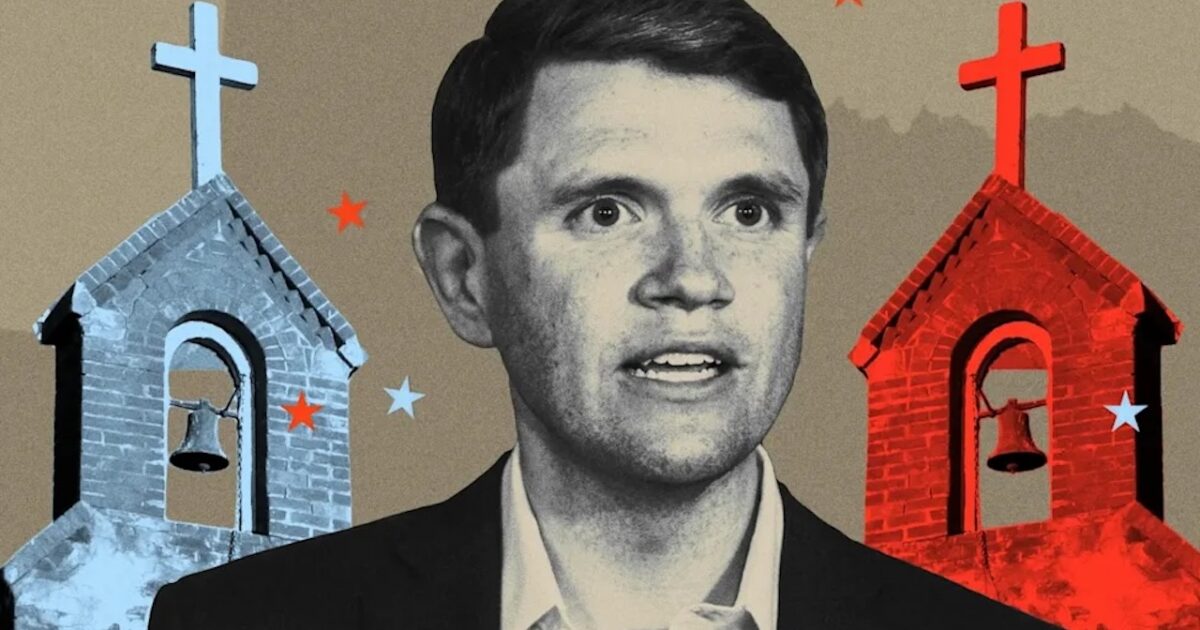
(Image source: Yahoo News)
Nothing exemplifies America’s penchant for the extravagant better than the state of Texas. With 10-gallon cowboy hats, oversized pick-up trucks, and massive high-school football stadiums, the state’s “bigger is better” mindset only serves to complement Texans’ sizable religiosity.
Texas, usually associated with the “Bible belt”—a group of states where Christianity (usually evangelical) plays a visible part in public life, is currently the hotbed for policies that blur the line between church and state. The GOP-controlled Texas legislature voted last May to require the Ten Commandments to be displayed in every public-school classroom. More recently, Texas public schools have included Bible passages within their required curricula.
And within this Lone Star State religious milieu comes a rising star in the Democratic Party, James Talarico.
Born to a single-mother and grandson of a Baptist minister, Talarico was raised in a Presbyterian church. A progressive congregation, his pastor was one of the first in his denomination to officiate at same-sex weddings. After college, Talarico pursued a Master of Divinity degree at Austin Theological Seminary and considered becoming a minister.
But now, Talarico is the 2026 Democratic nominee for Texas’s U.S. Senate seat.
Talarico’s clean-cut contour, carefully parted hairline, and somewhat boyish face feel reminiscent of the 1950s Leave-It-To-Beaver era. He’s 37-years old—young for a politician. He’s white. And he’s a religious Christian.
Talarico’s campaign is a unique blend of spiritual overtures with dichotomous economic analyses, arguing that, “A handful of billionaires have redesigned our politics for their own profit—‘us’ versus ‘them.’” At other times, Talarico’s stump speeches sound almost pastoral with his admonition at rallies that this election season, “Isn’t just a political battle, but a spiritual one.” One moment Talarico stresses the Golden Rule’s “Do unto others” or “Love thy neighbor” while calmly blaming America’s political and cultural woes on “the billionaires.” If one combines the sentimental, Mainline Protestant niceties of Mr. Rogers—who himself was a Presbyterian minister—with the populist oratory of Bernie Sanders, we get pretty close to encapsulating James Talarico’s campaign.
Talarico’s religious-coded messaging is having its moment in mainstream media—with appearances on Joe Rogan and Ezra Klein’s podcasts, leaning on his theologically liberal faith to discuss his senatorial campaign. His interview with late-night talk show host Stephen Colbert has drawn noteworthy interest, with over 7 million views on YouTube; he raised over $2 million for his campaign within 24 hours after its release.
“I think he has generated so much excitement within Presbyterian ranks, and especially with the national staff—everyone’s talking about him,“ said Jimmie Hawkins, Director of the Presbyterian Church (USA) Office of Public Witness, the denomination’s advocacy arm. “One of his primary contributions is that he is enabling others running for political office to talk about their faith openly in a way that does not turn people off.”
For many, Talarico’s appeal is his ability to weave a religious justification for his proposed policies, albeit from the progressive side. He offers an alternative for those who want to push back against the powerful and well-funded Christian Right, thereby showing Americans what’s possible today for the Christian Left.
***
The Christian Left is a nebulous, sometimes hard-to-pin, coalition of religiously motivated actors. It typically contains individuals who support such political positions as expansion of the social-safety net, supporting pro-choice policies, opposing the death penalty, lowering the military budget, and supporting LGBTQ rights.
The origins of today’s Christian Left can be traced back to the late-19th and early 20th centuries with the rise of the “social gospel,” a movement of liberal Protestant clergy who were responding to the negative effects of the Gilded Age and post-industrialization—poverty, poor working conditions, and child labor. Around the same time, their conservative counterparts, responding in part to liberal clergy’s acceptance of evolution—as well as to their novel interpretations and questions surrounding traditional doctrines like the Virgin Birth and the Trinity—formed coalitions to protect the “fundamentals” of the Christian faith. Thus, the fundamentalists—and their evangelical descendants—were born.
Of course, the Christian Left is not only made up of Mainline Protestants—some evangelicals tried to steer the movement toward addressing pressing social issues while also embracing evangelicalism. “Progressive evangelicalism,” however, never became a dominant force within American evangelicalism itself. When the movement was relatively split between Republicans and Democrats, in 1977, Jimmy Carter won around 51% of the white evangelical vote. By 2024, Donald Trump won them by 81%. Now, the term “evangelical” carries more connotations with conservative political positions rather than orthodox theological convictions.
Nevertheless, there are remaining progressive evangelicals who adamantly oppose the MAGA wing of the Republican Party and won’t give up the term easily.
“I won’t let them have the word ‘evangelical’—I wouldn’t give it over to them,” said Jim Wallis, founder of Sojourners and director of Georgetown University’s Center for Faith and Justice. For Wallis, the issue with American evangelicalism is an issue of race and not theology.
“I don’t have a problem with evangelical theology if it leads to following Jesus, which is what it’s supposed to lead to—but the current white evangelical culture [in America] is not known for following Jesus.”
In some ways, this year’s election season in Texas can be seen as a proxy war between the Christian Left and Christian Right. Talarico’s rival, the scandal-ridden Texas Attorney General, Ken Paxton, criticized Talarico as a “vegan who thinks God is nonbinary” after denouncing Talarico as “a threat to our way of life and values.” Paxton is reported to be a regular attendee of Prestonwood Baptist Church—a megachurch affiliated with the conservative Southern Baptist Convention (SBC) and whose pastor, Jack Graham, served as SBC’s president twice and has close ties himself to President Trump as one of his spiritual leaders.
The high-stakes Senate race in Texas highlights Talarico’s profile as someone who isn’t merely taking on Trump or the GOP, but another version of American Christianity that, up to now, has had a topsy-turvy trajectory in American civic life.
The Christian Left and Politicians’ Electability
The Christian Left, generally, has had a complicated relationship with progressive politics and the Democratic Party. From the formation of its counterpart, the Christian Right, in the early 1980s through the late 2010s, many faith leaders and activists associated with the Christian Left hesitated to speak out politically due to concerns about eroding the separation of church and state.
“When I first started doing this work in 2005, one of the biggest impediments was that religious leaders were taught not to step up to the podium at a press conference, quote scripture, and say why, as a Jew, Muslim, or Christian, they supported certain policies,” said Jen Butler, former faith outreach director for the Kamala Harris/Tim Waltz 2024 Presidential Campaign, and founder of Faith in Democracy. “And then I think over the years, a bunch of folks were realizing that we’ve lost the values debate by opting out and not weighing in with a specific faith-based argument; we’ve completely ceded the ground to the Christian Right.”
As clergy and faith-based activists avoided articulating religion in their policy preferences, policymakers on the left also refrained from centering religion. Following John Kerry’s loss to George W. Bush in the 2004 presidential election year, Democrats looked at Kerry’s inability to talk about faith during his presidential campaign, leading Democrats thereafter to work on closing “the God gap.” During this era, one Democratic politician who was noted for wearing religion on his sleeve was Barack Obama.
During his famous 2004 DNC keynote convention speech as then-senatorial candidate, refuting the ideological stereotypes associated with both parties, Obama said, “We worship an awesome God in the Blue States.”
Obama, of course, was not the first Democratic politician to speak candidly about faith and politics. There is a long history of Black clergy in progressive politics, such as Adam Clayton Powell Jr., Jesse Jackson, and, in recent times, Raphael Warnock.
“I don’t think Talarico’s race obscures the role of Black clergy running for office. But I do think it highlights an implicit bias—the assumption that Black candidates and Black elected officials are only, or primarily, speaking to Black voters,” said Jeanné Lewis, CEO of Faith in Public Life, a faith-based advocacy organization based in Washington, D.C.
“I do think there’s something about his base—beyond race, though including race—that isn’t used to being engaged explicitly around faith, and that is compelling.”
Talarico’s rise in Democratic politics follows a trajectory of other more recent Democratic politicians leaning into faith—like Pete Buttigieg and Raphael Warnock—yet it offers something unique for a progressive politician.
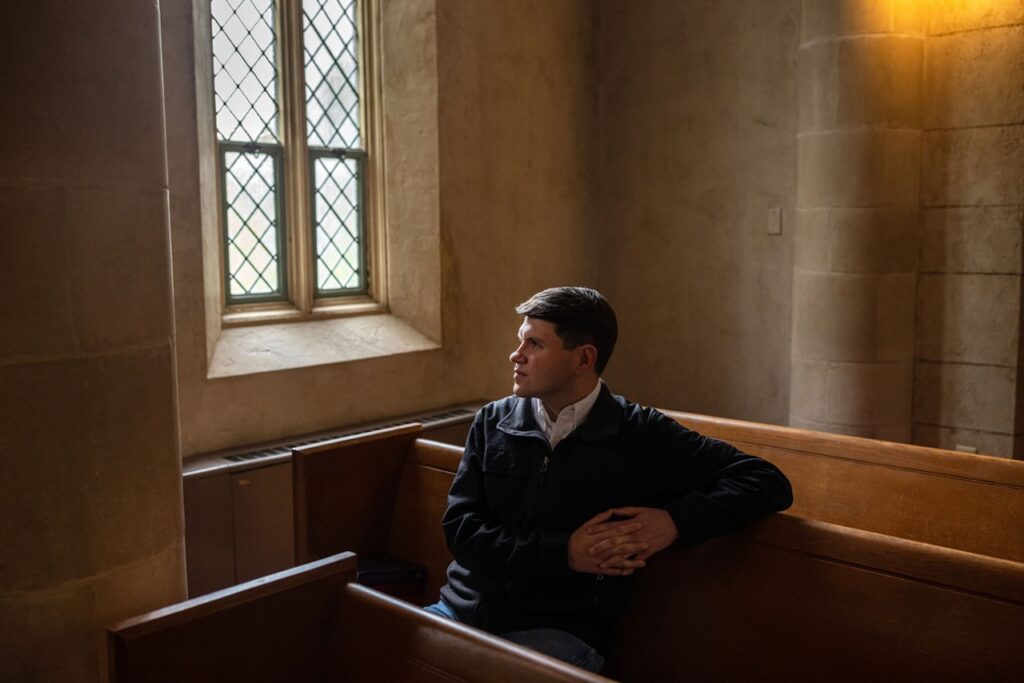
(Image source: Tamir Kalifa/Politico)
“Talarico is someone who is not just pulling from a toolbox of one or two Scripture verses, and then he goes right to talk about politics,” said Michael Wear, former faith outreach director for President Obama’s 2012 campaign, and founding CEO of the Center for Christianity and Public Life in Washington, D.C., describing Talarico’s faith-inflected conversations on both Joe Rogan and Ezra Klein’s podcasts.
“That you’d have a Democrat, or frankly, any politician, willing to talk about and [be] able to talk about theology and their own faith in the world from more than one angle and more than just a couple of talking points—he’s someone who will engage in significant back and forth, and that’s super interesting and unusual.”
***
In a political party whose largest religious demographic is people with no religious affiliation, Democratic politicians have been embracing the language of faith. Pennsylvania’s Democratic governor, Josh Shapiro, carries a strong Jewish thread within his new memoir, and Kentucky’s Governor Andy Bashar’s new book makes his Christian faith explicit within the title Go And Do Likewise—a reference to a quote attributed to Jesus in the Gospels.
“I think that there’s a kind of Jesus-envy among secular liberals and progressives who themselves hunger for a language of moral critique, but who don’t actually themselves believe in what Talarico believes in,” said Doug Rossinow, professor of history at Metro State University in St. Paul, Minnesota, and a scholar of the religious left. “[Progressives] have a longing for some kind of language of moral leadership because there’s such a deficit in the country.”
Rossinow says that in places across the globe where people have fought against authoritarian governments, churches were typically one of the three key pillars—including labor unions and student activists—that made up crucial resistance movements, from Poland under Soviet-Union Communism to Chile under the right-wing Augusto Pinochet.
“[Of] the three major components that you tend to see in civil society in movements against authoritarianism—and probably in the United States—the churches are the most robust.”
The robust and vocal nature of the Christian Left was reflected at the very beginning of President Trump’s second term. The Bishop of Washington, D.C. in the Episcopal Church, Mariann Edgar Budde, received international attention for her plea to Trump to “have mercy” on undocumented immigrants and LGBTQ communities during her sermon at the inaugural prayer service. Her denomination, along with Talarico’s Presbyterian Church and other Mainline Protestant denominations, liberal Catholics, and what’s left of progressive evangelicalism, have become vocal opponents to the Trump administration’s policies.
“I’d describe the second Trump era as a kind of scorched-earth policy toward anything progressive—almost shock and awe,” said Robert Wuthnow, professor of sociology emeritus at Princeton University and author of the recently released book, The Religious Left: What It Does and How It Can Do Better. Wuthnow writes that the strength of the Christian Left is found in its coalition-building with faith groups and secular partners. As the Trump Administration has specifically targeted such advocacy groups, it has only made their work more difficult.
“The religious left is obviously on the defensive. But in an odd way, when everything is happening against progressive policies, that encourages progressive groups to dig in and express their voice more strongly.”
But the moral language, Christian aesthetics, and institutional support that the Christian Left provides to progressive politics are also hindered by the fact that their influence on American life is waning, with no signs of reversal. The share of Mainline Protestants in America today makes roughly 11% of the population—a far cry from its heyday at around 30% in the 1970s. And the share of political liberals who identify as Christian has declined to 37% compared to 62% in 2007. For white Catholics, 36% of them are registered Democrats today, compared to when John F. Kennedy, a Catholic, won 82% of them in 1960.
“The white Christian left is rapidly declining, and not likely to be a thing as every year passes,” said Ryan Burge, professor of practice at the John C. Danforth Center at Washington University in St. Louis, and author of The Vanishing Church: How the Hollowing Out of Moderate Congregations is Hurting Democracy, Faith, and Us. Somewhat contrary to Rossinow and Wuthnow’s analyses, Burge sees the Christian Left as a movement in rapid freefall and falling relevance.
“If you’re a Democrat and you think you’re going to ride into an election on the back of white [progressive] Christians, that’s not a winning strategy,” Burge said.
According to Burge, the vast difference between the Christian Left and Right reflects current polarization within America.
The upcoming election season in Texas is a microcosm of that polarization and of two competing versions of American Christianity. While the Christian Left believes faith plays a role in addressing societal ills, the Christian Right wants to save individual souls. The Christian Left wants to dismantle racism and sexism, eradicate poverty, fix climate change, and foster LGBTQ inclusion in their churches and society; the Christian Right wants to maintain strict gender roles, remove LGBTQ materials from public schools and replace them with the Bible or conservative Christian books, and keep the federal government out of regulating industries like oil and gas. It’s a battle that will define not only American Christianity, but potentially America itself.
The Bonhoffer Dilemma
Although church attendance is dwindling in many mainline Protestant communities, the Christian Left is more focused on growing an activist movement than on getting people in pews.
“I think there are certainly denominations that have been losing members in churches, and there’s less religious attendance and structures as denominations have downsized and churches have closed, but we should never confuse attendance for faith-based or spiritually-grounded activism—those are all very different things,” said Guthrie Graves-Fitzsimmons, a progressive faith leader and vice-president of Programs and Strategies at Interfaith Alliance. “I think, for many people, they find their faith in the streets and acting as a follower of Jesus—and oftentimes, following Jesus leads you out of formal religion.”
For Wuthnow, the media attention on Talarico has generally not focused enough on Talarico’s home church, St. Andrews Presbyterian in Austin, Texas, and the larger network of progressive churches in Austin and Houston that have been working cooperatively on progressive issues for the past 40 years.
“If Talarico’s candidacy fails, that infrastructure will still be there—it won’t disappear,” says Wuthnow.
With electoral politics and activism—either with James Talarico or with things like anti-ICE protests—many on the Christian Left say the concern about effectiveness is not as important as staying faithful to moral convictions.
“If you’re asking whether we’re gonna win or lose, I have no idea—but most of my heroes hanging on my wall, politically, didn’t bloom,” said Wallis, citing figures like anti-Nazi, German theologian Dietrich Bonhoeffer, who was murdered by the Nazis in a concentration camp towards the end of the Third Reich.
“We’re at this funny point where the vision and voice are coming back—maybe we just have to hold out a light and model a moral and civil voice and pull people to it,” said Butler.
“The only way I stay involved in the work is because I have faith. I believe God is out there, and somehow, something’s going to happen.”
Miguel Petrosky is an essayist, writer, and journalist who writes about American and global politics, religion, and culture. He currently lives in Scotland.
Read the full article on the original source
