




Voices, Votes & Vision: The Latest in Politics & Public Policy
- Linnentown was razed during 1960s urban renewal at UGA's request, displacing residents and undercompensating them, per local study and former residents.
- ACC apologized in 2021 with the Linnentown Resolution; Mayor Kelly Girtz launched the Justice and Memory Project chaired by Hattie Thomas Whitehead.
- UGA refused participation and threatened lawsuit over right-of-way ownership, forcing a slimmed design confined to publicly owned right-of-way.
- Commission approved historical marker text and the Echoes of Linnentown concept by Jonathan Imafidor; a pedestrian plaza replaces one city parking space.
- Despite UGA's 2025 refusal, the commission expects the Walk of Recognition plaza unveiling this year and project completion next year.
The ACC Commission has approved a tentative concept for a memorial to be installed on UGA campus for the once thriving Black neighborhood of Linnentown, which was destroyed to build Brumby Hall, Creswell Hall and Russell Hall dormitories.
At Tuesday’s meeting, commissioners also required that the owners of the Pinewood Estates mobile home park provide residents with consistent access to water before voting to approve new construction plans there. Lastly, commissioners nearly rejected $825,000 of federal grant money for the Athens Homeless Coalition, citing concerns of “duplication of services.”
At the end of the meeting, ACC Police Chief Jerry Saulters stood up to address public outrage over a recently revealed abuse of police mass surveillance technology. APN will cover the details in a future article.
Contents
Linnentown “Walk of Recognition”
Pinewoods to gain access to city water
Commission nearly rejects federal homelessness grant
Linnentown “Walk of Recognition”
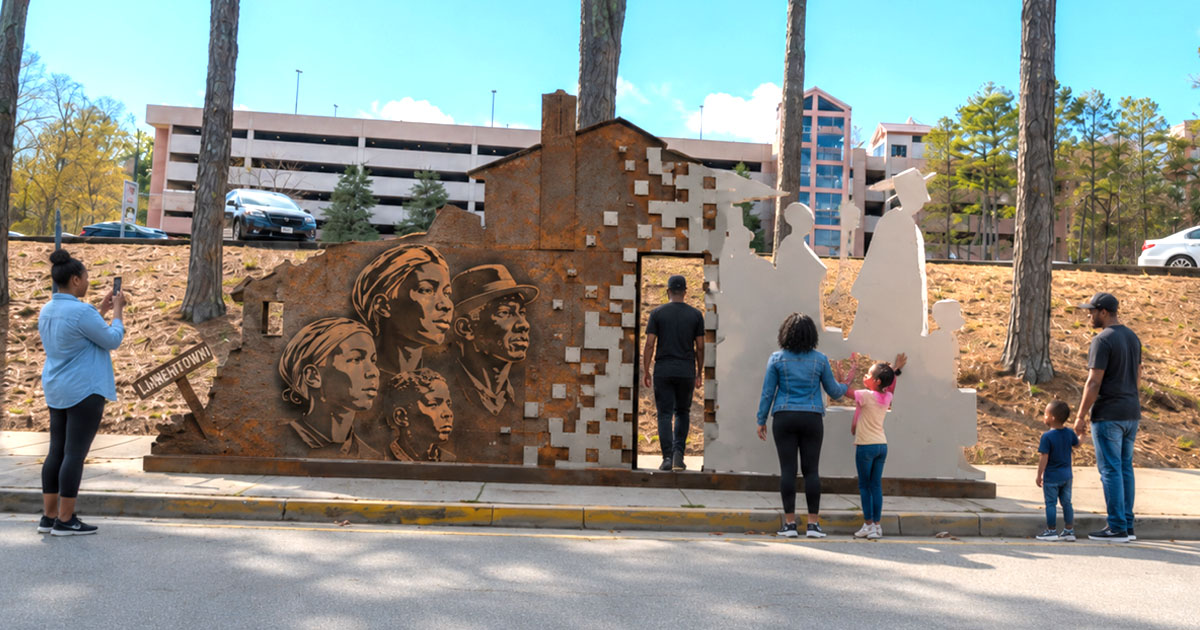
The ACC Commission has approved a tentative concept for the Linnentown “Walk of Recognition,” which is a public art project memorializing the destroyed neighborhood of Linnentown.
The city of Athens razed Linnentown during the “urban renewal” period of the 1960s at the request of the University of Georgia, which planned to expand its campus. As a result, Linnentown residents were forcefully displaced from their homes and greatly undercompensated for their property according to former residents and a study performed by UGA Geography professor Dr. Jerry Shannon.
This grim chapter of Athens history went unacknowledged by the two offending institutions until the height of the Black Lives Matter movement in 2021, when the ACC government formally apologized for its actions. The formal apology, called the Linnentown Resolution, condemned the urban renewal project in no uncertain terms, calling it an act of “institutionalized white racism and terrorism.” Going further, Mayor Kelly Girtz created the ACC Justice and Memory Project in an attempt to make amends for the harm that his institution caused. Chaired by author, activist and former Linnentown resident Hattie Thomas Whitehead, the Athens Justice and Memory Project has made numerous recommendations to the local government over the years, including a request for the installation of a memorial on UGA campus at the site of the destroyed neighborhood.
The memorial’s construction was greatly complicated due to strong resistance from the university. Unlike the ACC government, the University of Georgia has never apologized for its role in the destruction of Linnentown. When the memorial was first proposed, UGA refused to participate in the planning process and later threatened a lawsuit should the construction go forward.
The justification for the lawsuit is that UGA claimed to own the right-of-way at S. Finley Street (now called Linnentown Lane at this location) and Baxter Street, a claim that was credible enough to halt construction and cause a reduction in project scope. The Linnentown Walk of Recognition was originally planned to have multiple stops and a large mosaic cooperatively constructed by community members working side-by-side with former Linnentown residents. The new, slimmed down version of the design includes a historical marker and an art project designed to fit within the portion of the right-of-way owned by the public.
The concept rendering shown above is not the final version. Importantly, one ACC government-owned parking space at this location will be removed to create a small pedestrian plaza where passers-by can view the exhibit in safety from oncoming traffic. The art piece will also include artistic representations of residents who actually lived in the Linnentown neighborhood as they would have appeared in the 1960s.
With their vote on Tuesday, the ACC Commission also approved the text of the historical marker, which will read:
“Established around 1900, Linnentown was a thriving Black community on 22 acres. It included South Finley Street (now Linnentown Lane), Lyndon Row, and Peabody Street. Approximately 55 families lived here, with 66% owning their homes. Residents included skilled workers, beauticians, electricians, brick masons, cooks, a nurse and even a professional baseball player. The community valued education, with children attending Union Baptist Institute or Reese Street School and residents raising funds to support higher education. Linnentown was erased through the University of Georgia Urban Renewal Project (Ga. R-50), completed in 1966. This project was carried out by the City of Athens, in collaboration with the University System of Georgia, to build the Brumby, Creswell and Russell residence halls.”
In 2025, the ACC government once again invited UGA to participate in this project, but was again refused. Regardless of the university’s lack of participation and, at times, outright hostility towards this effort, the Linnentown Walk of Recognition should be completed sometime next year. An unveiling of the pedestrian plaza and historical marker is expected this year.
“This is very historic,” Whitehead said during public comment. “It shows how you can work with the mayor and commission to get things done. It’s very important that this [memorial] will be here for generations to come. On behalf of all the first descendants of Linnentown, the residents who are not here any longer and all of the community, I just want to say thank you.”
Pinewoods to gain access to city water
Residents of the Pinewood Estates mobile home park in north Athens have had inconsistent access to clean drinking water for many years due to a poorly-designed and faulty system of privately-owned pipes. Fortunately, these water woes may soon be coming to an end.
The owners of Pinewood Estates are applying for permission to build 110 new residential pads on the property, a significant expansion. Since trailer parks are only allowed in Athens if given special approval, ACC planners had an opportunity to make demands they would otherwise be unable to. In this case, they’ve chosen to require that the owners meet the current water needs of the existing residents first before they would approve the special use permit. On Tuesday, the ACC Commission agreed and voted unanimously to give their final approval to the expansion with this requirement.
Jeff Carter, the owner of Carter Engineering Consultants, told the mayor and commission that new water pipes arrived on site this week and will be installed “as soon as possible, as soon as contractors can get going and get it replaced.”
The water pipes will remain privately-owned but they will connect to the public water main which runs along US-29 right outside the neighborhood, instead connecting to a private well. While the well water is regularly tested for bacteria and other contaminants, people who drink the water when it is available often complain of a foul smell and taste. This problem should be resolved with the switch to the public water supply.
In addition to new drinking water pipes, the owners are also installing fire hydrants in the neighborhood to provide fire protection.
Commission nearly rejects federal homelessness grant
ACC Commissioners approved applications for two federal grants to help address homelessness in Athens. These votes would normally have been two of many that go undiscussed in APN’s reporting, but one of these votes ended up being extremely close, which is quite unusual.
The first of the two grants would bring in $940,000, if awarded, shared between three different agencies (Advantage Behavioral Health Systems, Family Promise and the Sparrow’s Nest) for shelter units, transitional housing and supportive services for the unhoused. Eight commissioners voted in support of it, with Commissioner John Culpepper being absent and Commissioner Stephanie Johnson abstaining.
The second grant met with far more resistance. If awarded, this $825,000 grant would allow the Athens Homeless Coalition to enhance its coordinated data entry system with regard to youth and young adult homelessness (meaning people 18-24 years of age). The grant would also pay for the development of a youth action board made up of young people who have been unhoused at some point in their lives. Board members would share their experiences and propose solutions to institutional barriers that might prevent youth like them from accessing services in the future.

Michael Bien, executive director of the Athens Homeless Coalition, explained the grant’s purpose to commissioners during public comment. He also stayed at the podium to answer questions after.
“Young adults experiencing homelessness are less understood than the general homeless population. They are harder to identify, harder to engage and less likely to access services and exit homelessness,” Bien said.
A grant like this would normally be placed on the commission’s “consent agenda,” meaning that it would be passed with a quick vote and no discussion. It’s rare that any commissioner would want to refuse money from the federal government to help address homelessness, which many voters consider to be one of Athens’ most pressing problems.
Yet, that’s exactly what happened. Not one, but three commissioners voted against accepting the competitive $825,000 grant for the Athens Homeless Coalition if it is ultimately awarded.

Commissioner Dexter Fisher was the first to object to the grant, saying that it was “a duplication of services” or an unnecessary waste of money. Fisher felt that the existing coordinated data entry system the Athens Homeless Coalition already uses should be sufficient for all ages. He also said that he thought much of the data Bien wanted to collect was already being collected by the Athens Wellbeing Project, a partnership led by UGA researchers.
“I’m a big advocate for the homeless population,” Fisher said. “My issue is with the duplication of services.”
Bien, an expert in the field, calmly explained to Fisher that the Athens Wellbeing Project has typically done door-to-door surveys in the past, meaning that it has not surveyed people experiencing homelessness at all in most of the data it has collected. While this has changed in recent years, Bien maintained that youth experiencing homelessness are “particularly vulnerable” and stand to benefit from a special focus on the needs they have and the barriers they experience.
Fisher was not moved by this explanation and continued to state that he thought the grant was unnecessary.
Johnson was the second commissioner to object to the grant, saying that transitional housing was the greatest need when it comes to serving the homeless. Johnson also said she agreed with Fisher that the grant was redundant.

Commissioner Ovita Thornton was the final commissioner to object, and she did so in a characteristically flamboyant way.
“Shame on HUD [the US Department of Housing and Urban Development],” Thornton declared. “They should have been putting out money…that provides direct service [to people experiencing homelessness].”
The previous grant application for Advantage Behavioral Health Systems, Family Promise and the Sparrow’s Nest did include funding for transitional housing and direct services but Thornton still expressed serious doubt about it at a meeting last month. While Thornton did end up voting to support this particular grant (but not the second), Johnson found herself unable to do so because of some highly specific questions she had about perceived inaccuracies in the staff report about the grant. She was more opposed to the second grant, which did not provide direct services, as discussed above.

“I don’t want anyone to think that anybody up here [any commissioner] is against that demographic [people experiencing homelessness]. It’s just there’s a duplication of services,” Johnson said.
In an extremely close 6-3 vote, Commissioners did give their approval to the Athens Homeless Coalition to receive the grant money, if awarded. Ordinances like this require six votes to pass. This means that if any other commissioner had voted against it, it would have failed.
Help APN continue covering local news for the Athens area!
Please consider becoming a member or giving a one-time donation via PayPal.
Read the full article on the original site

