




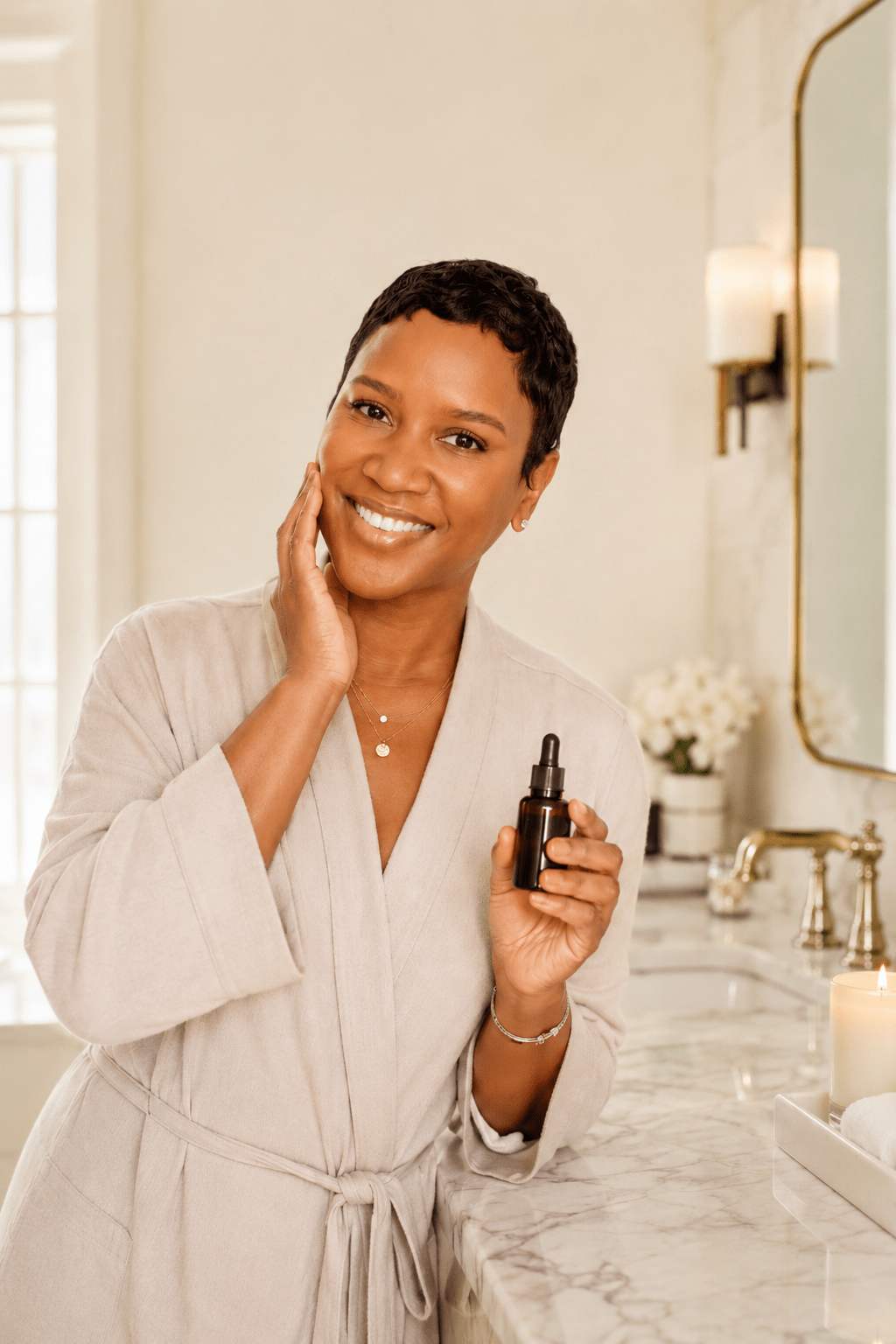
Glow & Grow: Black Beauty, Haircare, and Skincare Tips
- Start retinol only when your skin is calm; do not begin during active eczema, burning, peeling, or already irritated barrier.
- Choose a low-strength, beginner-friendly formula instead of the highest percentage; formulation matters more than percentage alone.
- Begin at low frequency: use one night per week, progress gradually to twice weekly, leaving recovery nights between.
- Apply an pea-sized amount to dry skin; buffer with moisturizer or use the moisturizer-sandwich; avoid eyelids, corners, and broken skin.
- Use daily sunscreen, expect months for results, and do not quit over mild flaking to reduce risk of post-inflammatory hyperpigmentation.
Estimated reading time: 18 minutes
Most people who believe retinol does not work for them have a half-used bottle somewhere to prove it.
They tried it for a few nights. Their skin became tight, flaky, red, or unusually sensitive. The bottle went into a drawer, and the reaction became evidence that their skin simply could not tolerate retinol.
Sometimes the formula really is not a good fit. But often, the ingredient is not the entire problem.
The way it was introduced is.
Learning how to start retinol is less about finding the strongest formula and more about creating an on-ramp your skin can tolerate. That matters at every age, but it becomes especially important after 40, when skin may be drier, more reactive, and slower to recover from irritation.
Retinol is one of the most researched ingredients for healthy aging. It is also one of the ingredients that people are given with the least useful instructions.
Someone tells you to buy it, use a pea-sized amount, and wear sunscreen. What often gets left out is how slowly you may need to begin, how to protect sensitive areas, what an adjustment can look like, and how to recognize when your skin needs you to stop.
That is what this post will walk you through.
By the end, you will know which form to consider, how often to use it, how to apply it with less irritation, what the first several weeks may feel like, and which mistakes cause people to give up before retinol has had a chance to work.
Why Retinol Earns Its Place After 40
Two changes tend to become more noticeable in your forties.
The first involves collagen. Your skin produces less of it than it once did, which can contribute to changes in firmness and the appearance of fine lines.
The second involves skin renewal. The processes that help shed older surface cells and replace them become less efficient, making rough texture, uneven tone, and fine lines more visible.
Retinoids can help address both concerns. They support collagen-related processes and encourage more regular skin renewal, which is why they appear so often in dermatologist-recommended routines for visible signs of aging.
For a wider look at which healthy-aging ingredients are worth considering after 40, read Skincare Ingredients That Actually Matter After 40.
But knowing that retinol works is not usually where people need the most help.
The problem begins when a proven ingredient meets a routine that is not prepared for it. Someone buys the right type of product, introduces it too aggressively, develops irritation, and assumes their skin cannot tolerate retinol at all.
Many people can use a retinoid successfully.
They simply need a better starting plan.
Retinol vs. Retinoid vs. Tretinoin
The language around retinoids can make the skincare shelf feel more complicated than it needs to be.
Retinoid is the umbrella term for a family of vitamin A derivatives. Retinol is one member of that family.
The easiest way to understand the common forms is to picture a ladder:
- Retinyl esters sit near the bottom. They are generally the gentlest and slowest.
- Retinol is the next step.
- Retinaldehyde, usually shortened to retinal, sits closer to the active form.
- Tretinoin is a prescription retinoic acid. It does not need to be converted before the skin can use it.
Your skin ultimately uses retinoic acid. Retinyl esters, retinol, and retinal must go through conversion steps inside the skin before reaching that active form.
In general, fewer conversion steps can mean a more direct and potentially stronger effect. They can also mean a greater chance of irritation.
But the ladder is a teaching tool, not a perfect product-ranking system. Concentration, formulation, delivery system, stability, and frequency all influence how a product behaves on your skin.
Tretinoin is one of the strongest and most extensively studied options. It can be excellent, and I am not going to pretend a gentle cosmetic retinol is identical to prescription tretinoin.
I also personally cannot tolerate it.
Even the lowest prescription strength has been too much for my dry, sensitive, eczema-prone skin.
That does not mean tretinoin failed. It means it was not the right starting point or long-term option for my skin.
You do not need the strongest retinoid available. You need the one you can continue using.
A powerful product sitting untouched in a drawer will do less for your skin than a gentler formula you can use consistently.
Dana’s Tip: Choose a starting formula one step gentler than your ambition tells you to. It is easier to increase later than it is to calm an irritated barrier and begin again.
How to Start Retinol, Step by Step
Starting retinol well is not especially complicated.
1. Start when your skin is calm
It mostly requires restraint.
Your skin barrier is the outermost part of your skin. It helps hold moisture in and keep irritants out.
Do not introduce retinol when your skin is already burning, peeling, unusually tight, or reacting to another product. You should also avoid beginning during an active eczema or dermatitis flare.
Starting a strong active on an already-stressed barrier makes irritation more likely. It also makes it harder to determine whether the retinol itself is a problem or whether your skin was already overwhelmed.
If your current routine stings or your skin feels raw, start with How to Repair Your Skin Barrier before adding retinol.
2. Begin with a low-strength formula
There is a natural tendency to reach for the highest percentage on the shelf because the larger number seems more effective.
For a beginner, that approach often backfires.
A stronger concentration may cause more irritation without producing better results if you cannot use it consistently. Your first goal is not maximum intensity. It is finding a formula and frequency that your skin can manage.
Instead of shopping by percentage alone, look for a product described as beginner-friendly, gentle, or appropriate for sensitive skin.
Remember that percentages are not always directly comparable between products. The complete formula matters.
3. Begin at a low frequency
I start with one night per week.
One.
I keep that schedule for a week or two and pay attention to how my skin responds. If my skin remains calm, I move to two nights per week, leaving several recovery nights between applications.
That is my conservative approach for dry, sensitive, eczema-prone skin. Your dermatologist or the instructions for a prescription product may recommend something different.
The larger principle remains the same: begin with less than you think you need and increase gradually.
You are not falling behind by moving slowly.
Slow is the point.
4. Apply it at night
Most retinol products are designed for an evening routine. Some retinoids can be unstable in light, and nighttime application makes it easier to keep the routine simple.
Cleanse your face, let your skin dry, then apply your retinol.
Your retinol night routine does not need to be elaborate. Especially in the beginning, simpler is usually better.
5. Use a pea-sized amount
A pea-sized amount is enough for the entire face.
Using more does not create faster results. It simply increases the amount of active ingredient contacting your skin, which can increase irritation.
Dot the product lightly across your forehead, cheeks, and chin. Then spread it into a thin, even layer.
6. Apply it to dry skin
This detail matters.
Applying a retinoid while your skin is still damp may increase penetration. That can also increase the likelihood of irritation.
After cleansing, allow your face to dry before continuing with the rest of your routine.
You do not need to set a timer or create a complicated waiting ritual. The goal is simply to avoid putting retinol directly onto skin that is still wet.
7. Buffer it if your skin is sensitive
Buffering means applying moisturizer before your retinol.
The moisturizer creates a small cushion between your skin and the active ingredient, making the application easier to tolerate. You can still receive the benefits of the retinoid without giving sensitive skin the full impact at once.
A simple buffered routine looks like this:
- Cleanse.
- Allow your skin to dry.
- Apply moisturizer.
- Apply a pea-sized amount of retinol.
You can also use the moisturizer-sandwich method:
- Apply a thin layer of moisturizer.
- Apply your retinol.
- Finish with another layer of moisturizer.
I also protect the areas on my face that tend to become irritated first. For me, that includes the creases around my nose, the corners of my mouth, and the delicate area near my eyes.
Before applying retinol, I place a small amount of occlusive balm over those areas.
Think of it as a shield for the parts of your face that are most likely to become dry or irritated.
This is a personal adjustment, not something every beginner has to do. It becomes useful once you know where your own sensitive zones tend to be.
8. Keep other strong actives out of the way
This is not a permanent rule.
Experienced retinoid users may be able to successfully combine retinol with other active ingredients. But during the introduction period, using one strong active at a time makes it much easier to understand what your skin can tolerate.
While your skin is adjusting:
- Keep exfoliating acids on a different night.
- Continue using vitamin C in the morning if your skin already tolerates it.
- Use gentle hydrating serums and essences.
- Apply moisturizer generously.
- Continue using niacinamide if it supports your skin without causing irritation.
Retinol can be drying. Hydration and moisturizer are not optional extras around the active ingredient.
They are part of the retinol routine.
For help arranging the rest of your products, read How to Layer Your Skincare Products.
9. Apply sunscreen every morning
Retinol is generally used at night, but your morning routine should end with sunscreen.
There are two separate reasons for this.
First, many retinoid formulas can degrade in light, which is one reason nighttime use is preferred.
Second, ultraviolet exposure contributes to the same collagen changes, fine lines, and uneven pigmentation you are trying to address with retinol.
Daily sunscreen protects the progress your nighttime routine is working to create.
Sunscreen is not a punishment for using retinol. It is part of protecting your results.
For sunscreen guidance created specifically with melanin-rich skin in mind, read Sunscreen for Black Women: Why the Old Advice Is Wrong.
How Often to Use Retinol When You Are Starting
When someone asks how often they should use retinol as a beginner, my initial answer is once per week.

Stay there for one or two weeks. If your skin remains comfortable, move to two nights per week with several recovery nights between applications.
A conservative introduction might look like this:
- Weeks 1 and 2: Sunday only
- Weeks 3 and 4: Sunday and Thursday
- Weeks 5 and 6: Remain at twice weekly, or add another night only if your skin is calm
Do not increase your frequency simply because you made it through the first application without peeling.
Retinol irritation can build after repeated use. Your skin may look completely fine after the first night, but it may begin to feel dry or sensitive after the second or third application.
Hold each schedule long enough to see how your skin responds.
You also do not have to work your way up to nightly use. Depending on the formula and your skin, two or three consistent nights per week may be the right long-term schedule.
That is still consistent retinoid use.
The people who abandon retinol often take the opposite approach. They begin three, four, or even seven nights per week. Their skin pushes back, and they interpret that reaction as proof that retinol is not for them.
Your frequency during the first month can determine whether there will be a third month.
Dana’s Tip: Give retinol a permanent place on your calendar. “Every Sunday” is much easier to follow than a vague plan to use it sometime during the week.
How to Apply Retinol at Night
The application details may seem small, but they can matter more than the name on the bottle.
Begin with a gentle cleanser and allow your face to dry. Apply moisturizer first if you are buffering.
Use one pea-sized amount for your entire face. Dot it across the forehead, cheeks, and chin, and then spread it into a thin layer.
Avoid applying retinol directly:
- On the eyelids
- Too close to the eyes
- Inside the creases of the nose
- At the corners of the mouth
- On broken, raw, or actively irritated skin
Retinoids can migrate slightly after application, so you do not need to place the product directly against every crease or delicate area.
Finish with moisturizer if your skin needs additional support.
Dana’s Tip: Do not add extra retinol directly to a fine line or dark spot. Retinol does not work like a spot treatment, and applying more product in one area usually leads to more irritation, not faster results.
What the Adjustment Weeks Actually Feel Like
The first few weeks of using retinol can look a little worse before they look better.
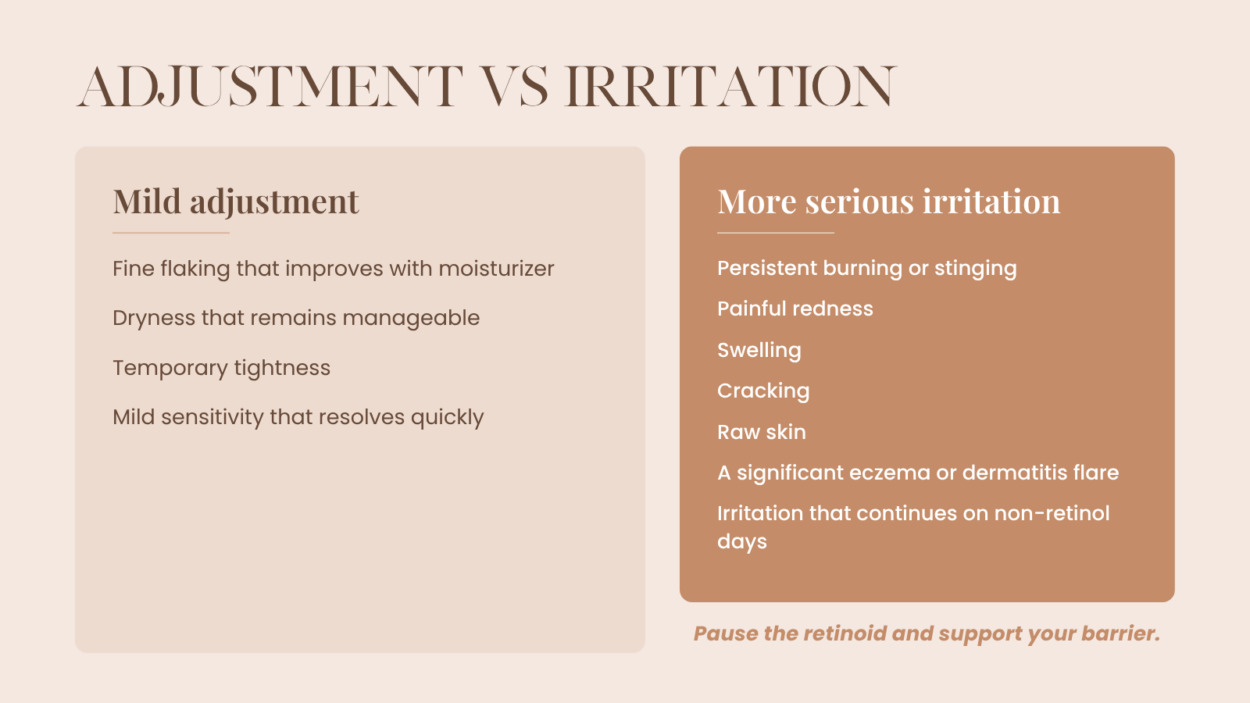
Some people experience:
- Mild dryness
- Light flaking
- Temporary tightness
- A slight increase in sensitivity
These symptoms can be part of the adjustment period.
But there is an important difference between skin that is adapting and skin that is being damaged.
A mild adjustment may look like:
- Fine flaking that improves with moisturizer
- Dryness that remains manageable
- Temporary tightness
- Mild sensitivity that resolves quickly
When that happens, do not immediately throw the product away.
Do not increase your frequency, either.
Keep the rest of your routine simple, moisturize well, and give your skin time to settle into the current schedule.
Steady is the skill.
More serious irritation may look like:
- Persistent burning or stinging
- Painful redness
- Swelling
- Cracking
- Raw skin
- A significant eczema or dermatitis flare
- Irritation that continues on your non-retinol days
That is not an adjustment period you need to push through.
Pause the retinoid and return to a simple, barrier-supportive routine. Once your skin has recovered, you may need a lower strength, fewer applications, more buffering, or guidance from a dermatologist.
The goal is not to quit at the first sign of a small flake.
It is also not to force your skin through pain or barrier damage.
Stay steady when the adjustment is mild. Step back when the irritation is painful, persistent, or getting worse.
How Long Does Retinol Take to Work?
Retinol takes weeks and months, not days.
Some people begin to notice early changes in smoothness or texture after approximately two to three months of consistent use. More significant changes in fine lines, uneven pigmentation, and overall skin quality can take longer.
That is why you should not judge the product after one week unless you are evaluating whether the formula feels tolerable.
A more useful evaluation asks:
- Can I use this product consistently?
- Is my skin remaining reasonably calm?
- Does it fit easily into my routine?
- Am I beginning to see gradual improvement after several months?
Retinol does not usually provide the immediate gratification of a hydrating serum or rich moisturizer.
Its value comes from what consistent use can support over time.
If you quit after a few applications, you never give it the opportunity to do what it does best.
Retinol and Black Skin: Why a Slow Start Protects Us
There is a persistent idea that Black skin is too sensitive for retinol or cannot tolerate active ingredients.
The evidence does not support that conclusion. Retinoids can be effective and generally well tolerated in pigmented skin, as discussed in the review Topical Retinoids for Pigmented Skin.
Our skin is not inherently too fragile for retinol.
The meaningful difference is what may happen after irritation.
When melanin-rich skin becomes inflamed, the inflammation can leave a visible mark. The initial irritation may resolve within several days, while the resulting post-inflammatory hyperpigmentation can remain for weeks or months.
That means the cost of rushing retinol may extend beyond temporary flaking or discomfort.
You may end up with a dark spot that you then have to spend months trying to fade.
This is why beginning with a lower strength, applying it once weekly, buffering, and increasing gradually are not limitations.
They are protective strategies.
Used appropriately, retinoids may help improve tone and texture over time. But the causes of dark spots and the ingredients that help fade them deserve their own complete lesson.
For now, the assignment is narrower:
Start slowly enough that you do not give your skin an unnecessary reason to become inflamed.
Three Mistakes That Make People Quit Retinol
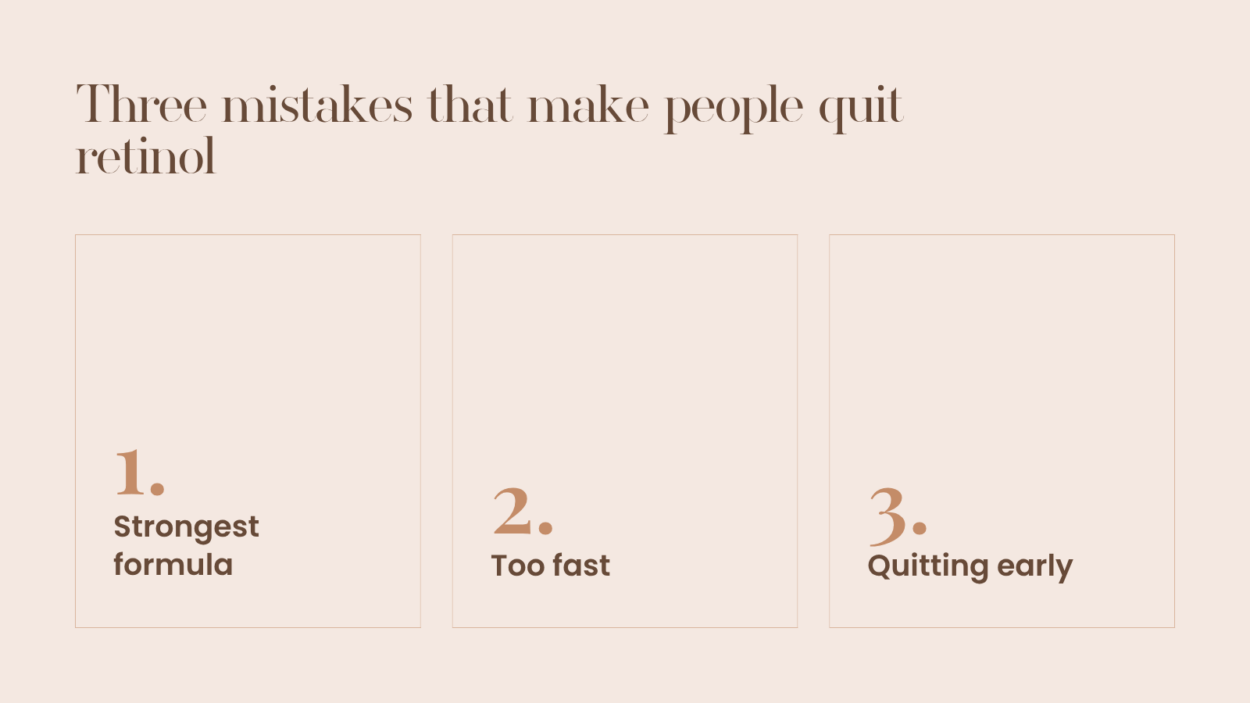
Most failed retinol attempts can be traced back to one of three mistakes.
1. Buying the strongest formula available
The percentage on the front of the bottle is not a scoreboard.
Using a stronger formula does not prove that you are more serious about healthy aging. The right strength is the one your skin can tolerate consistently.
More intense is not automatically more effective.
2. Moving too fast
Starting with nightly use or increasing the frequency every few days does not shorten the timeline.
You cannot force your skin to build tolerance faster simply because you want faster results.
Moving too quickly often leads to irritation. Significant irritation then forces you to stop, repair your barrier, and begin again.
The fastest route is often the one that allows you to keep going.
3. Quitting during a mild adjustment period
This is one of the most frustrating mistakes because it often happens before the ingredient has had enough time to create a visible change.
A small amount of manageable dryness or flaking does not automatically mean you chose the wrong product.
Support your skin. Keep the frequency where it is. Give your skin time to adjust.
The adjustment period may be part of the toll, but it is not the destination.
Pay only the reasonable toll. Do not accept barrier damage as the price of entry.
Go Deeper in the Video
This post is designed to serve as your written reference guide.
In the companion YouTube lesson, I walk through the same method visually, including the retinoid ladder, the pea-sized amount, where I place an occlusive buffer, and what I mean when I say the first few weeks require restraint.
Each Beauty In Color YouTube lesson is paired with a searchable blog post you can bookmark and return to when you need it.
Watch the full lesson here:
Retinol FAQ
- How do I start retinol without irritation?
Begin with a low-strength formula and use it one night per week. Apply a pea-sized amount to dry skin, and buffer it with moisturizer if you are sensitive. Keep exfoliating acids and other strong actives on separate nights while your skin adjusts. - How often should I use retinol as a beginner?
My conservative starting method is one night per week for one or two weeks. If your skin remains calm, move to twice weekly with several recovery nights between applications. - What strength of retinol should a beginner use?
Choose a low-strength or beginner-friendly formula rather than automatically purchasing the highest percentage. Formulations vary, so the percentage alone does not tell you exactly how irritating or effective a product will be. - Should I apply retinol before or after moisturizer?
Either approach can work. Applying moisturizer before retinol buffers the active ingredient and may be more comfortable for dry or sensitive skin. You can also apply another layer of moisturizer after your retinol. - Can I use retinol if I have eczema?
Do not begin during an active eczema flare or apply retinol to broken, inflamed, or irritated skin. Because tolerance varies, people with eczema-prone skin may benefit from speaking with a dermatologist before introducing a retinoid. - How long does retinol take to work?
Early visible changes may begin after approximately two to three months. Improvements in fine lines, uneven tone, and overall skin quality may require several months of consistent use. - Is retinol safe for Black skin?
Yes. Retinoids can be used successfully on Black and melanin-rich skin. The key is to minimize excessive irritation, as inflammation can trigger post-inflammatory hyperpigmentation. - Do I need sunscreen if I only use retinol at night?
Yes. Daily sunscreen protects against ultraviolet exposure that contributes to collagen loss, uneven pigmentation, and other visible signs of aging. It supports the same goals you are addressing with retinol. - Should I stop retinol if my skin flakes?
Not necessarily. Light, manageable flaking can occur during the adjustment period. Keep your frequency steady and increase your moisturizer. Pause the product if the flaking becomes severe or is accompanied by burning, pain, cracking, swelling, or raw skin. - Can I use retinol while pregnant?
Topical retinoids are generally avoided during pregnancy. Speak with your physician about what is appropriate if you are pregnant, trying to conceive, or breastfeeding.
The Bottom Line
Retinol works. It is well studied, and after 40, it is one of the most useful ingredients to consider adding to a healthy aging routine.
But the results do not come from buying the strongest bottle.
They come from introducing the ingredient in a way your skin can sustain.
Start with a low strength. Use it one night per week. Apply a pea-sized amount to dry skin. Buffer it if you are sensitive. Keep the rest of your routine simple, moisturize generously, and apply sunscreen every morning.
When the adjustment is mild, do not panic or push harder.
Hold steady.
When the irritation becomes painful, persistent, or damaging, step back and protect your barrier.
You do not need the strongest retinol.
You need the one you will still be using three months from now.
Consistency may be the active ingredient nobody prints on the label, but restraint is what makes that consistency possible.
What To Do Next
Shop With Me
The products I keep in rotation plus my budget-friendly picks, all in one place.
Read the full article from the original source
