




National News and Opinion from other Black News Outlets:
- Freedom Quilting Bee formed in 1966 as a survival cooperative resisting mass eviction and white supremacist economic warfare after the Voting Rights Act.
- The Bee used quilt profits to buy 23 acres in Alberta, creating land ownership and selling parcels to families evicted for civil rights activism.
- They built the Martin Luther King Jr. Memorial Sewing Center offering a factory, daycare, and local employment, anchoring community organizing and autonomy.
- The Bee modeled cooperative economics, converting craft into collective capital to reclaim land, counter heirs' property loss, and inspire community land trusts.
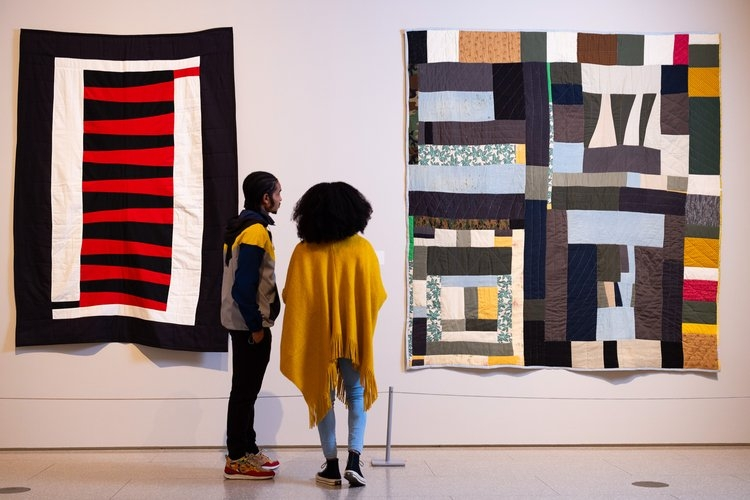
Popular histories of the Freedom Quilting Bee are often told as tales of aesthetic revelation. They describe the translation of rural Black women’s handiwork into the high-fashion arena of New York City, a translation facilitated by the discovery of the genius of Gee’s Bend residents in the red clay wastes of Wilcox County, Alabama. The visual account is represented in images of outrageous, geometric denim quilts displayed on the blank surfaces of the Smithsonian or billowing over mid-century modern beds in affluent households, procured through Sears-Roebuck catalogs in the late 1960s. In this version of the tale, the “Gee’s Bend” style becomes a successful expression of American folk art, a reflection of humanity’s survival.
But to think of the Freedom Quilting Bee solely as an artistic movement is to deny it any of its radical political beginnings. It robs the quilts of their most important setting: the mud, the terror, and the ultimate necessity of earth to rest one’s feet upon.
The women of Alberta and Gee’s Bend organized not because they were overflowing with creativity, but because they were being hunted. The Bee was created during the bloody winter of 1966, in the wake of a white supremacist backlash after the passing of the Voting Rights Act. When sharecroppers in the Alabama Black Belt decided to go register, the white landowning class launched a strategic, organized attack: mass eviction.
Families who had cultivated the same soil for generations were driven off the land, where their belongings were heaped up by the roadside, and where they faced a winter without shelter or money. In the midst of this scarcity, the Freedom Quilting Bee emerged as a survival force rather than a sewing circle. Though art historians recognize the abstraction and improvisations in their work, a deeper look into their archives uncovers a design plan toward what the American South still so desperately longs: Black land sovereignty and economic abolition.
The Geography of Dispossession
In order to comprehend what made the Bee possible, one first has to come to terms with how Wilcox County looked in 1965. It was the heart of the Black Belt—a place of fertile, dark earth, but even much more for its clear-cut racial classification. Here the plantation system was still in effect, only at a different stage in history and economy. Though Black people constituted more than half the population, they held no political power and owned practically no land.
By the time the Civil Rights movement arrived in Wilcox County, it brought not only marches but also economic warfare. As the official history of the Bee states, the political atmosphere was suffocating. Civil rights workers were being jailed, and retaliation against local sharecroppers was rapid and merciless. The logic of the white landowner was simple and deadly: If you want to vote as a citizen, you can’t live here on my land as a serf.
This displacement prompted a refugee crisis in the Black Belt. Tent cities, organized by The Student Nonviolent Coordinating Committee (SNCC), emerged in adjacent Lowndes County, but Wilcox was exceptionally cut off. It was in this moment of identity crisis that the women of the community, led by local matriarchs like Estelle Witherspoon and the formidable Minder Coleman, mobilized the one resource the white political establishment considered worthless: their domestic labor.
The catalyst was Father Francis X. Walter, a white Episcopal priest who, upon passing the clotheslines, saw the quilts and recognized their commercial potential. However, the agency was in the ownership of the women alone. They saw that if they could turn their scrap-work into money they could shed the financial stranglehold of the white landlords.
This was not “empowerment” in the sanitized, corporate sense; it was a hostile takeover of their own survival. When they formally incorporated as a cooperative in 1966, they did so in direct opposition to the traditional local white merchants who had always held the gatekeeper position of Black commerce. They decided their prices. They elected their own officers. In a county where Black people were beaten for aspiring to power, the Bee created a corporate institution that was undeniably, defiantly free.
A Radical Purchase: 23 Acres of Freedom
The most radical thing that the Freedom Quilting Bee did was not the quilts they sold, but what they did with the money.
In the capitalist ideology, profit is taken for oneself. In the Bee’s cooperative ideology, profit was taken for the soil. The women knew a simple principle of the people of the South: without land, freedom is just a lease. So long as they lived in tenants’ shacks, their political activity could always be punished with homelessness. To be truly free, they had to buy back the Black Belt.
This essential insight into land as liberation echoes the work of Fannie Lou Hamer in the neighboring state of Mississippi. Hamer’s foundational organizing, was in large part responsible for the passage of the Voting Rights Act, yet this work came at the price of her own dispossession; after merely attempting to register to vote in 1962, Hamer was fired and evicted from her home in the Sunflower County plantation she had known for the past 18 years. Hamer knew that a ballot was meaningless if a white landlord held the key to your physical existence. To fight back against this economic terrorism, she campaigned for agrarian resistance by establishing the Freedom Farm Cooperative in 1969. By buying hundreds of acres in the Mississippi Delta, Hamer’s cooperative guaranteed Black families access to housing, cultivation of their own food, and organizing without the constant fear of the eviction notice. The Bee women were working from the same page when they set up their farming cooperative.
In 1968, with the profits earned from increased sales and contributions from an expanding fund-raising organization, the Freedom Quilting Bee bought 23 acres of land in Alberta, Alabama.

This purchase is hard to overstate. In 1968 South, moving 23 acres of land from white to Black hands was a major power shift in the community. It was an act of “soil” reclamation that went against the era’s trend of Black land loss.
The Bee did not accumulate this land for personal money-making ventures. Instead, in a forward-looking way that foreshadowed the contemporary practice of community land trusts, the Bee used the lands to protect their neighbors. The cooperative sold eight parcels of the newly purchased land to families who lost land through the action of white landholders protesting their civil rights activities.
They become the landlords to save the community.
Owning the deed to the earth beneath their feet was protecting these families against the chief weapon of white supremacy: displacement. If you owned the land, the sheriff could not kick you off when you came to vote. If you owned the land, you could host a civil rights meeting and the landlord one day while riding by could not say “Get off my land!. The quilts were the currency, but the land was the goal. It was a spatial intervention—a remapping of the county map where a literal “safe space” was created in which Black life could not get evicted.
The Martin Luther King Jr. Sewing Center
Having obtained the land, they also sought to establish their physical presence. They didn’t want to work in cramped shacks anymore, with the flickering light of kerosene lamps; they wanted a factory of their own.
As per the timeline of the Baltimore Museum of Art, the Bee broke ground on a new sewing center in 1969. The day they dedicated the building, they named it the Martin Luther King Jr. Memorial Sewing Center.
It is also interesting to consider the year: 1969. King had only been assassinated a year before. Here in the heart of George Wallace’s Alabama, naming a Black-owned plant after the late King was a bold declaration of association. It was a clear indication to the white population of Wilcox County that this building was a bastion of the movement.
The building was not only a place of work, but a civic hub. It offered a day-care center, a revolutionary concept for working women in the rural South in the 1960s. By providing childcare that allowed mothers to work and still keep their children, the Bee practiced a form of feminism that was very pragmatic, and highly democratic, and years ahead of corporate America.
This enabled them to expand in a manner that was wholly alarming to the local white establishment. They obtained business from top U.S. chain stores, especially Sears, Roebuck & Co. to manufacture corduroy shams for pillows. The Souls Grown Deep Foundation chronology records the spectacular escalation of the era: by 1992, the Bee was for a short time the leading employer in the town of Alberta.
But the contract with Sears also carried its own complex tensions. Standardization was demanded. They wanted the chaotic, ad hoc “look” of the so-called Gee’s Bend aesthetic, but they wanted it mass-produced, with stitch-in-the-ditch uniformity and mechanical predictability. The Bee women in the end had to walk the tightrope between their origins in art and craft and the demands of industrial capitalism. They standardized their production to hold on to the bag, using earnings from the “boring” contracts of sewing to subsidize the creation of their wildly creative, one-of-a-kind heirlooms. They hacked the system, cannibalizing mass-market capitalism to fund their radical community experiment.
The Aesthetic of Survival
Though the Bee was revolutionary in its economic structure, the quilts themselves narrated the story of the land. In the early days, the bee’s purchases of materials came from no fabric stores, but rather were gleaned from the lives of the workers who made them.
The famous “work clothes” quilts were made from fading denim of the men who labored in the fields: husbands and sons. The washed-out blues, soiled greys, and patches of heavy wool—these were the actual materials of sharecropping. By distilling these garments into lively, rhythmically striking shapes, the women were making beautiful objects out of the things that oppressed them.
This was an aesthetic of “making do,” but it was also a visual language of resistance. Not adhering to the standard European quilt patterns, by insisting on improvisation, doing it “my way,” they expressed, at least symbolically, their political refusal to abide by Jim Crow’s rules.
The art world has a tendency to fetishize this kind of work, to liken it to the cool abstraction of Thelonious Monk’s jazz, and to compare it to the sleek modernism of Henri Matisse. The Freedom Quilting Bee Legacy, however, points us to the fact that this work was homegrown. It came out of solitude and necessity. It was a method of order in a place of chaos. When a woman set down to sew a quilt in a drafty cabin in 1966, she was taking the pieces of a hard life and imposing her own order upon them. She was trying to say, I can make something whole out of this brokenness.
Heirs’ Property and the Modern Echo
But what has this story got to do with us? Why should we dwell upon a sewing cooperative half a century ago?
Because the South is presently losing thousands of acres of Black land.
Black land loss in the American South has precipitously fallen from the dizzying heights of early twentieth-century ownership through the predatory mechanisms of “Heirs’ Property” laws, tax sales, and gentrification. The USDA has chronicled the extensive dispossession of Black farmers—a slow-motion but nonetheless systematic eviction comparable in scale, if not in speed, to the outflux of Black people in the 1960s.
The model of the Freedom Quilting Bee offers up an alternative story of loss. It demonstrates that cooperative economics rooted in culture and artistic production can be a tool of land reclamation. The bee demonstrated that art is not merely for the gallery wall, that it can be a tool of capital accumulation. They demonstrated that a quilt can be a shield.
Against the deepening fascist crisis in the country, in which the South paves the way for structured abandonment and state violence, anti-capitalist, cooperative alternatives present a life saving path forward for Black folks tasked with defending and caring for our own.
Moreover, the Bee disputes the contemporary notion of the “side hustle” in which we are told to turn our hobbies into individual profit. Instead, the Bee turned their domestic abilities into shared security. They didn’t just want to get rich; they wanted to get safe. They knew individual wealth in a racist system is fragile, but community-owned land is a fortress.
The Legacy of Salt
The Freedom Quilting Bee eventually followed the tried-and-true trajectory of every cooperative: a shrinking membership, plateauing markets, and a changing international textile industry. But the Freedom Quilting Bee will never be measured by the results they logged each quarter. They will be remembered by that 23 acres in Alberta.
The Souls Grown Deep Foundation, the contemporary collectors, and art institutions have tirelessly pressed for official recognition of these quilts as works of major importance to the canon of American art. Still, as we raise our glasses to the visual success of the Bee, let us not forget the political lesson.
When we look at a Freedom Quilting Bee quilt, we should see more than colors and shapes. We should see a deed. We should see a map of resistance. We should see the strategic genius of women who saw a pile of rags and found a way to buy their way out of slavery.
The Archives of the South are full of stories of loss. There are stories of burned churches, stolen farms, smothered voices. The story of the Freedom Quilting Bee is unusual because it is a story of clinging. It is a story of “salt,” that ancient preservative that prevents decay.
They stitched the salt down into the ground. They showed us that freedom isn’t just a vote, and it’s not just a song. Freedom is dirt. Freedom is a foundation. Freedom is a sewing machine that purrs in a building you own, on land no one can take away from you.
As we are once again experiencing new rounds of displacement, ranging from climate gentrification in New Orleans and Miami, to the high eviction rates and mass displacement of legacy Black communities in Atlanta, the Bee method is more important than ever. We need new cooperatives. We need more artists to create co-ownership of our cultural production. We need to keep in mind that the most beautiful thing that the Freedom Quilting Bee ever produced was not a blanket, but a future.
Read more on the original source
