




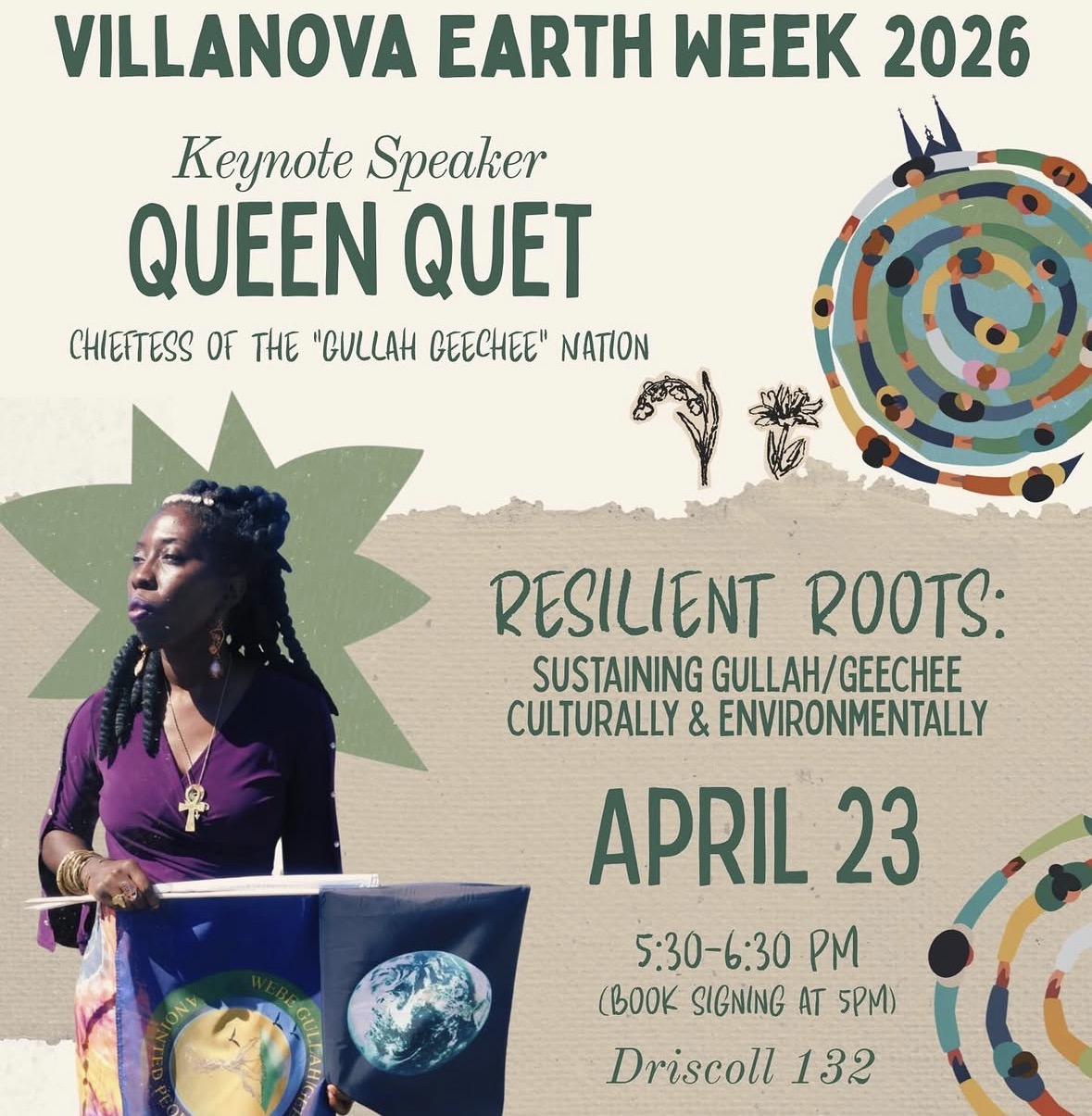
On Thursday, April 23, Villanova Sustainability welcomed Queen Quet to deliver the Earth Week Keynote Address. The event was titled, “Resilient Roots: Sustaining Gullah/Geechee Culturally & Environmentally.” The lecture took place in Driscoll Hall 132 and was attended by students and faculty.
- Queen Quet, Chieftess and founder of the Gullah/Geechee Sea Island Coalition, advocates globally for environmental justice and cultural survival.
- She described how development, gentrification, and climate change combine to erode land, cause flooding, and threaten culture.
- The Gullah/Geechee culture is inseparable from the land; rising seas threaten homes, food security, sacred sites, and traditions.
- She promoted solutions: the Open and Rural and Critical Lands Fund, incentives to protect critical areas, and fundraising for the Gullah/Geechee Land and Legacy Fund.
The Gullah/Geechee are the descendants of enslaved Western Africans, who were able to preserve their indigenous African traditions and create the unique Gullah language. The Gullah/Geechee people reside across the east coast, from Jacksonville, N.C. to Jacksonville, Fla. They officially became an internationally recognized Nation in 2000.
Quet serves as the first Chieftess and Head of State of the Gullah/Geechee Nation, and is the founder of the Gullah/Geechee Sea Island Coalition. Quet is also an environmental justice advocate who travels the world educating people about how climate change has impacted the Gullah/Geechee Nation. She is also a computer scientist, mathematician, historian and published author. While Quet had visited Philadelphia many times, she noted that this would be her first keynote address in the area.
Throughout the lecture, Quet discussed frustrations regarding the destruction of land and the continuous push for development across the coastal land and the Sea Islands.
“Somehow this beautiful paradise is not a beautiful paradise until you build a building there,” Quet said. “Until you make a golf course there.”
Quet also discussed the lack of consideration for the Gullah/Geechee people and their input. She told stories of land developers ignoring her warnings not to build on certain land. She told the audience that the Gullah/Geechee were once called “emotional natives.”
The rising sea levels and growing effects of climate change are putting the land on which the Gullah/Geechee Nation resides at risk. Quet told stories of houses falling into the sea and flooding. The Gullah/Geechee have lived in balance with the environment for generations and are directly connected to their land.
“The sea levels are rising and rising and overtaking us, our community and our culture, our farmland and our traditions and all the stories and sacred areas,” Quet said.
After lecturing for around 30 minutes, Quet then showed the audience a short documentary about the Gullah/Geechee Nation and their land.
“I want to make sure y’all can see the sea islands and my island in particular,” Quet said. “The title is one of the reasons I love it so much. Can y’all read that out loud for me?”
“Keepers of the Land,” the audience said in unison.
The video showed the sacred land of the Gullah/Geechee Nation and how the climate crisis is threatening their culture and history. Food security is being affected by flooding and rising temperatures.
“Gullah/Geechee culture is inextricably tied to the land,” Quet said in the video. “If you poison the water, you poison the culture, you poison the culture, there is no cultural heritage called Gullah/Geechee.”
In the video, the narrator asked Gullah/Geechee and Marine Scientist Albert George what the biggest threat to their community is: Gentrification, development or climate change?
“All of the above,” George said. “You don’t have one without the other.”
The video also featured clips of Quet’s ancestral farmland, which was originally purchased by her great-great-grandfather in 1862. She has faced continuous pressure from developers to sell her land.
“There is no consideration,” Quet said in the video. “There is no price tag. There is nothing you could give me to sell you my land. That’s insanity.”
After the video concluded, the audience was able to ask Quet questions.
One student in attendance asked about what could be done to reverse some of the damage to the land.
In response, Quet discussed the Open and Rural and Critical Lands Fund, which was created in South Carolina to use taxpayer money to restore developed land to natural spaces. She also mentioned working to incentivize people not to build on critical land areas and engaging in preemptive strikes.
Another audience member asked Quet about the effects of rising sea levels.
Quet discussed how the Gullah/Geechee people haven’t experienced much ocean land loss because they don’t build right on the shoreline. They have, however, witnessed people lose property to rising sea levels and flooding, which is an environmental hazard to the entire community.
After the lecture, students could purchase books and get them signed by Quet, all sales supporting the Gullah/Geechee Land and Legacy Fund. The lecture gave students and faculty a glimpse into the Gullah/Geechee way of life and how to maintain a balanced relationship with the environment.
