




Before Jacksonville became a modern city, it was built, literally, by the hands, skill, and resilience of Gullah Geechee people. They were descendants of West and Central African people forcibly brought to the Southeastern coast of the U.S. and who retained many of their indigenous African traditions through architecture, food, culture, religion and occupations.
- Gullah Geechee labor powered logging, turpentine, and stevedoring, driving Northeast Florida's lumber and naval stores economies.
- During WWII, shipbuilding employed thousands of Gullah Geechee at St. Johns River Shipbuilding Co., building liberty ships and sustaining Eastside maritime identity.
- Black women served as midwives, domestic workers, and nurses trained at Brewster Hospital and Boylan School, sustaining community health.
- Organized labor and Black enterprise: International Longshoremen’s Association Local #1408 and Afro-American Life Insurance Co. advanced workers' rights and Black economic power.
From the riverfront docks and turpentine camps to rail lines, hospitals and small businesses, their labor powered the city’s growth and shaped its cultural identity. These 13 historic photographs tell the story of workers, entrepreneurs and caregivers whose contributions often went unrecognized yet remain embedded in Jacksonville’s physical and social landscape.
Through these 13 images, we revisit a legacy of endurance, innovation, and community-building that continues to influence the city we love today.
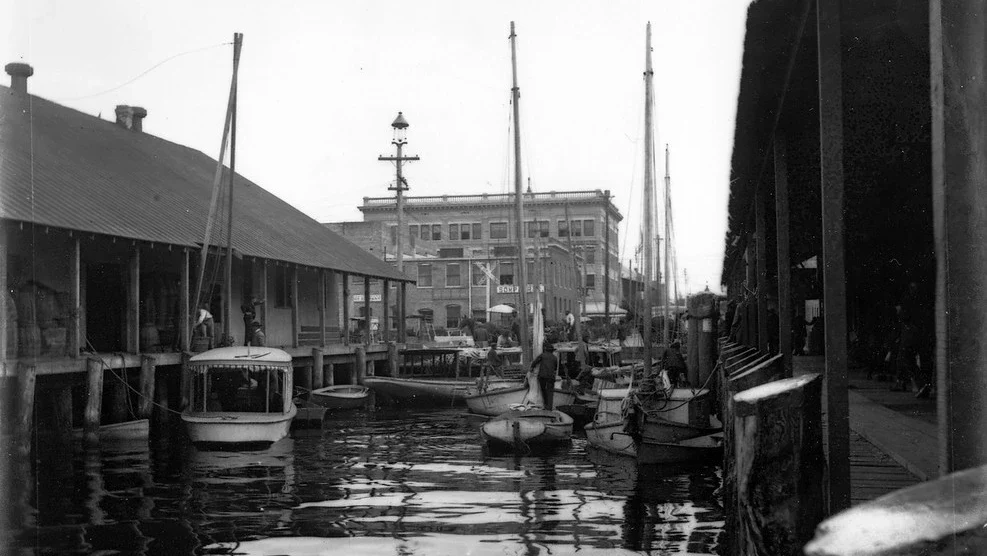
 By the 1850s, rafts, barges and steamboats carried lumber to sawmills in Jacksonville. | Library of Congress
 Founded in 1822, Jacksonville grew into a hub for shipping agricultural products from surrounding plantations to market. The lumber trade also fueled Northeast Florida’s growth, as vast forests and strong demand from the North and Caribbean shaped the economy. By the 1850s, rafts, barges and steamboats carried lumber to sawmills in Jacksonville.
As a bustling river port, Jacksonville developed into a city shaped by enslaved laborers, who worked as loggers, turpentine harvesters, river pilots, stevedores, carpenters, masons and mill hands. From 1842 to 1860, Jacksonville’s population expanded from 450 to more than 2,100, surpassing St. Augustine as Northeast Florida’s leading center and port.
Enslaved people were sometimes permitted to hire themselves out. They may not always act the way their enslavers intended. Jacksonville’s wharves welcomed self-hire enslaved, who sometimes seized opportunities to stow away on Northern-bound vessels and escape. An enslaved man in the possession of merchant Thomas O. Holmes hired himself out and worked as a stevedore before stowing away on the Boston schooner Matilda in 1855.
 Turpentine collectors were mostly African Americans who scraped gum, or tree sap, in area pine forests into barrels for transportation and ultimate processing in Jacksonville into turpentine. | Library of Congress
The turpentine and resin industry and their turpentine camps were a driving economic force for rural North Florida communities during the late 19th century as Jacksonville emerged as the Atlantic capital of the naval stores industry. Collectors were mostly African Americans who scraped gum, or tree sap in area pine forests into barrels for transportation and ultimate processing in Jacksonville into turpentine.
 The St. Johns River Shipbuilding Co. on the Eastside employed thousands of Gullah Geechee residents. | State Archives of Florida
During World War II, the U.S. Navy transformed Jacksonville’s economy, building three naval bases while the Marine Corps established Blount Island Command. By 1944, shipbuilding operations at the St. Johns River Shipbuilding Co. on the Eastside employed thousands of Gullah Geechee residents among its 20,000 workers, building liberty ships to transport troops and supplies across the globe. Today, shipbuilding continues to play a vital role in the Eastside’s maritime economy and community identity.

For centuries, blue crabs have sustained Jacksonville families as both a vital food source and economic staple. The city remains home to Florida’s first crab meat processing plant, continuing a long maritime tradition. In 2022, more than 1.2 million pounds of hard and soft shell blue crabs were harvested from the St. Johns River. Today, countless crab traps dot Jacksonville’s waterways, reflecting a legacy that endures across generations.
 Willie Dunham and his crew help with the planking of the 54-foot shrimp boat Miss Joann during construction at Mayport in 1985. | State Archives of Florida
Shrimping has long anchored Jacksonville’s economy, sustaining fishermen, seafood markets, boat repair shops, restaurants, and transport services. Many of these businesses have been run by families for generations.
 From left to right, a 1967 photograph captures International Longshoremen’s Association Local #1408 members Charles Stewart, Paul Fields, Robert Bennett, Landon Williams, and Romia Johnson Sr. at a Talleyrand Marine Terminal Open House. | JAXPORT
Located on Jacksonville’s historic Eastside, JAXPORT’s Talleyrand Marine Terminal opened in 1914 as the Municipal Docks and Terminal Co., shifting much of the city’s maritime activity from Downtown to Talleyrand. Today, the 173-acre terminal remains a vital hub, handling containerized and breakbulk cargo, imported automobiles, and liquid bulk goods like turpentine and molasses, along with steel, lumber, paper and a variety of frozen and chilled products.
Founded in 1936, the International Longshoremen’s Association Local #1408 gave Black dockworkers a collective voice during an era of segregation and harsh labor conditions at the Eastside’s Talleyrand docks. Before the union, longshoremen faced low pay, no benefits, and uncertain employment.
 Many Black women, such as those pictured here in Jacksonville, became midwives in the 1930s. | State Archives of Florida
Midwives in Florida have deep roots in enslaved and post-Emancipation Gullah Geechee communities. Mothers depended on these female healers for birth care when formal medical services were denied them or not accessible. In 1931, the Florida State Board of Health launched a midwife licensing program.
 Left: Black domestic workers built mutual aid networks, helped fund Black community initiatives, and infused domestic labor with dignity and skill. | State Archives of FloridaRight: Brewster Hospital was the primary hospital for Black physicians, nurses, and patients until the Civil Rights Act of 1964 legally ended segregation. | Ritz Theatre & Museum
Throughout the 19th and 20th centuries, Black women in Jacksonville, many of them Gullah Geechee descendants, labored as domestics, cooks, laundresses and nannies in white households while sustaining their own families and neighbors. Domestic work provided steady but limited wages and treatment varied by household.
Both the Boylan School and Brewster Hospital trained African American women to be nurses. Brewster Hospital served the African American community in Jacksonville from 1901-1966 and ultimately became part of today’s University of Florida Health complex. Generations of Black women graduated from Boylan and Brewster, serving the nursing community in Jacksonville and beyond.
 A 1934 photograph shows a section gang, or “gandy dancers,” laying track for airport construction. | State Archives of Florida
Jacksonville has been Florida’s railroad hub since the late 19th century. After the Civil War, many Gullah Geechee men found work maintaining the railways. Renowned for coordinating labor through rhythmic work songs, “gandy dancers” were unique in their use of task-related work chants.
 In 1976, the Jacksonville Terminal Company was placed on the National Register of Historic Places. | State Archives of Florida
The Jacksonville Terminal Company was the country’s largest train station south of Washington, D.C., and the main employer for the Gullah Geechee neighborhoods of LaVilla, Brooklyn, Campbell Hill and New Town. The terminal, which opened in 1919, was first organized by Henry Flagler in the 1890s. With 2,000 workers, it was the city’s second-largest employer during its heyday. Traffic peaked in 1944, when 40,000 trains passed through the terminal, carrying nearly 10 million passengers. It was the “Gateway to Florida” for passengers who included the Duke and Duchess of Windsor in 1941 and every U.S. president from 1921 until the terminal’s closure in 1974.
 By 1941, Swisher’s factory was the world’s largest and a major employer for nearby Gullah Geechee neighborhoods. | Jacksonville Public Library
Commercial cigar making in Florida began in the 1830s, flourishing in Jacksonville by the late 19th century. In 1924, John Swisher transformed a former munitions factory in New Springfield into a mechanized cigar plant, the first of its kind. The machines halved cigar prices, making King Edward cigars a global bestseller.
 Afro-American Life Insurance Co. staff | Ritz Theatre & Museum
Founded in 1901, the Afro-American Life Insurance Co. grew into one of the Southeast’s most influential Black-owned businesses. Created to meet the unique needs of the Black community, the Afro extended far beyond insurance, investing in housing, business and education across the South. In 1941, it helped finance Jacksonville’s Main Street Bridge, symbolizing its lasting impact on both the city’s growth and the advancement of Black enterprise.
Now Available: Jacksonville’s Gullah Geechee Heritage
A Community Story. A Cultural Record. A Call to Remember.
Jacksonville’s Gullah Geechee history lives in the land, the water, the neighborhoods, and the memories passed down through generations. Jacksonville’s Gullah Geechee Heritage brings those stories forward, rooted in place, shaped by community, and preserved for the future.
Jacksonville’s Gullah Geechee Heritage, a new book by Ennis Davis and Adrienne Burke, is now available for purchase.

“Gullah Geechee is a foundational culture for the United States influencing everything from our foodways and music to the way we speak. It has a descendant community that numbers in the hundreds of thousands internationally. Many of them contributed greatly to the economic engine that has fueled Jacksonville’s growing metroplex since Reconstruction. However, there are no universities or colleges in Florida (or elsewhere in the Gullah Geechee corridor) that consistently offer courses in Gullah Geechee studies and none that provide a major or degree in the field. Works of public history like Davis and Burke’s “Jacksonville’s Gullah Geechee Culture,” which successfully mine Florida’s public archives, government records, oral histories and scholarly publications, demonstrate that a foundation for a teachable canon and generative scholarship about the centuries-long history of the Gullah Geechee people of Northeast Florida exists — and should be endowed.”
— Heather L. Hodges, former executive director, Gullah Geechee Cultural Heritage Corridor (2017-2020)
