









Stay Informed: Latest News from Across Georgia
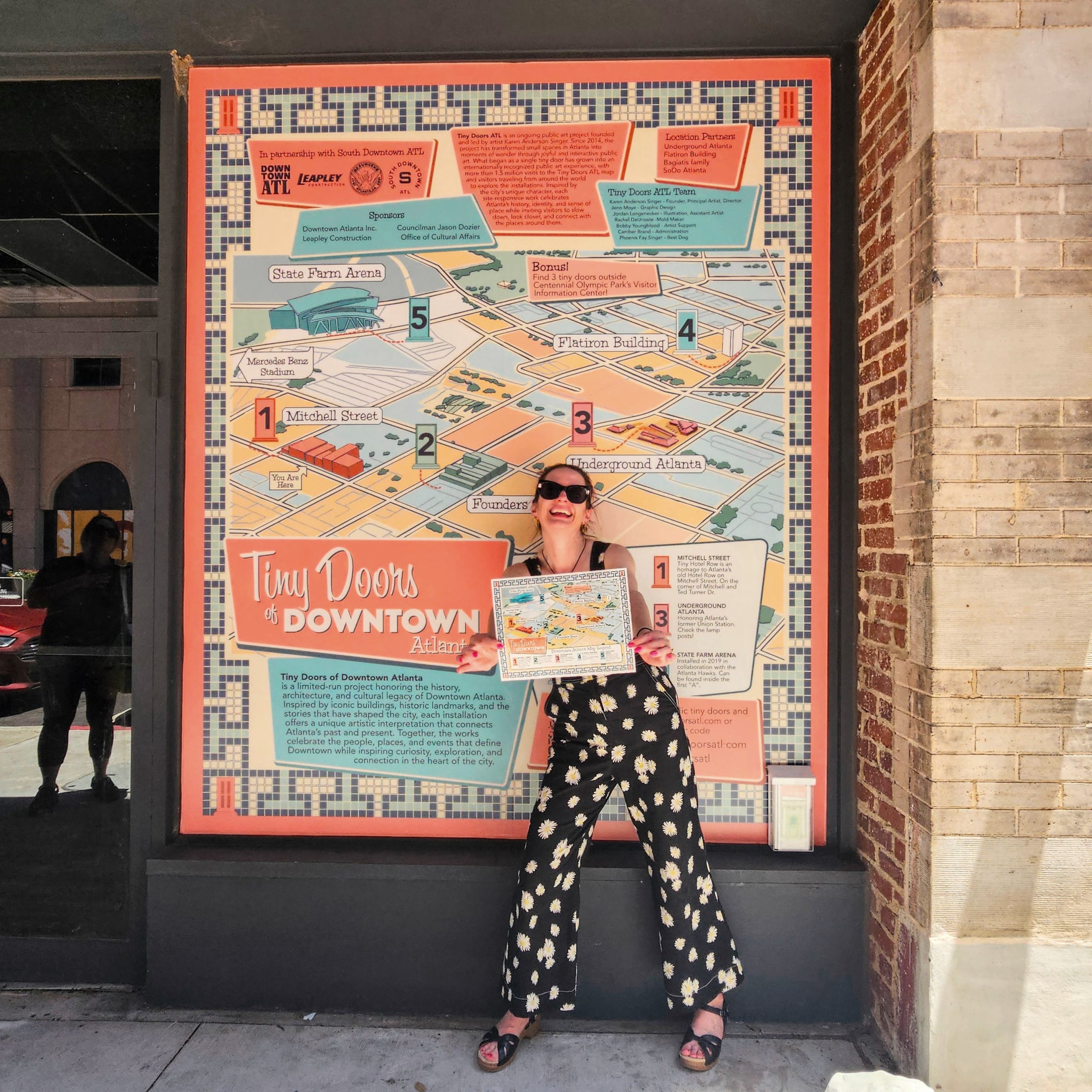
- Four new Tiny Doors ATL unveiled downtown for the World Cup, located at Founders Green, Mitchell Street, Underground Atlanta, and Flatiron Building.
- A limited-edition printed map, designed with graphic artist Jenn Moye, guides visitors in a mid-century travel guide style.
- Research in archives informed pieces, examining colorized photos of Union Station and historic Mitchell Street for authenticity.
- At Underground Atlanta, a red-brick train station wraps around a lamppost; Singer stretched a mold to bend it around the pole.
- All four works are free, street-level, wheelchair accessible, walkable within South Downtown, and meant to draw visitors beyond the World Cup.
Karen Anderson Singer has spent more than a decade making Atlanta stop and look closer. The artist known as Tiny Doors ATL places miniature sculptural doors on the walls, columns, and lampposts of the city — one deliberate installation at a time, always by invitation. This month, with the FIFA World Cup bringing the world to Atlanta’s doorstep, Singer and her team did something they had never done before: unveiling four new Tiny Doors ATL works simultaneously downtown.
“I’ve never done four at once, and I don’t plan on doing it again,” Singer said. “The World Cup was a very special opportunity to highlight a neighborhood in a really concentrated, deliberate way.”
The Tiny Doors of Downtown Atlanta project, unveiled June 13 in partnership with South Downtown, Downtown Atlanta Inc., Leapley Construction, and the City of Atlanta, places four new works at Founders Green, Mitchell Street, Underground Atlanta, and the Flatiron Building. Singer collaborated with graphic artist Jenn Moye on a limited-edition printed map, designed in the style of mid-century travel guides, that leads visitors on foot through the four South Downtown installations.
Finding South Downtown’s story
Tiny Doors ATL installations begin with research. Singer digs into the spirit of each location — the architecture, original color palette, and neighborhood history. For the South Downtown project, that meant spending weeks in library collections, including Georgia State’s, pulling photographs of Mitchell Street and of Atlanta’s second Union Station, a building no living person has seen in person. The colorization of those images became its own interpretive puzzle.
“No one could tell me what color it actually was,” Singer said of Union Station. “I found the same photos colorized different ways. So I’m thinking about these photographers who are choosing colors, and I’m going, ‘What did you pick? Or is that what you remembered it looking like?’”
Research for the Tiny Doors of Downtown Atlanta project carried a personal charge. Singer’s great-grandparents, Garnet and Bernice O’Neil, were postcard photographers who traveled the United States documenting roadside motels and regional landmarks. Their work is still collected today.
“As I was working on South Downtown, I was looking back on images just like [my great-grandfather’s],” Singer said. “I was not looking at Google Maps or drone photos or cell phone reviews. I was looking at photos taken by artists because they were the only people with cameras. And so I really had this fun connection, this artist-to-artist moment.”
That conversation across time shaped two of the four Tiny Doors of Downtown Atlanta pieces.


At Underground Atlanta, a miniature red-brick train station — complete with arched windows, a green door, and a locomotive — wraps around a lamppost overlooking the downtown skyline. Singer styled the piece to resemble a colorized postcard from Atlanta’s railroad era.
“I’ve never bent a mold before around a lamppost,” Singer said. “We measured the circumference of the lamppost, bought a bucket that matched, pulled it out of the mold and stretched it. It’s really a new idea, that piece.”
Read More:
• How to eat and drink like a local in downtown Atlanta
• City announces free Wi-Fi expansion at key Atlanta locations
The second historically rooted piece, Tiny Hotel Row, sits at the corner of Mitchell and Ted Turner Drive. Where the Union Station piece honors a single building, the piece compresses the entire block’s history into a single, layered black-and-white composite of Hotel Row businesses from the 1800s through the 1900s.
“If you were a time traveler, you would find something from your era in that piece,” Singer said.
Designed to look like it was always there
Singer’s process centers on a specific mission.
“My goal is to put the piece in and have people wonder how long it’s been there,” she said. “I don’t ever want them to look brand new. I want them to look like they’ve always belonged there.”
That instinct drives her creative choices. In the early years of the project, Singer kept a bucket of dirt in her car to refill the soil that foot traffic wore away beneath installed doors. She no longer installs over soil for that reason.
She rejects the idea that the doors are hidden. “It’s on the front of the Fox Theatre, the front of State Farm Arena,” she said. “You couldn’t smack someone in the face more with public art. But the fact that it’s tiny makes it feel hidden.”
Free, walkable, and built for everyone
Singer has always insisted that Tiny Doors ATL belongs to everyone. Every installation is free, wheelchair accessible, and at street level. The South Downtown cluster makes that promise immediate: all four works sit within walking distance of each other, ready for anyone who shows up.
Singer hopes they outlast the World Cup moment that helped bring them to life.
“After the World Cup, it could be reasons to still go to South Downtown,” she said. “Not to let it fade.”
Read the full article on the original site
