





Global Black Voices: News from around the World
- Chari streamlined restocking via app, WhatsApp and phone, enabling fast direct-to-shop orders with 24 hour delivery.
- By sharing shop-level sales data, Chari secured supply deals with producers like Procter & Gamble and L'Oréal.
- Acquiring Karny delivered digital bookkeeping, credit-sale insights and a ready user base for cross-promotion and targeted growth.
- After obtaining a central bank payment license, Chari launched POS, a Chari wallet and payment services, making the model financially sustainable.
Ismael Belkhayat
Interview with Ismael Belkhayat
CO-FOUNDER and CEO, CHARI
Lives in: Casablanca, Morocco
After building a property portal and a corporate transport venture, Moroccan entrepreneur Ismael Belkhayat, together with his wife, Sophia Alj, launched Chari in 2020 to give small shopkeepers a faster, simpler way to restock their shelves. Five years later, the business has evolved into a platform that also provides various financial services in effect, a bank for corner shops.
How we made it in Africa editor-in-chief Jaco Maritzspoke to Belkhayat about the journey.
Topics discussed during the interview include:
- Belkhayats earlier ventures in property and corporate transport
- Spotting the gap that led to Chari streamlining stock orders for small shops
- Getting shopkeepers to use the platform
- Overhauling the business model
- Entrepreneurship lessons learned
Watch the full interview below: (only available on howwemadeitinafrica.com)
Interview summary
Moroccan-born Ismael Belkhayat and his wife, Sophia Alj, founded Chari in early 2020. By 2025, investors valued the business at $125 million.
In Morocco, small, independent mom-and-pop shops account for about 80% of retail sales, with an estimated 200,000 scattered across the country.
For shopkeepers, restocking was cumbersome. Many shut their doors to trek to cash-and-carry warehouses, losing sales and paying for transport. Others relied on small-scale wholesalers with old trucks and limited product ranges. Deliveries could be late and prices uncompetitive. Larger distributors visited only once every two weeks, leaving stores short if they misjudged demand.
Chari set out to make the process more efficient. Through its app, shopkeepers could browse and order a wide range of goods, with delivery promised within 24 hours. Orders could also be placed via WhatsApp or by phone for those less comfortable with the app. This removed the need to close the shop or manage multiple suppliers, and let shopkeepers place orders at times that suited them. Once an order was placed, Chari organised the delivery directly to the shop.
Early missteps included building an app packed with features many shopkeepers didnt want. Many had older phones with limited storage and outdated operating systems. What they wanted was a simple app with big buttons, says Belkhayat. He now thinks starting with WhatsApp alone would have been better.
At first, no major consumer goods manufacturers wanted to work with the young startup. Chari instead bought products from the same cash-and-carry outlets where its target shopkeepers shopped. With no profit margin on these goods and added costs for delivery, customer service and technology the company was losing money in its early days.
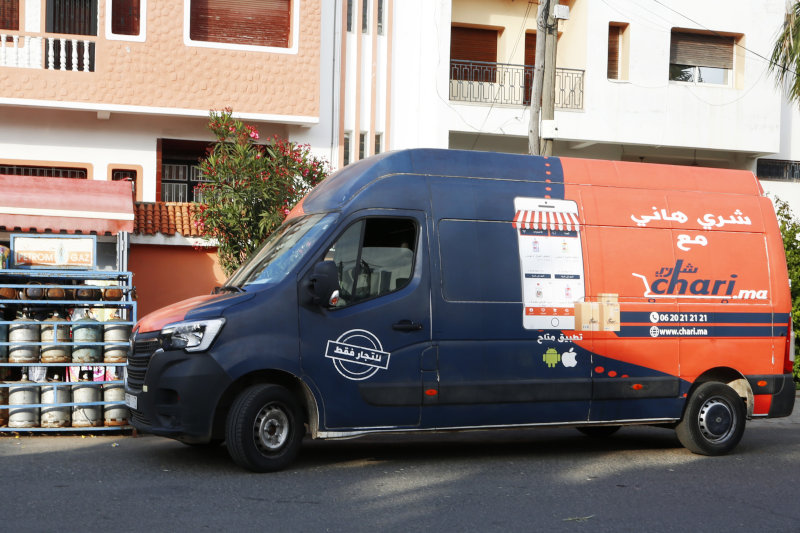
A Chari delivery vehicle.
Even so, Chari was able to collect detailed data on shopkeepers buying patterns. A few months later, the team went back to the manufacturers, this time offering access to that data as part of their pitch. Up to that point, suppliers had almost no visibility into what happened to products sold to independent shops once they left the warehouse. Charis information showed, for example, their market share in specific neighbourhoods and which products were often bought together insights they had never had before.
As a result, Chari signed supply agreements with companies such as Procter & Gamble, LOral, Mondelez, Colgate-Palmolive, Ferrero and Johnson & Johnson. These manufacturers supplied Chari with consumer goods, which Chari then in turn sold to mom-and-pop shops.
As Charis team spent more time with shopkeepers, they found that many were using Karny, a free Moroccan app also founded by two former BCG consultants that combined basic bookkeeping with tools to track their credit sales.
Nearly half of the sales small shopkeepers made were on credit. This was one of the main reasons customers preferred their local stores over large supermarket chains. The system worked because merchants personally knew their customers including their families and where they lived and could rely on them to repay. Karny allowed shopkeepers to record these transactions digitally and automatically send reminders when debts were due.
At the time, Chari was trying to drive more orders through its own app. Social media campaigns brought downloads at a reasonable cost, but few translated into purchases. Many shopkeepers struggled with the technology or abandoned the app altogether. Chari then sent sales representatives to sign up merchants in person, install the app, and walk them through their first orders. The approach worked better but was expensive and too slow to scale beyond Casablanca.
Karny offered a more efficient solution. Its users were already comfortable with digital tools, giving Chari a ready-made audience for cross-promotion. In August 2021, Chari acquired the app, gaining both a targeted marketing channel and detailed transaction data to support its growth.
Throughout 2021, Chari raised $5 million for its Seed round, typically a startups first major funding from external investors, used to refine the product and scale early operations. Officially announced in October, the round valued the company at $70 million. Investors included Rocket Internet, the company behind the Jumia e-commerce platform; Africa-focused venture capital firm P1 Ventures; and Y Combinator; among others.
By this stage, Chari had about 7,500 regular users of its core app. But despite the rapid growth in customer numbers, all was not well. The company was bleeding money, with the high cost of delivering goods to individual shopkeepers and providing customer care driving its already thin margins into the red.
The CEO realised something had to change to make the business more sustainable. We had a business model that didnt make sense, he recalls. The answer, he believed, was to offer Charis existing network of shopkeepers a range of fintech services.

An employee at a Chari warehouse.
In November 2022, Chari received a payment institution licence from Moroccos central bank, allowing it to offer a range of financial services. For instance, it gave small merchants tools to accept digital payments. For in-store purchases, Chari supplies point-of-sale machines card readers that process payments. For online orders, it offers a virtual payment gateway. When a customer pays a merchant, the money is deposited instantly into their Chari wallet, which works like a basic bank account
Beyond payments, Chari enables store owners to offer extra services to their customers, such as topping up mobile phone credit, paying utility bills, transferring money, or making government-related payments such as taxes.
By combining its e-commerce operations with fintech, Chari has been able to build a much more sustainable business. E-commerce alone is almost impossible to make profitable, Belkhayat explains. Fintech alone is also very complex because the cost of acquisition of a new client, cost of training of a new client is very high. So if you keep the two businesses separated, no one of them works. However, the day you mix them up, it starts making sense. And the reason for this is very simple: e-commerce allows you to acquire users, to gain loyalty, and to gain trust. And fintech allows you to monetise users.
In 2022, Chari expanded to Tunisia, a similar French-speaking market. Later that year, it bought Diago, a Cte dIvoire-based app linking shops with fast-moving consumer goods producers. Cte dIvoire has been one of Africas fastest-growing economies but is a very different market, so Chari chose acquisition over building from scratch.
Looking back, Belkhayat says that if he were to start over, he would have prioritised building a profitable, sustainable company from day one, rather than focusing solely on user growth.
We used to convince the investors to join us because we were growing fast. Today we convince investors to join because we have a vision on how to become profitable and sustainable, he says. His advice to other entrepreneurs: Start fast, grow fast, burn money thats not the issue but have a clear view on how to make it become profitable as soon as possible.
Just as Chari pivoted from being primarily a distributor of consumer goods to focusing on fintech services, Belkhayat urges other founders to adapt their business models to market realities. He has seen many startups fail because they could not make that shift.
Never stick to one idea and start knowing that it will keep evolving, he says, adding that those who succeed are usually the ones who know how to adapt to a situation and never give up.
I would have shut down the operations a long time ago if I hadnt found out-of-the-box solutions with additional revenue streams. Ive seen so many B2B e-commerce [startups] shutting down because they kept trying to do the exact same model that wasnt successful in various regions. So my advice to anyone whos starting is to realise that its a stressful and long journey and be ready to adapt, he adds. Because the situation will never be as the one you are expecting.
Related articles
Read the full story from the original publication
