




Health Watch: Wellness, Research & Healthy Living Tips
- A slow, mutual psychosis, diagnosed as folie à deux, trapped Mom in Mark's delusions and deep codependency.
- Off-grid deprivation caused medical decline: severe dehydration and hyponatremia, falls, rehab admissions, and strained family attempts at help.
- Tragic end: Mark died of cancer, Mom suffered a crippling stroke, now in a nursing home with quiet, rooted visits.
For days before her last hospital visit, Mom’s texts worried me.
She sent them from the one-room mountain cabin she shared with my stepfather, Mark. They pinged each day on my phone like tiny arrows: two dozen or more, with random all-caps.
Mom: Making mark red velvet CAKE. we have the gang of coyotes eating and harassing down below on the flats. Going to rest and take it easy and go TOMORROW FOR FOOD and water AGAIN.
Me: Make sure you’re hydrated!
Mom: I will sweet ANGEL
My 77-year-old mother wanted sympathy, the kind Mark believed was for the weak: offers of a cup of a tea, a hug. Long ago, decades even, she had learned not to seek it from him. With him, she was a trooper.
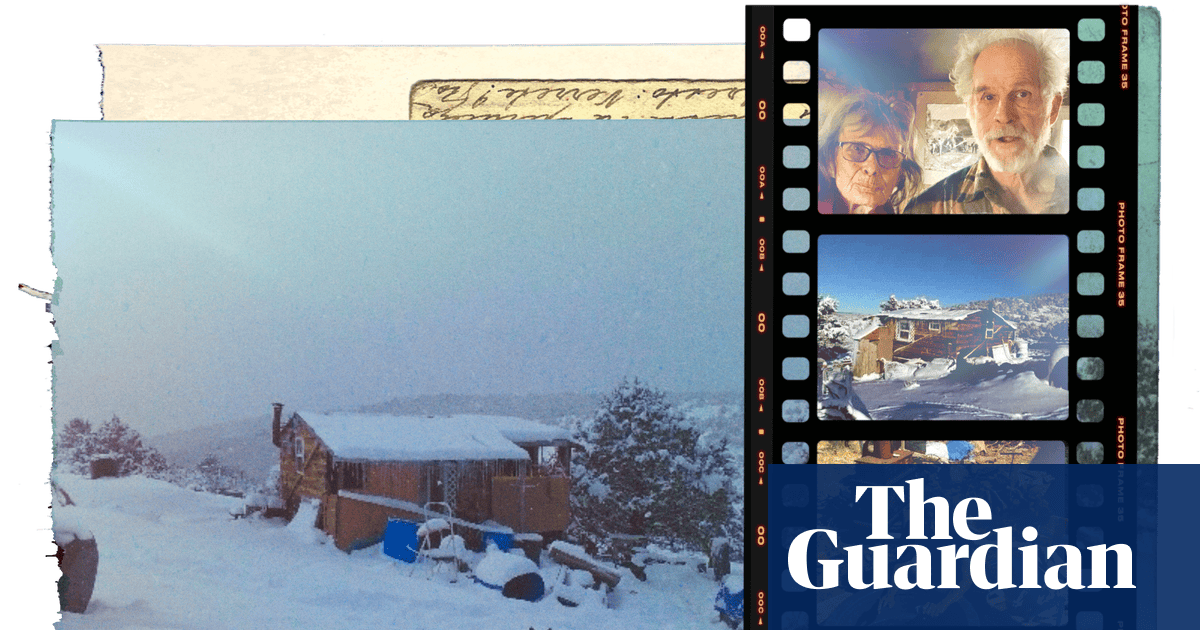
At 62 she had retired and followed him up to a high desert mountain, 6,500ft (1,981 metres) in north-east California. Two and a half hours from the nearest town, their 20 acres (8 hectares) were nothing but dry rock, bitterbrush and a lone juniper here and there, raising a gnarled arm against the horizon.
For 15 years, they lived with no power or plumbing in a 150-sq-ft cabin they had bought off Craigsist – a shack, really, so small there was no room for a couch or dining table so they ate on the bed. She bathed with a basin of warm vinegar water and chose each night whether to squat over a chamber pot or trudge up the hill to the outhouse.
She took pride in her resilience, but her deeper comfort was this: he would never leave her.
But life was getting harder. She was five years older than Mark, and off-grid living was taking more of a toll on her. Her joints ached in the icy mornings, UTIs plagued her. She was losing her teeth.
By the next week, she wrote that she had fallen twice, which persuaded Mark they needed to go to the hospital in Susanville, a five-hour round trip.
Underneath my genuine concern was a deeper fear – that this could be another one of her veiled cries for help. She had had a mystery illness years before, and I had a familiar feeling that there was nothing actually wrong, not physically. Instead, I suspected she had hit the wall again with their grueling life on the mountain.
To declare her existence untenable – to her husband, to me, to anyone – was not an option. Like a house of cards, her entire persona as his ride-or-die partner would collapse. Worst of all, he might tell her to leave, that he would be better off alone. That, for my mother, was unthinkable.
After hours of tests, of blood draws, a CT scan, an EEG, the doctors could not find anything wrong. But she felt dizzy, she insisted. She showed them, taking slow, stumbling steps, leaning on the nurse’s arm like a tipsy dance partner. Maybe she’d had a small stroke? They couldn’t rule it out.
Tossing and turning until after midnight, I finally got a text at 12.20am.
Mom: In AMBULANCE TO RENO
I read the text again, feeling cold, then flushed. I pictured the ambulance reeling across the dark desert night, then across the state line from California to Nevada. Headed to Reno, headed for me.
The next morning, after a stop at Trader Joe’s for a smoothie and a bouquet of flowers, I found Mom in the neurology ward in a room bigger than their cabin. Beside her, the attending nurse typed notes into the standing computer, a giant rolling cart like a mini-office on wheels.
“Oh you’re here! That’s my daughter,” my mother said, clasping her hands to her chest.
She looked shrunken but happy in the imposing hospital bed. She yelped with joy at the flowers and smoothie.
I tried to be honest with the nurse.
“They have no power, no generator, no water. They haul it up in 200-gallon jugs.”
The nurse raised her eyebrows and typed that in. Then she looked at me. “So for showering …”
“Outside in the summer, with a hanging solar-powered bag,” I said, and added – not sure if it would help: “Five gallons.”
“Hmm, and in the winter?”
Mom and I exchanged a glance. “Sponge baths, with vinegar.”
The nurse typed silently as I noted Mom’s hands, wondering if this nurse had seen how dirty they were. How could she not? Later, I would need two washcloths to clean the dug-in dust and dirt. Under her wedding ring, the skin was a darker brown that needed extra scrubbing.
The nurse then asked about the bathroom layout.
“Well, actually, there’s an outhouse.”
A frown appeared briefly. “How far outside?”
About 75ft, Mom told her, then described the narrow path up the slope. I pulled out my laptop at this point, brought in case there was downtime to work, and clicked on a picture. It looked like an upright coffin on the hill.
“See?”
I showed her another one of the inside. Mom craned to look, too, and I noticed how smudgy her glasses were. I dug a lens wipe out of my purse and unwrapped it while the nurse peered at the genuine toilet seat on top of the wooden bench, the coffee can full of lime to sprinkle into the hole, a roll of toilet paper. Mark had made a small shelf that held reading material: a US army survival guide, tattered copies of Better Homes and Gardens and Pioneer Magazine.
“So there’s no handrail …” Her frown was permanent now.
Mom piped up, eager to shift the mood. “Mark can make one. He’ll nail up a branch.”
The nurse nodded as if that was a normal workaround. I would feel the familiar weight of her and others’ judgment over the coming week.
During those hospital visits, I remembered being fascinated about feigned illnesses during war time. In the civil war, since most soldiers had little medical knowledge, they usually faked something familiar, like rheumatism. The war department caught on and ended that by year two. Other common pretended ailments were heart disease, vision problems and hemorrhoids.
For fake paralysis, doctors would attach electrodes to the legs and flip the switch, or press tubes of radium to the skin until it burned. I was impressed by the ingenuity of one soldier who stuffed the heart of a turkey in his rectum to resemble piles. Others swallowed tobacco, causing nausea and vomiting, or coated their tongues with soap or chalk.
To combat these ruses, doctors would give them awful duties such as cleaning vomit and feces so they would think their lot would be better back with their regiment. Another tactic would be to make the treatment worse than the illness, by, for example, applying fly blisters to the spine or dosing them with castor oil.
I had a hunch Mom was doing the same. All the previous week, she had made her own symptoms by drinking just enough to keep herself alive and eating the barest portions. That made her dizzy and caused her falls.
One afternoon after another hospital visit, I tried to figure out why I had been so quiet when it came to Mom and Mark. I could sense the nurses, friends and family members wanting me to confront my mother. I had heard comments like: “Get power of attorney. Call the sheriff. This is elder abuse.”
By defending Mom’s choices, I suppose I was defending myself too. I understood why she and Mark loved the wild. The city jangled my nerves, and I missed small-time life from my youth, so when she wanted to return to their cabin, I understood. Like her, I had sacrificed monetary success for my writing, living a life with few if any luxuries. But I could no longer ignore that there was a cost to the quiet.

Sure enough, the problem with Mom turned out to be hyponatremia, a sodium deficiency due to dehydration. They recommended Gatorade and eight glasses of water every day. This felt more than anticlimactic, and my mother looked chagrined. Then she announced she wanted to be discharged immediately and go to my house. But because the nurses had reported some unsteadiness when they walked her around, she needed to go to the rehab hospital for seven to 10 days.
“What?!” Mom yelled. She shifted on the bed and the alarm blasted, then stopped. “Damn it! I don’t need any more ‘care’. I can fall anytime, anywhere. At my daughter’s, for starters!”
“But you’re weaker now,” one of the nurses pointed out.
Then, to everyone’s astonishment, she got up and danced a jig. The alarm shrieked again.
“See?!” she shouted. “I’m just FINE.”
“Please sit down,” the nurse said, arms out, as the intercom chimed in like the voice of God.
With furious defeat in her eyes, Mom glared at everyone in turn, then folded her arms across her chest. She knew she had to play along, but her patience was cracking like a thin sheet of ice. Below that layer was anger, even rage. That anger was directed at the staff, at the rules, and maybe somewhere deeper, also at herself. She had made a pact with the man she loved decades before, one that had since hardened and encircled her.
When I got home, I made an appointment for my mother with a psychologist who had helped me get through my divorce. It was a long shot, but I hoped when this crying wolf episode was over and Mom was out of rehab, I could convince her to go.
To my surprise, Mom agreed to see Dianna, the psychologist, on her next visit with me in Reno. On the night before the appointment, she took an hour-long hot bath, slipped into the fleece pyjamas I had laid out for her, and snuggled under the red, electric blanket. As always, what she wanted to do was join an Alcoholics Anonymous phone meeting. She loved to spend an hour listening to other people and how they pushed through the challenges of their lives. She put it on speaker, so I could hear the shares from the kitchen, and after a while I could figure out the topic: forgiveness. Fear. Self-pity.
When it was her turn, I listened in the hallway and her tone was off, forced, as if trying to reassure everyone that she was OK up on the mountain. Very fine actually and it’s such an adventure! And yes, of course sometimes she feels sorry for herself, very sorry actually, especially when her fingers are as cold as frozen carrot sticks so she can’t even text her daughter. And yes it gets crazy lonely with no neighbors or visitors. But she has it better than a lot of folks.
“Gratitude,” she said. “That’s what the topic should be next time! Or how about grit!? Now that’s a topic I could get behind.”
These meetings were impossible on the mountain, the signal too sketchy unless you were 200 yards up the road. Mark, though, could get the news he wanted on his cell phone, where he learned how the weather system was being manipulated and wars were brewing and evil people were plotting in windowless rooms in places like the mountains of Switzerland. The banking system was also about to fail, so they needed to get their money from the bank and he would wear it in a money belt around his waist.
“He says it’s going to be like Y2K,” Mom told me. I pointed out that that was a nothing burger.
She cracked up at the phrase, delighted.
“You should tell him that when you get home,” I said. “Hey Mark – chill out! It’s all just a big, fat, juicy nothing burger!”
We laughed so hard Mom spat out her tea.
During Mom’s therapy appointment, I waited at a nearby Starbucks, but having seen Dianna myself, I could imagine it well. I was sure Mom was immediately soothed by the serene decor of the office, the low-bubbling tank with its gently swaying fish, the lavender palette and soft couch pillows. Dianna, a statuesque blonde in her early 60s, was always dressed in flowy silk outfits in muted colors like dusty rose and light gold. Her large eyes brimmed with wise compassion, yet to me she had dispensed firm, sometimes uncomfortable insights. They were just what I needed.
Later at home, I asked Mom how it went.
“Well, she was really dramatic.”
“How so?”
“She diagnosed us with folie à deux.” She chuckled a little, then sighed. “It’s a real diagnosis. But ridiculously rare.”
“I think I’ve heard of it.” I knew from my French that it meant “madness of two”.
“According to Dianna, Mark and I are nuts and I need to get off the mountain. She told me” – and here Mom paused for a beat – “‘One day you will die from this.’”
I took that in, my chest tight. It felt like Dianna had reduced all of my fears into one, blunt sentence – the one I could never bring myself to say to my mother.
“Wow.” I took a deep breath. “She’s very smart, you know. And experienced. What do you think of what she said?”
“Well again, it was a bit dramatic. I’ll have to think about it.”
“Are you going to tell Mark?”
“Probably.”
That night after she went to bed, I spent hours researching folie à deux. I was sucked into a twilight world of deadly codependency that leads to insanity, suicide, murder. I learned that folie à deux is an indeed rare but actual diagnosis in the Diagnostic and Statistical Manual of Mental Disorders (DSM IV), where it is referred to as “Shared Psychotic Disorder”, in which one person develops delusions that mirror another person’s delusions due to a close, long-term relationship. Like a marriage. (If three people share the delusion, it’s a folie à trois.)
Other factors include financial challenges, and it is highly correlated with people who are isolated outsiders. I felt an odd mix of sorrowful vindication: this was what had been happening to them for decades. Then, reading further, I locked on to one of the four subtypes of this disorder: folie induite (imposed psychosis). Unlike folie simultanée (simultaneous psychosis), where both people are equally delusional, with folie induite, one patient takes on another’s delusion.
A flood of memories enveloped me, of Mom defending Mark’s dreams, of her insisting that most people just will not admit that they envy the freedom she and Mark have. That their lives are wondrous and worth the deprivation and sacrifice. That Mark was very wise and knowledgeable.
I searched for treatment – how are these people helped? One line crushed me: “Due to the rarity of this disorder presenting in a clinical setting, the clinical course and prognosis are not fully understood.”
A few months later I headed up for a visit, sleeping in a tent since there was not enough room in the cabin. Mom was proud to show me a sign they had carved and painted, giving their place a name with a mocking acceptance: “Folie A Deux”. I took a picture of them in front of it.
It was clear to me that Mom had chosen her life with Mark, come what may. And I had to accept her choice.
Two years later, by the time Mark relented to see a doctor, cancer had spread much too far. He died a few weeks later.
My mother had a crippling stroke and now lives in a nursing home. The injury damaged her emotional center, so life for her is that of a strange contentment.
I visit her every week and push her in the wheelchair down the shady street. She loves the trees, and sometimes we just stop and rest beneath their reaching branches and shifting shadows. Below us, the roots dig down deep into the earth, grasping and holding on for dear life.
Read the full article on the original source
