


Close Menu
Savannah HeraldSavannah Herald
  • Home
  • News
    • Local
    • State
    • National
    • World
    • HBCUs
  • Events
  • Directories
  • Weather
  • Traffic
  • Sports
  • Politics
  • Lifestyle
    • Faith
    • Senior Living
    • Health
    • Travel
    • Beauty
    • Fashion
    • Food
    • Art & Literature
  • Business
    • Real Estate
    • Entertainment
    • Investing
    • Education
  • Guides
    • Juneteenth Guide
    • Black History Savannah
    • MLK Guide Savannah
We're Social
  • Twitter
  • Facebook
  • YouTube

Subscribe to Updates

Get the latest creative news from FooBar about art, design and business.

Trending
  • Best Kentucky Derby betting apps: How to bet on the Kentucky Derby and where to bet on horse racing
  • IPL 2026: In a first, Delhi Capitals train at BCCI’s CoE
  • Crush Reload, rebranded Orange Crush Returns to Tybee for 2026
  • To Gain Customer—and Employee—Loyalty, Go Beyond Good Enough
  • JaCobian Morgan: From Canton to Jackson to HBCU Champion, Now the NFL Draft
  • At African American Mayors Association Conference, Colin Kaepernick gives glimpse into memoir on his 2016 protest that changed the NFL
  • Georgia Southern University student sales team defends Speed Sell title at national competition
  • Gulfstream’s Skyward event draws global business aviation leaders to Savannah
Facebook X (Twitter) Instagram YouTube
Login
Savannah HeraldSavannah Herald
  • Home
  • News
    • Local
    • State
    • National
    • World
    • HBCUs
  • Events
  • Directories
  • Weather
  • Traffic
  • Sports
  • Politics
  • Lifestyle
    • Faith
    • Senior Living
    • Health
    • Travel
    • Beauty
    • Fashion
    • Food
    • Art & Literature
  • Business
    • Real Estate
    • Entertainment
    • Investing
    • Education
  • Guides
    • Juneteenth Guide
    • Black History Savannah
    • MLK Guide Savannah
Savannah HeraldSavannah Herald
Home » How Babies’ Brains Develop – BlackPressUSA
Health

How Babies’ Brains Develop – BlackPressUSA

Savannah HeraldBy Savannah HeraldApril 14, 20266 Mins Read
Facebook Twitter Pinterest LinkedIn WhatsApp Reddit Tumblr Email
How Babies’ Brains Develop – BlackPressUSA
Share
Facebook Twitter LinkedIn Pinterest Email

Voices, Votes & Vision: The Latest in Politics & Public Policy

Key takeaways
  • Secure attachments with trusted caregivers form the cornerstone of healthy early brain development, linking care and learning in the first 1,000 days.
  • Engage in serve and return interactions and reduce toxic stress, per the Center on the Developing Child.
  • Child care providers and loving caregivers buffer toxic stress and support families facing economic hardship, strengthening infants’ development.
  • Early learning yields lifelong benefits, improving health, education, and earnings; James Heckman highlights top economic returns from earliest investments.

By Katie Dukes, director of early childhood policy, EdNC

 When babies are born, their brains contain billions of neurons. But how those neurons interact — and what they can do as babies grow through childhood into adulthood — is largely shaped by their experiences in the first 1,000 days of life.

The architecture of the brain is built in those first three years, creating a foundation that enables thinking, learning, and adapting over time. More than 85% of adult brain volume is built during this critical period. Luckily, we know exactly what infants and toddlers need to develop healthy brains that will set them up for a lifetime of well-being.

How to Support Brain Development

Decades of research have identified several building blocks that are essential to constructing strong foundations for the brain in the first 1,000 days. 

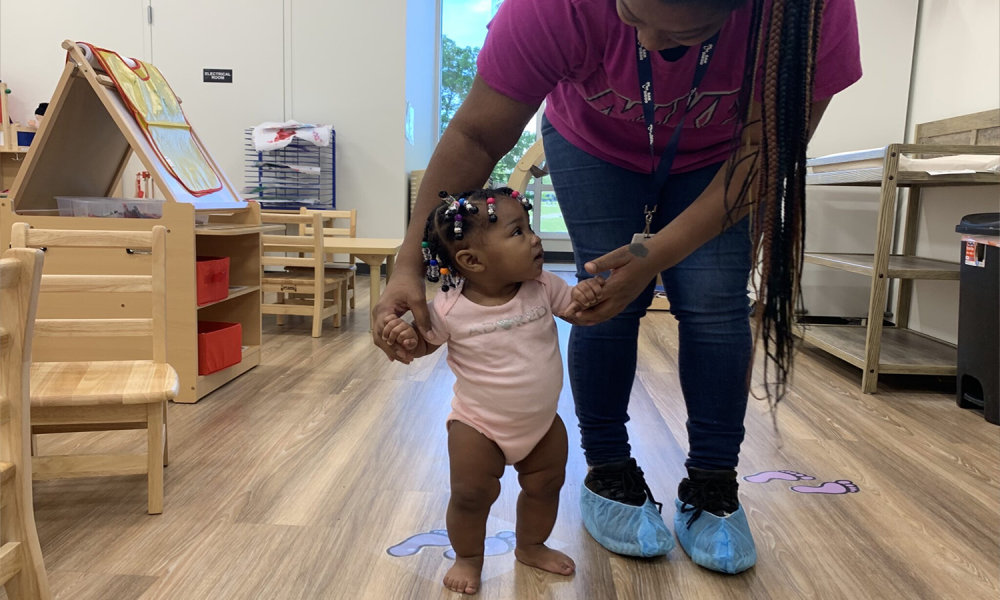
Researchers agree that the cornerstone of healthy brain development is the formation of secure attachments between babies and the trusted and caring adults in their lives. 

Whether these caregivers are parents, kin (including friends and neighbors), or trained early childhood professionals, they should be “knowledgeable about how to support (babies’) development and learning and responsive to their individual progress,” says a report from the National Academies of Sciences, Engineering, and Medicine.

Note the connection between caring and learning. Caring adults are crucial to developing the capacity for learning in the brains of infants and toddlers. In early childhood, care and learning are inseparable.

To strengthen the brain’s capacity for learning in the first 1,000 days, the Center on the Developing Child at Harvard University has identified two key strategies that trusted adults can use — engaging in “serve and return” interactions and minimizing exposure to toxic stress.  As researchers at the center explain, serve and return interactions occur when an infant or toddler “babbles, gestures, or cries, and an adult responds appropriately with eye contact, words, or a hug.”

Engaging in serve and return with caregivers helps babies and very young children build and strengthen neural connections related to communication and social skills in their developing brains.

The absence of consistent serve and return exchanges can release potentially harmful stress hormones into the brains of infants and toddlers. And prolonged exposure to such hormones can result in what is known as “toxic stress.”  Minimizing exposure to toxic stress in the first 1,000 days is crucial for healthy brain development.

According to the Center on the Developing Child, typical causes of toxic stress during this period include “physical or emotional abuse, chronic neglect, caregiver substance abuse or mental illness, exposure to violence, and/or the accumulated burdens of family economic hardship.” But the center also points out that trusting relationships with adult caregivers can act as a buffer against these hardships.

That’s why child care providers — whether they be friends, family, and neighbors, or licensed home-based or center-based caregivers and educators — can be so essential in the lives of families who may be experiencing economic hardships such as food or housing insecurity.

As Dr. Dana Suskind, a pediatric specialist and expert in early childhood brain development, writes in her book Parent Nation, “Loving (adults) do not need a PhD or expensive gadgets to do an excellent job at supporting early brain development and building our future citizens. They need easily acquired, basic knowledge about how to best foster critical neural connections.”

To that end, The Basics is an initiative that uses a public health approach to educate and empower caregivers about their role in healthy brain development. In addition to a wide array of online resources (some available in multiple languages), The Basics offers a printable one-pager that can be posted in homes, classrooms, pediatrician offices, or anywhere else caregivers may find themselves. 

Adults — including policymakers — who embrace the basic building blocks of healthy brain development for infants and toddlers are helping build a foundation that will yield benefits well beyond the first 1,000 days.

Why Support Brain Development

Many people, especially educators who work with children in kindergarten through third grade, can point to early learning as crucial for “school readiness,” but that term can be easily misunderstood. 

In EdNC’s many conversations with elementary educators, the vast majority say school readiness means young children being prepared to participate in group learning. This includes having skills such as developing relationships with trusted adults outside their homes, sitting in a circle or standing in a line with other children, communicating about their wants and needs, sharing objects with others, fine motor control, and knowing a little bit about how to regulate emotions. 

While school readiness may also include some basic academic skills, elementary educators assure EdNC that teaching children how to count, write, and spell is only possible when young learners arrive at school with the social and emotional skills that make them ready to learn. 

And it’s the brain development that occurs in the first 1,000 days that makes this possible.

In addition to helping young students be school-ready, numerous studies have shown that early learning leads to better performance on third-grade math and reading tests.  But the benefits of early learning don’t stop there — they last a lifetime.

Decades of studies have consistently shown that children who receive high-quality early learning have better health, education, and earnings outcomes, and are less likely to be incarcerated or use government assistance programs over the course of their lives.

Nobel prize-winning economist James Heckman found that the highest rate of economic returns comes from the earliest investments in children. More specifically, investment in early care and learning yields a 13% annual return to society. 

As Suskind puts it, “What happens in the first three years of a child’s life has lifelong consequences, for better or for worse. Those years represent an opportunity that won’t come again.”

Babies born today are expected to live for almost eight decades, meaning they’ll likely see the 22nd century. But it’s the care and learning they receive in the next 1,000 days that provide the foundation for what they’ll build for themselves and our society. 

Read the full article on the original site


Atlanta Politics Black Political Leaders Black Political News Civic Engagement Civic Literacy Community Advocacy Democracy in Action Election News Georgia Politics Legislation Updates Local Government Updates Minority Voter Impact Policy and Government Political Opinion Public Policy News Savannah Political News Southern Politics Voter Education VoteSmart Resources Voting Rights
Share. Facebook Twitter Pinterest LinkedIn WhatsApp Reddit Tumblr Email
Savannah Herald
  • Website

Related Posts

Politics April 14, 2026

At African American Mayors Association Conference, Colin Kaepernick gives glimpse into memoir on his 2016 protest that changed the NFL

Health April 14, 2026

Best Mental Health Apps for Anxiety and Stress Management

Entertainment April 14, 2026

Every Must-See Look From Coachella Weekend 1

State April 14, 2026

Lance Bottoms hosts roundtable for Georgia healthcare reform

Health April 14, 2026

Iran war has some US water utilities facing a fluoride shortage

Health April 13, 2026

5 Ways to Put Your Health Dollars to Work This Spring

Comments are closed.

Don't Miss
Education February 4, 2026By Savannah Herald06 Mins Read

Digital Education Tools in Caribbean Schools

February 4, 2026

Global Black Voices: News from around the World Digital Education Tools in Caribbean Schools :…

Obituary | Betty Ann Milligan of Savannah, Georgia

December 15, 2025

Obituary | Reverend John Williams, Jr. of Hinesville, Georgia

December 15, 2025

Vacation disagreements with your bigoted uncle

December 5, 2025

Obituary | Lucius “Brown” Bilal, Jr. of Havelock, North Carolina

December 15, 2025
Archives
  • April 2026
  • March 2026
  • February 2026
  • January 2026
  • December 2025
  • November 2025
  • October 2025
  • September 2025
  • August 2025
  • July 2025
  • June 2025
  • May 2025
  • April 2025
  • March 2025
  • February 2025
  • January 2025
  • December 2024
Categories
  • Art & Literature
  • Beauty
  • Black History
  • Business
  • Climate
  • Education
  • Employment
  • Entertainment
  • Faith
  • Fashion
  • Food
  • Gaming
  • Georgia Politics
  • HBCUs
  • Health
  • Health Inspections
  • Home & Garden
  • Investing
  • Local
  • Lowcountry News
  • National
  • National Opinion
  • News
  • Obituaries
  • Politics
  • Real Estate
  • Science
  • Senior Living
  • Sports
  • SSU Homecoming 2024
  • State
  • Tech
  • Transportation
  • Travel
  • World
Savannah Herald Newsletter

Subscribe to Updates

A round up interesting pic’s, post and articles in the C-Port and around the world.

About Us
About Us

The Savannah Herald is your trusted source for the pulse of Coastal Georgia and the Low County of South Carolina. We're committed to delivering timely news that resonates with the African American community.

From local politics to business developments, we're here to keep you informed and engaged. Our mission is to amplify the voices and stories that matter, shining a light on our collective experiences and achievements.
We cover:
🏛️ Politics
💼 Business
🎭 Entertainment
🏀 Sports
🩺 Health
💻 Technology
Savannah Herald: Savannah's Black Voice 💪🏾

Our Picks

SAA Girls Cross Country Team Wins State Championship, Boys Team Places 4th

November 20, 2025

Battle for the ballot NABJ Black News & Views

August 28, 2025

New Amplifiers Increase Atacama Big Millimeter Selection

January 12, 2026

Kemp’s choice to not run for Senate leaves GOP subject open in opposition to Ossoff

February 28, 2026

Hen Salad – Jehan Can Prepare

August 28, 2025
Categories
  • Art & Literature
  • Beauty
  • Black History
  • Business
  • Climate
  • Education
  • Employment
  • Entertainment
  • Faith
  • Fashion
  • Food
  • Gaming
  • Georgia Politics
  • HBCUs
  • Health
  • Health Inspections
  • Home & Garden
  • Investing
  • Local
  • Lowcountry News
  • National
  • National Opinion
  • News
  • Obituaries
  • Politics
  • Real Estate
  • Science
  • Senior Living
  • Sports
  • SSU Homecoming 2024
  • State
  • Tech
  • Transportation
  • Travel
  • World
  • Privacy Policies
  • Disclaimers
  • Terms and Conditions
  • About Us
  • Contact Us
  • Opt-Out Preferences
  • Accessibility Statement
Copyright © 2002-2026 Savannahherald.com All Rights Reserved. A Veteran-Owned Business

Type above and press Enter to search. Press Esc to cancel.

Manage Consent
To provide the best experiences, we use technologies like cookies to store and/or access device information. Consenting to these technologies will allow us to process data such as browsing behavior or unique IDs on this site. Not consenting or withdrawing consent, may adversely affect certain features and functions.
Functional Always active
The technical storage or access is strictly necessary for the legitimate purpose of enabling the use of a specific service explicitly requested by the subscriber or user, or for the sole purpose of carrying out the transmission of a communication over an electronic communications network.
Preferences
The technical storage or access is necessary for the legitimate purpose of storing preferences that are not requested by the subscriber or user.
Statistics
The technical storage or access that is used exclusively for statistical purposes. The technical storage or access that is used exclusively for anonymous statistical purposes. Without a subpoena, voluntary compliance on the part of your Internet Service Provider, or additional records from a third party, information stored or retrieved for this purpose alone cannot usually be used to identify you.
Marketing
The technical storage or access is required to create user profiles to send advertising, or to track the user on a website or across several websites for similar marketing purposes.
  • Manage options
  • Manage services
  • Manage {vendor_count} vendors
  • Read more about these purposes
View preferences
  • {title}
  • {title}
  • {title}
Ad Blocker Enabled!
Ad Blocker Enabled!
Our website is made possible by displaying online advertisements to our visitors. Please support us by disabling your Ad Blocker.

Sign In or Register

Welcome Back!

Login below or Register Now.

Lost password?

Register Now!

Already registered? Login.

A password will be e-mailed to you.