




Global Black Voices: News from around the World
- Israel's blockade systematically blocks humanitarian aid, causing preventable disease and malnutrition; the UN-backed IPC has declared famine in Gaza City.
- International law classifies starvation as a war crime; the ICC has indicted Israeli leaders for using starvation as a method of warfare.
- Israel's campaign is unique: entirely human-made, rigorous and sustained, enabled by control over borders and strict inspection of aid.
- Gaza Humanitarian Foundation backed by Israel and the US shrank safe distribution, with deadly incidents at aid sites and restricted UN NGO operations.
“We are imposing a complete siege on [Gaza]. No electricity, no food, no water, no fuel — everything is closed. We are fighting human animals and we must act accordingly.”
That was Yoav Gallant, then the Israeli defense minister, two days after Hamas’s attack on October 7, 2023, killed some 1,200 Israelis and took 250 more hostage. The following week, Israel’s national security minister, Itamar Ben-Gvir, echoed a similar sentiment: “So long as Hamas does not release the hostages,” he posted on X, “the only thing that should enter Gaza is hundreds of tons of air force explosives — not an ounce of humanitarian aid.”
Israel, in other words, did not engineer a famine in Gaza overnight. From the war’s outset, Israel has been blocking humanitarian aid from entering the Gaza Strip, to varying degrees, resulting in the spread of preventable diseases, including malnutrition, across the territory. In fact, since late 2023, international organizations have been warning that Gaza has been on the brink of famine. In April of last year, Save the Children confirmed that children had been dying from starvation. And now, the UN-backed Integrated Food Security Phase Classification (IPC) — the world’s leading authority on hunger crises — has officially determined that there is a famine in Gaza City and its surrounding areas, adding a warning that famine will rapidly spread to other parts of the Gaza Strip without immediate intervention.
So why is it that it took this long for the world to turn its attention to this humanitarian disaster?
Part of the answer is that in recent weeks, the situation really has gotten much more dire, after Israel ended its 42-day ceasefire with Hamas in March and stopped allowing any aid into Gaza for two months, as my colleague Joshua Keating recently wrote.
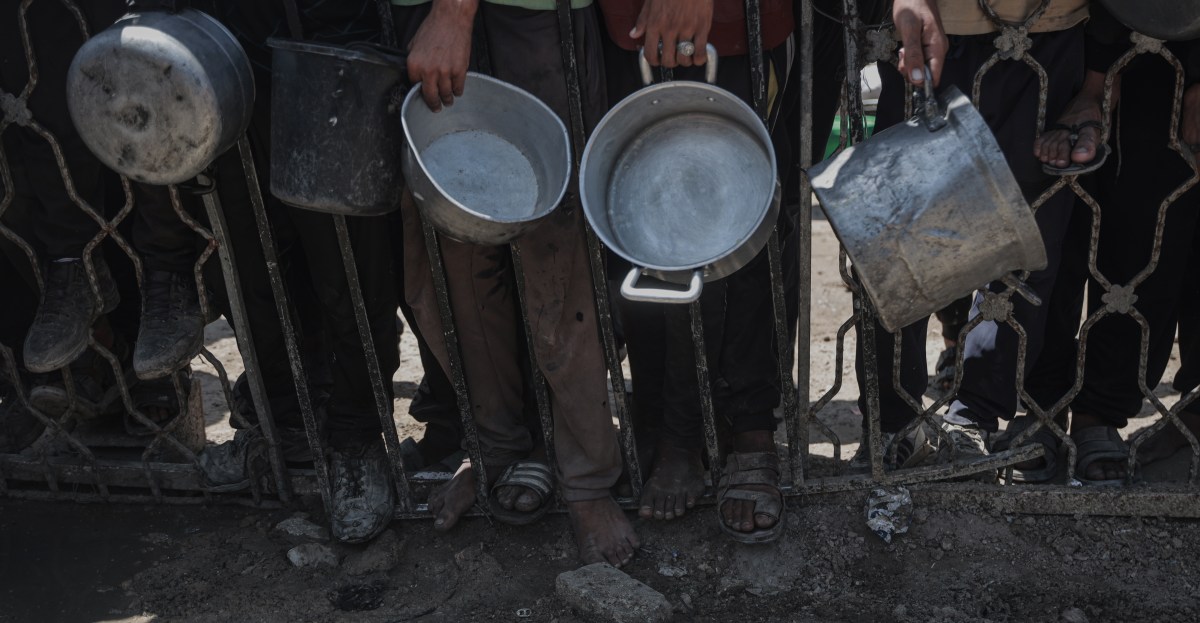
But there’s another factor: The images coming out of Gaza have been absolutely heart-wrenching. Photos and videos have gone viral — on news sites and on social media — clearly showing malnourished babies starving to death, as well as those showing children and adults with their skin clinging to their bones with barely anything in between. “It is tragic that it takes those types of really graphic, really horrible images to break through,” said Alex de Waal, an expert on famine who serves as the executive director of the World Peace Foundation at Tufts University. “And that is such a terrible commentary on just a gargantuan failure.”
This, of course, is nowhere near the first time horrific images from Gaza have surfaced and sparked outrage around the world. But there’s something about the visibility of a human-made famine that, for many people — including some of Israel’s most ardent supporters — crosses a moral threshold.
Starving an entire population cannot be spun as collateral damage or merely the cost of war — a messaging tactic that Israel has turned to to justify its killing of innocent people despite plenty of evidence that it has routinely targeted civilians. “You can’t starve anyone by accident. It has to be deliberate and sustained,” de Waal said. “It is beyond dispute that you have to starve people systematically because it takes so long.”
Indeed, Israel’s use of starvation as a weapon of war has been well-documented by human rights organizations since 2023, and both Gallant and Israeli Prime Minister Benjamin Netanyahu have been indicted for war crimes by the International Criminal Court, including the use of starvation as a method of warfare.
Israel’s mass starvation of Gaza is, by definition, a form of collective punishment — imposing potentially fatal consequences on every Palestinian living in the enclave, whether they are a combatant or an innocent civilian. That’s why using starvation as a weapon of war is illegal under international law.
But that wasn’t always the case. What Israel is doing is part of a long history of weaponizing food and basic resources. Still, while there are many examples of countries intentionally creating or exacerbating famine conditions on populations, there are also aspects of Israel’s current policies in Gaza that are unique.
How countries have used starvation as a weapon of war
Using starvation as a weapon of war wasn’t always explicitly illegal under international law. The siege of Leningrad by the Nazis and their allies, which lasted from 1941 to 1944, was one of the deadliest sieges in history, killing more than 1 million people.
Many of these deaths were attributed to starvation. An American-run tribunal, however, determined that the forced starvation was compatible with international law. After all, it was a tactic that the Allies themselves had used as well, notably in their blockades of German-occupied territories and in Japan.
There are many examples throughout history of famines that were either entirely engineered or deliberately made worse through reckless colonial and war policies. In 1943, as the British empire’s colonial rule of the Indian subcontinent was nearing its end, the Bengal famine killed up to 3 million people.
Since then, studies have uncovered scientific evidence that the famine was not a result of climate conditions like serious drought. Instead, British policies, under Prime Minister Winston Churchill — which included confiscating rice and boats from the coastal parts of Bengal and exporting rice from India to other parts of the empire — seriously exacerbated famine conditions. Churchill denied this, saying that the reason there was a famine was because Indians were “breeding like rabbits” and suggesting that if the situation was indeed as dire as people claimed, then Mahatma Gandhi would be dead.
Another example is the Holodomor, the famine that killed millions of Ukrainians under the Soviet Union in the early 1930s. Joseph Stalin pursued a range of policies that engineered famine conditions — including restricting the movement of people, seizing grain even when there wasn’t enough to feed the local population, and exporting grain even as Ukrainians starved — in part, historians argue, to tamp down Ukrainian nationalist movements. Several countries and scholars have since recognized the famine as an act of genocide.
The US also used blockades as a means to advance its war interests. One of its military campaigns against Japan during World War II was named “Operation Starvation” — which aimed to destroy Japan’s economy by limiting the distribution of food and other imports. The military assault deprived Japan of essential raw materials and led to food shortages. That, along with naval blockades and America’s destruction of agricultural infrastructure contributed to widespread malnutrition and starvation.
It was only after World War II that the Geneva Conventions of 1949 established some rules about the responsibility to allow food and other essentials into enemy territory for vulnerable populations. But even then, by and large, starvation tactics were still permissible.
“The reason it was permitted was because the Americans and the British rather liked using it,” de Waal said. “It really wasn’t until the British and the Americans had abandoned their colonial wars — the American one being Vietnam in the ’70s — that they thought, ‘Okay, now we’re not going to fight these kinds of wars, and we can get around to banning it.’”
The Additional Protocols to the Geneva Conventions, which were agreed to in 1977, finally prohibited the “starvation of civilians as a method of warfare [or combat].” And just over 20 years later, in 1998, the Rome Statute of the International Criminal Court officially codified weaponizing starvation as a war crime.
How Israel’s starvation of Gaza is different
Any food shortages in Gaza have been directly triggered by the Israeli siege, not by any market failures or climate disasters, since Israel has the capacity to allow more food in at a moment’s notice.
“Here, what we see is all the ingredients coming together in a deliberate way. We see the [Israeli leaders’] statements; we see the total bombing of all the food production,” said Neve Gordon, a professor of human rights law at Queen Mary University of London. “I don’t think there’s [another] case in history, because other cases had to do with other stuff going on that were not human-made. Here, the whole starvation — from beginning to end — is human-made.”
Israel has also significantly limited traditional aid groups’ operations and, for months, entirely blocked aid from entering Gaza. Generally, UN-coordinated aid providers, which include UN agencies and established NGOs, have been able to enter and operate in war zones.
But since the ceasefire ended in March, Israel has placed unprecedented constraints on those organizations. Instead, since May, Israel has been coordinating with the Gaza Humanitarian Foundation (GHF), a newly formed US- and Israel-backed private entity that operates militarized distribution sites in central and southern Gaza.
GHF has denied that its system is unsafe. But it operates far fewer distribution sites than experts recommend — dramatically decreasing the number of aid sites that were in place before Israel instituted its total blockade in March, making it more and more difficult for Palestinians to access food.
Israeli troops have also shot at aid-seekers at GHF’s distribution sites, and, according to the UN, some 1,000 Palestinians have been killed trying to get aid from GHF. Gordon calls GHF “a famine profiteering company,” adding that it “does not actually provide the necessary food, while producing these hunger games that everyone was watching, [showing] starving people are going to get food and getting shot at.”
Israeli government officials have defended GHF and instead blamed Hamas for the food shortages, accusing the group of looting humanitarian supplies despite Israeli military officials saying that there’s no proof that Hamas has systematically stolen aid. But the UN and many NGOs have called for GHF to be shut down, calling it dangerous and ineffective — a departure from established international humanitarian relief systems and a rejection of basic humanitarian principles.
While Egypt has been complicit in enforcing the blockade through its border with Gaza, the reality is that even aid going into Gaza through the Egyptian border has to go through Israeli inspection. The result is that Israel has effectively vacuum-sealed Gaza, with full control of what aid gets in.
Israel could have chosen to prevent a famine at any point. Instead, it has repeatedly hampered or entirely rejected efforts to deliver life-saving aid to Palestinians — all in contravention of international law. “Israel is not unique at all in using hunger as a weapon of war,” de Waal said. “What is unique about the Israeli one is just how rigorous and how sustained it is, and how it is in defiance of an international humanitarian capacity that can respond just like that. So if Netanyahu wanted every [child in Gaza] to have breakfast tomorrow, it can be organized.”
One example of Israel’s (and the world’s) capacity to stop the worst from happening is the polio vaccination campaign that happened last year. When polio — which had been eradicated from Gaza for 25 years — resurfaced as a result of the humanitarian and sanitation crisis imposed by Israel’s war, governments around the world pressured Israel to agree to a humanitarian pause in combat, in order to vaccinate children across the Gaza Strip. In the middle of the war, the vaccination campaigns were successful, reaching 95 percent of the target population. An effort to stop malnutrition can be similarly efficient.
The faster Israel relents and allows unimpeded aid delivery, the more lives can be saved. But unfortunately, it’s already too late for far too many Palestinians in Gaza. “Even if there was divine intervention — and we had a ceasefire and the best doctors and the right kind of food — I think we’d still have hundreds [or] thousands of deaths,” Gordon said. “But we’re not going to have that divine intervention.”
Update, August 22, 10:10 am ET: This article was originally published on August 7, 2025, and has been updated to include news of the IPC’s classification of famine in Gaza.
Read the full story from the original publication
