




Nonprofit Spotlight – Making a Difference in Our Community:
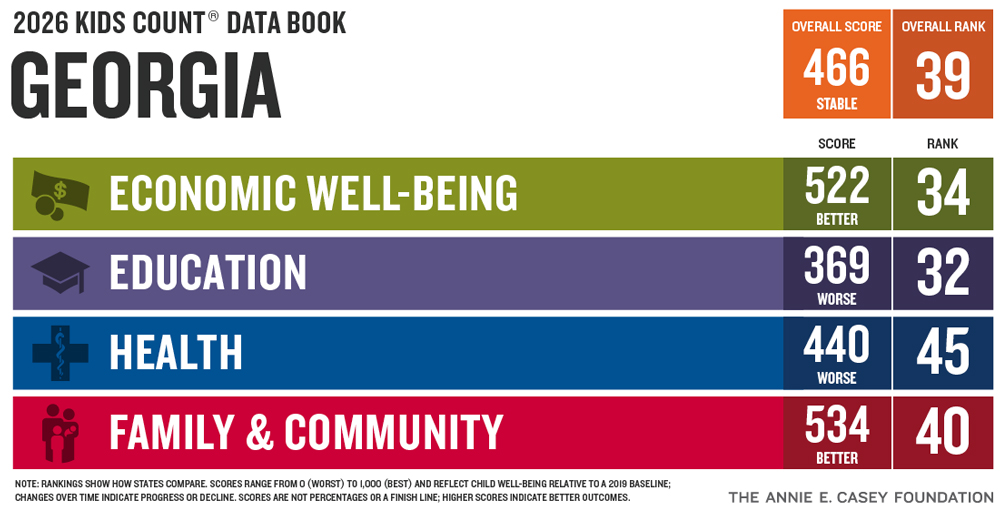
- Overall, Georgia ranks 39th in child and family well-being; new KIDS COUNT scoring shows a slight decline since 2019.
- Health outcomes worsened, with Georgia falling to 45th and child and teen deaths rising by 17% since 2019.
- Economic well-being improved to 34th as child poverty fell to 16%, yielding about 56,000 fewer children in poverty.
- Education held at 32nd, yet 70% of fourth graders are below proficient in reading and math proficiency declined for eighth graders.
- Family and community stayed at 40th; concentrated high-poverty areas remained unchanged and single-parent household rates remain high.
Georgia Ranks 39th in the Nation for Child and Family Well-Being
Health Setbacks Overshadow Economic Gains as Georgia Slips in New Index
Child and teen deaths surge faster than the national rate; low birthweight ticks up; and population of uninsured children rise—even as fewer children are living in poverty and economic conditions improve.
Georgia ranks 39th out of 50 states for overall child and family well-being, according to the 2026 KIDS COUNT® Data Book, released today by the Annie E. Casey Foundation.
For the first time, the publication includes a new scoring methodology in addition to rankings, making it easier to track whether outcomes for children and families are improving or worsening over time. While Georgia held steady from last year’s published rank at 39th, our state’s score declined slightly, indicating that child well-being worsened modestly compared with the previous report. That downward trend continues a gradual slide from the state’s highest-ever ranking of 37th in 2023 and 2024.
Georgia ranked 48th in the inaugural KIDS COUNT® Data Book, released in 1990, and has not been among the bottom 10 states since 2017—but recent progress has stalled. The state’s challenges are most evident in health outcomes, where Georgia fell six places to 45th, even as gains in economic well-being improved three spots to 34th.
“When we dig into the data and look at how states are clustered, Georgia can either take action and make meaningful gains or maintain the status quo and regress further—dropping us into the bottom 10,” said Georgia Family Connection Partnership (GaFCP) Data Manager Jacquan Jordan. “Given this data story and how quickly our state is evolving, our call to action is clear. We must look beyond the surface, because when we peel back the layers of the data, we discover hard-working Georgians who are living on the edge.”
The KIDS COUNT® Data Book uses 16 indicators to rank each state across four domains—health, education, economic well-being, and family and community—to assess child and family well-being. The 2026 Data Book also introduces a new scoring system (0 – 1,000 scale) alongside traditional rankings, anchored to 2019 pre-pandemic baselines.
Georgia’s story is one of contrasts. The state made its most significant gains in economic well-being—with child poverty falling and teen employment improving. However, those gains were overshadowed by a sharp regression in health outcomes and continued struggles in education. Trends in family and community show modest improvement, though Georgia remains entrenched near the bottom of national rankings in that domain.
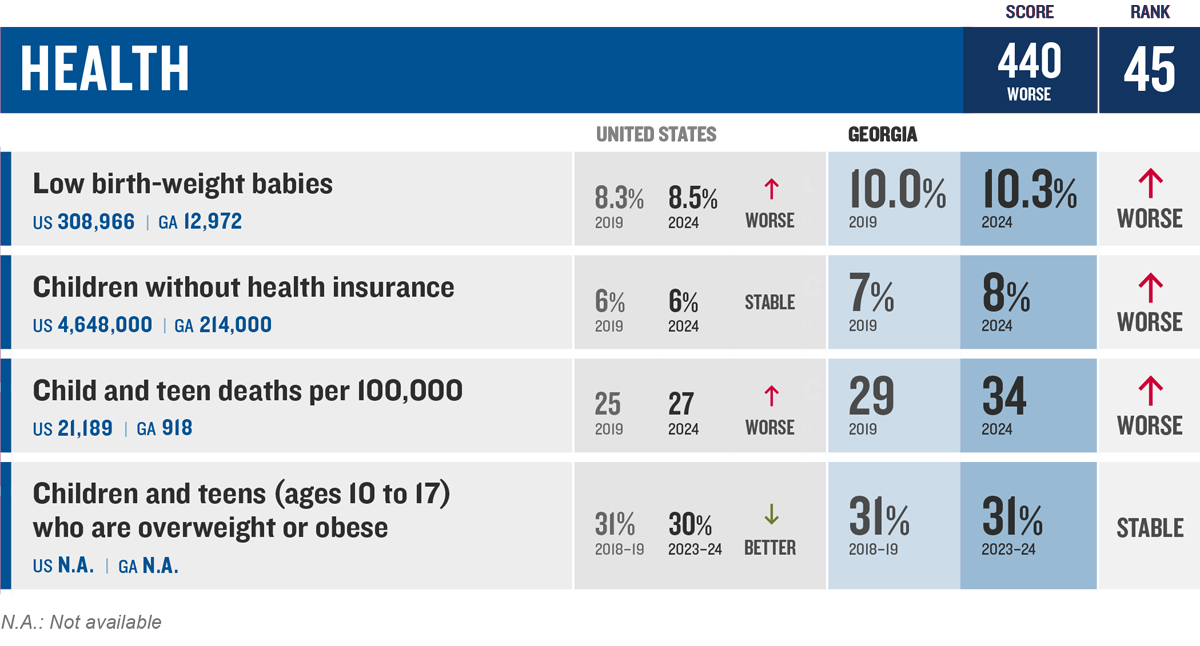
Georgia’s sharpest setback is in the health domain, where the state fell six places to 45th—our state’s lowest health ranking in recent years. The drivers are consistent and alarming: a persistently high low-birthweight rate, an accelerating child and teen death rate, and a growing population of uninsured children.
“Unfortunately, I’m not surprised by these setbacks,” said April Hartman, MD, FAAP, division chief of General Pediatric and Adolescent Medicine and vice chair for Advocacy at the Medical College of Georgia, Augusta University. “Georgia’s decline in child health outcomes reflects challenges too many vulnerable families experience every day. Children’s health is shaped by more than what happens in a doctor’s office. When families struggle with access to care, housing, food, transportation, or mental health support, those challenges affect child well-being. Improving outcomes will require investments that address the whole child and the whole family.”
One disturbing trend in Georgia’s health data is the rising child and teen death rate. Georgia recorded 151 more deaths of children ages 1 to 19 in 2024 than in 2019—a 17% increase. The national child and teen death rate also increased, but at a slower pace of 8%. Georgia’s death rate is rising at more than twice the national rate of increase.
After a brief dip in 2023, Georgia’s low-birthweight rate climbed back to 10.3% in 2024—a 3% increase in the number of low-birthweight babies from 2019. Georgia continues to rank among the worst states nationally on this indicator and remains well above the national average of 8.6%. Low birthweight is the strongest predictor of infant mortality and a leading indicator of women’s overall health.
The number of children in Georgia without health insurance increased by 43,000 in 2024 compared to the previous year—reversing years of progress. Since 2019, Georgia has seen a 14% increase in its uninsured child population.
Georgia’s rate of teens ages 10 to 17 who are overweight or obese edged up slightly to 31% in 2023 – 2024 from 30% in 2022 – 2023. This indicator is tracked through the National Survey of Children’s Health and reflects longer-term trends in physical health and nutrition for Georgia’s young people.
“We often talk about innovation, but we need solutions that produce measurable results for children and families,” said Hartman. “Lasting progress will come from working together—bringing communities, providers, educators, and policymakers to the same table to listen to communities, address
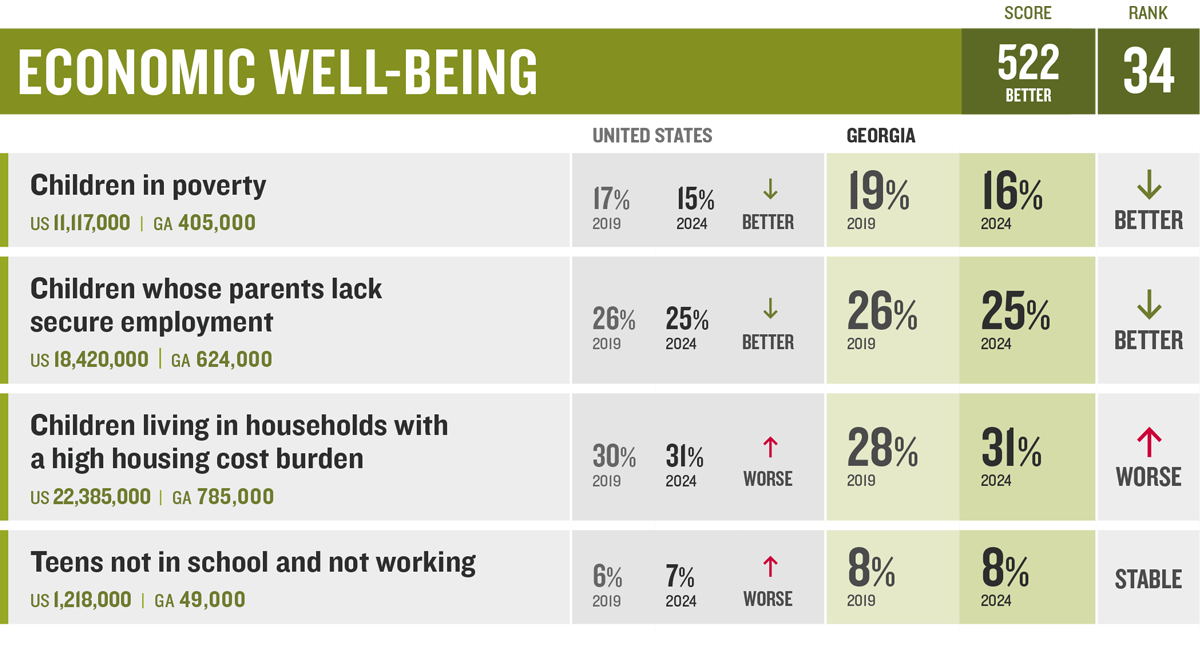
Georgia saw its strongest improvement in the economic well-being domain, improving two spots from 36th to 34th—driven primarily by a significant reduction in child poverty.
The percentage of children living in poverty in Georgia fell to 16% in 2024, down from 19% in 2019—a decline that represents 56,000 fewer children living in poverty over five years. This brings Georgia in line with the national average of 15% and marks one of the most meaningful improvements the state has recorded on any indicator.
Georgia also held ground on parental employment: the share of children in families where no parent has full-time, year-round employment remained at 25% in 2024, a slight improvement from 2023, 2022, and the 2019 baseline of 26%. Georgia continues to track closely with the national rate.
The number of Georgia teens ages 16 to 19 not in school and not working was 45,000 in 2024, a 13% improvement from 48,000 in 2019. This runs counter to the national trend, where this population increased by 17%—representing 53,000 additional youth disconnected from school and the workforce nationwide in the same time span.
Housing costs remain a persistent challenge. The number of children in households spending more than 30% of income on housing increased by 74,000 children between 2019 and 2024, reaching 785,000 children—an 11% increase over five years.
“Year after year, Georgia businesses share that one of their top workforce concerns is housing access and affordability for their employees,” said Georgia Chamber Foundation Executive Director Daniela Perry. “Homeownership is a proven wealth generation tool that is not possible for too many families at present. The KIDS COUNT® data provide direction for strategic investments to promote long-term economic prosperity for Georgia families.”
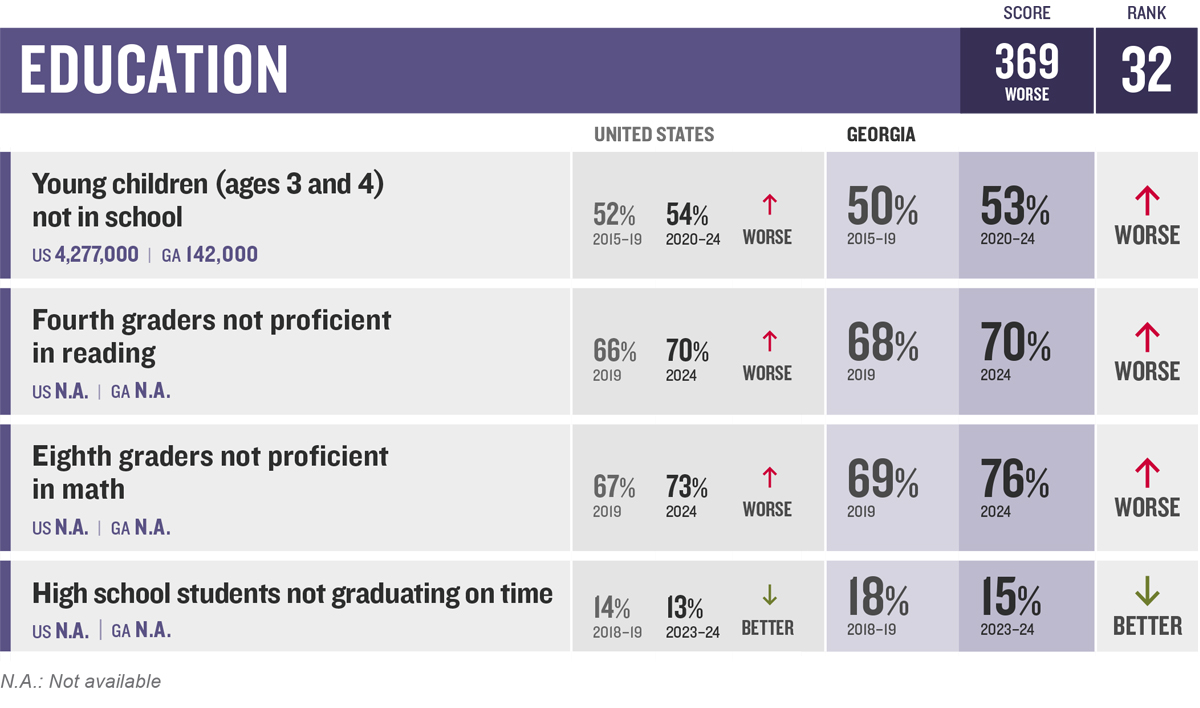 Georgia’s education ranking remained steady, holding at 32nd. However, that stability masks continued and, in some cases, worsening performance on underlying indicators. Georgia’s plateau in education reflects a broader national trend of post-pandemic learning loss.
The percentage of fourth graders scoring below proficient in reading was 70% in 2024, matching last year’s level and representing a 3% increase from the 2019 baseline of 68%. While Georgia’s rate aligns with the national average, it underscores the urgency of early literacy intervention. Research consistently links fourth-grade reading proficiency to high school graduation, future earning potential, and long-term health outcomes.
Access to preschool showed a slight decline. The percentage of children ages 3 and 4 not attending preschool increased to 53% in the 2020–24 school year, up 50% from 2015 to 2019 and ranking Georgia 14th nationally.
Math proficiency continues to deteriorate. The percentage of Georgia’s eighth graders scoring below proficient in math reached 76% in 2024, compared to 73% nationally and up from 69% in 2019—a 10% increase over five years. This is among the most concerning trends in Georgia’s education data.
Georgia made measurable progress in high school graduation rates. The percentage of students not graduating on time fell from 18% in the 2018–19 school year to 15% in 2023–24—a 17% improvement. The national rate declined from 14% to 13% over the same period. Georgia improved faster than the nation but continues to lag the national benchmark.
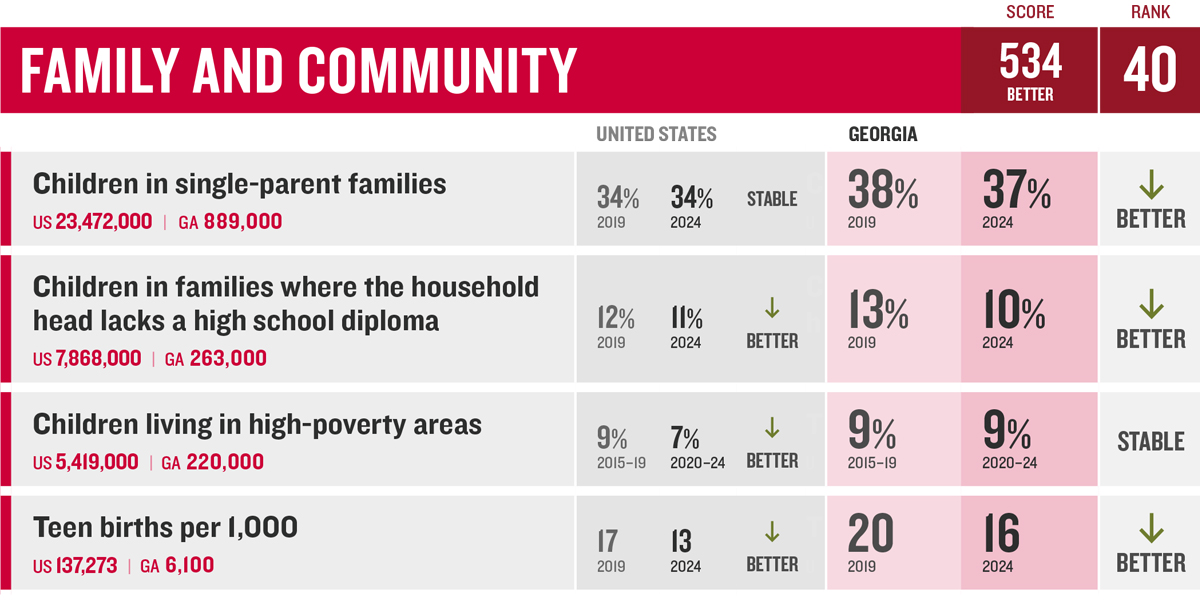 Georgia’s ranking in the family and community domain remained unchanged at 40th, keeping the state in the bottom 20 nationally. The lack of movement reflects persistent challenges across several indicators, particularly the percentage of children living in high-poverty areas, which has remained largely unchanged over time.
The teen birth rate in Georgia fell to 16 births per 1,000 females ages 15 to 19 in 2024, down from 17 in 2023. Georgia has recorded a 20% reduction in teen births since 2019, representing approximately 990 fewer teen births in 2024 compared to 2019. This is a meaningful public health win, though Georgia’s rate still exceeds the national average.
The percentage of children living in single-parent families in Georgia was 37% in 2024, continuing to outpace the national rate of 34%. This indicator has shown little change in recent years and remains a challenge for Georgia families.
The percentage of children in families where the household head lacks a high school diploma fell to 10% in 2024, representing 29,000 fewer children in that setting compared to the previous year. While short-term progress is occurring, the longer-term trend remains stubbornly slow with this figure improving by only 2% since 2019.
The share of children living in high-poverty areas (census tracts with poverty rates of 30% or more) held steady at 9%, unchanged between the 2019 – 2023 and 2020 – 2024 estimates. Georgia has made no progress on concentrated poverty over five years—a challenge that disproportionately affects black and Latino children in urban and rural communities.
“Georgia is at a crossroads,” said GaFCP Executive Director Gaye Smith. “We have an opportunity to make significant gains—or risk falling further behind. The path we take depends on the choices we make today. We’ve seen that Georgians can reap benefits when public and private partners work together and make significant investments like those we’ve made in education. Now it’s time to expand that work to other areas of family and community well-being so we can build a Georgia that will prosper for generations to come.”
Download the 2026 KIDS COUNT® Data Book.
Explore the interactive 2026 Data Book.
Download the 2026 Georgia Data Profile.
Download the 2026 Georgia Profile in Spanish.
Journalists interested in creating maps, graphs, and rankings in stories about the 2026 Data Book can visit our Georgia KIDS COUNT page.
A New Way to Measure Progress: Updated KIDS COUNT® Methodology
For the first time, the 2026 Data Book includes both scores and rankings for each state, overall and by domain. Scores are reported on a 0 – 1,000 scale, where higher values indicate better outcomes for children. They’re anchored to 2019, the last full year before the COVID-19 pandemic. This allows comparisons over time—not just across states in a single year, but also in whether outcomes are improving or declining.
The four domains, 16 indicators, and equal weighting of indicators within each domain remain the same.
What’s new are the scores that show how far apart states really are in their outcomes for child and family well-being, and the level of progress each state has made since 2019. The U.S. received an overall score of 547 out of 1,000.
Why This New Lens Matters for Georgia
Under the updated methodology, Georgia’s 2025 ranking published as 39th would have been 38th. With 2024 data, Georgia now ranks 39th, reflecting negative changes in outcomes for Georgia’s children—not simply shifts in how other states performed. The scores make clear that Georgia has room for improvement in every domain, particularly health, and that the state’s plateau in rankings masks underlying ground lost since 2019 in areas like education.
Download An Updated Methodology for the KIDS COUNT® Index.
Contact:
Bill Valladares
GaFCP Communications Director
404-739-0043
william@gafcp.org
Krystin Dean
GaFCP Communications Specialist
706-897-4711
krystin@gafcp.org
Georgia Family Connection Partnership (GaFCP) is a public-private partnership created by the State of Georgia and investors from the private sector to assist communities in addressing the serious challenges facing children and families. GaFCP also serves as a resource to state agencies across Georgia that work to improve the conditions of children and families. Georgia KIDS COUNT provides policymakers and citizens with current data they need to make informed decisions regarding priorities, services, and resources that impact Georgia’s children, youth, families, and communities. Georgia KIDS COUNT is funded, in part, through a grant from The Annie E. Casey Foundation, a private charitable organization dedicated to helping build better futures for disadvantaged children in the United States. Visit gafcp.org.
The Annie E. Casey Foundation creates a brighter future for the nation’s children by developing solutions to strengthen families, build paths to economic opportunity and transform struggling communities into safer and healthier places to live, work, and grow. Visit aecf.org. KIDS COUNT® is a registered trademark of The Annie E. Casey Foundation.
Read more on the original source
