



Close Menu
Savannah HeraldSavannah Herald
    • Home
    • News
      • Local
      • State
      • National
      • World
      • HBCUs
    • Events
    • Directories
    • Weather
    • Traffic
    • Jobs
    • Sports
    • Politics
    • Lifestyle
      • Faith
      • Senior Living
      • Health
      • Travel
      • Beauty
      • Fashion
      • Food
      • Art & Literature
    • Business
      • Real Estate
      • Entertainment
      • Investing
      • Education
    • Guides
      • Back to School Savannah
      • Summer Camp Guide
      • Juneteenth Guide
      • Black History Savannah
      • MLK Guide Savannah
    We're Social
    • Twitter
    • Facebook
    • YouTube

    Subscribe to Updates

    Get the latest creative news from FooBar about art, design and business.

    Trending
    • India’s first privately-developed rocket reaches orbit on dramatic debut launch
    • Taylor Farms Expands Iceberg Lettuce Recall to 27 States Amid Cyclospora Outbreak
    • Oil Prices Cross $90 a Barrel as U.S.-Iran Conflict Widens
    • Spain 1 – 0 Argentina
    • Sarah Downs Equips NASA’s Robots With Assembly Skills
    • How to watch the World Cup final, live stream for free around the world
    • Nolan’s ‘The Odyssey’ Brings in $124.5 Million at the Box Office on Opening Weekend
    • Taco Stuffed Zucchini Boats with Ground Beef and Rice
    Facebook X (Twitter) Instagram YouTube
    Login
    Savannah HeraldSavannah Herald
    Savannah HeraldSavannah Herald
    Home » Software engineer on the real state of AI agents (they’re not there yet)
    Tech

    Software engineer on the real state of AI agents (they’re not there yet)

    Savannah HeraldBy Savannah HeraldJune 30, 20265 Mins Read
    Facebook Twitter Pinterest LinkedIn WhatsApp Reddit Tumblr Email
    Software engineer on the real state of AI agents (they
    Share
    Facebook Twitter LinkedIn Pinterest Email

    Tomorrow’s Tech, Today: Innovation That Moves Us Forward

    Key takeaways
    • Utkarsh Kanwat warns compounded error rates make long autonomous workflows unreliable; optimistic per-step reliability of LLMs still collapses success.
    • Design agents with 3 to 5 discrete, verifiable steps, explicit rollback points, and human confirmation gates.
    • Conversational agents incur quadratic token costs; stateless function-generation (description in, function out) avoids context and runaway expenses.
    • Tool design is often underestimated; tools must return compact, structured feedback so agents stay within limited context windows.
    • Enterprise constraints like legacy APIs, rate limits, and compliance demand connection pooling, transaction rollbacks, and audit logging managed by conventional engineering.

    A hot potato: Amid growing hype around AI agents, one experienced engineer has brought a grounded perspective shaped by work on more than a dozen production-level systems spanning development, DevOps, and data operations. From his vantage point, the notion that 2025 will bring truly autonomous workforce-transforming agents looks increasingly unrealistic.

    In a recent blog post, systems engineer Utkarsh Kanwat points to fundamental mathematical constraints that challenge the notion of fully autonomous multi-step agent workflows. Since production-grade systems require upwards of 99.9 percent reliability, the math quickly makes extended autonomous workflows unfeasible.

    “If each step in an agent workflow has 95 percent reliability, which is optimistic for current LLMs, five steps yield 77 percent success, 10 steps 59 percent, and 20 steps only 36 percent,” Kanwat explained.

    Even hypothetically improved per-step reliability of 99 percent falls short at about 82 percent success for 20 steps.

    “This isn’t a prompt engineering problem. This isn’t a model capability problem. This is mathematical reality,” Kanwat says.

    Kanwat’s DevOps agent avoids the compounded error problem by breaking workflows into 3 to 5 discrete, independently verifiable steps, each with explicit rollback points and human confirmation gates. This design approach – emphasizing bounded contexts, atomic operations, and optional human intervention at critical junctures – forms the foundation of every reliable agent system he has built. He warns that attempting to chain too many autonomous steps inevitably leads to failure due to compounded error rates.

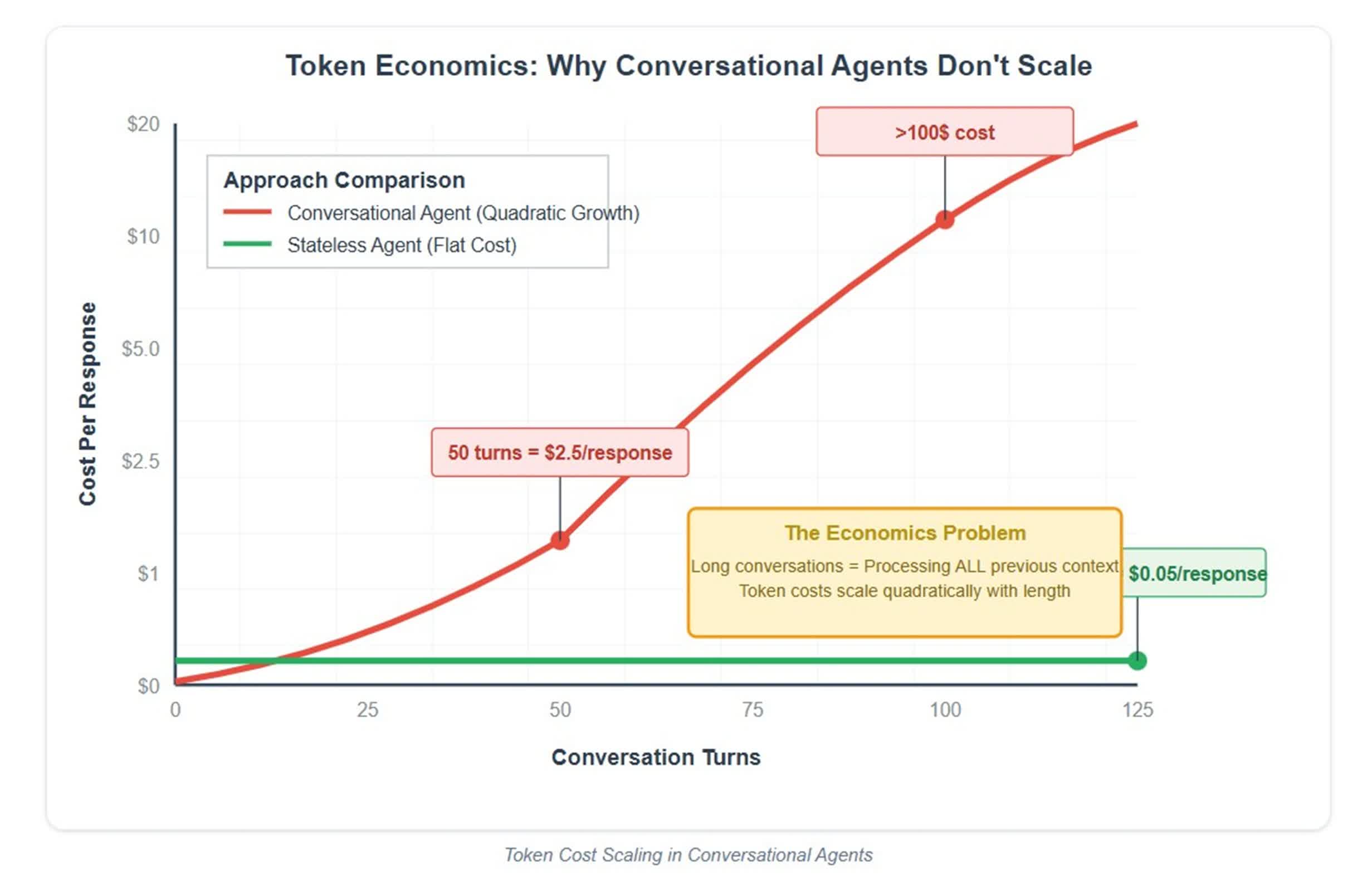
    Token cost scaling in conversational agents presents a second, often overlooked barrier. Kanwat illustrates this through his experience prototyping a conversational database agent, where each new interaction had to process the full previous context – causing token costs to scale quadratically with conversation length.

    In one case, a 100-turn exchange cost between $50 and $100 in tokens alone, making widespread use economically unsustainable. Kanwat’s function-generation agent sidestepped the issue by remaining stateless: description in, function out – no context to maintain, no conversation to track, and no runaway costs.

    “The most successful ‘agents’ in production aren’t conversational at all,” Kanwat says. “They’re smart, bounded tools that do one thing well and get out of the way.”

    Beyond the mathematical constraints lies a deeper engineering challenge: tool design. Kanwat argues this aspect is often underestimated amid the broader hype around agents. While tool invocation has become relatively precise, he says the real difficulty lies in designing tools that provide structured, actionable feedback without overwhelming the agent’s limited context window.

    For example, a well-designed database tool should summarize results in a compact, digestible format – indicating that a query succeeded, returned 10 thousand results, and displaying only a handful – rather than overwhelming the agent with raw output. Handling partial success, recovery from failure, and managing interdependent operations further increases the engineering complexity.

    “My database agent works not because the tool calls are unreliable,” Kanwat says, “but because I spent weeks designing tools that communicate effectively with the AI.”

    Kanwat critiques companies that promote simplistic “just connect your APIs” solutions, saying they often design tools for humans rather than for AI systems. As a result, agents may be able to call APIs, but they frequently fail to manage real workflows due to a lack of structured communication and contextual awareness.
    Kanwat notes that enterprise environments seldom provide clean APIs for AI agents. Legacy constraints, fluctuating rate limits, and strict compliance requirements all pose significant hurdles. His database agent, for instance, incorporates traditional engineering features like connection pooling, transaction rollbacks, query timeouts, and detailed audit logging – elements that fall far outside the AI’s scope.

    He emphasizes that the agent generates queries while conventional systems programming manages everything else. In his view, many companies pushing the promise of fully autonomous, full-stack agents fail to reckon with these harsh realities. The real challenge, he argues, is not AI capability but integration – and that’s where most agents fall apart.

    Kanwat’s successful agents share a common approach: AI manages complexity within clear boundaries, while humans or deterministic systems ensure control and reliability. His UI generation agent creates React components but requires human review before deployment. DevOps automation produces Terraform code that undergoes review, version control, and rollback. The CI/CD agent includes defined success criteria and rollback procedures, and the database agent confirms destructive commands before execution. This design lets AI handle the “hard parts” while preserving human oversight and traditional engineering to maintain safety and correctness.

    Looking ahead, Kanwat predicts that venture-backed startups chasing fully autonomous agents will struggle due to economic constraints and accumulating errors. Meanwhile, enterprises attempting to integrate AI with legacy software will face adoption hurdles because of complex integration issues. He believes the most successful teams will concentrate on creating specialized, domain-focused tools that apply AI to complex tasks but retain human oversight or strict operational limits. Kanwat also cautions that many companies will face a steep learning curve moving from impressive demonstrations to dependable, market-ready products.

    Read the full article on the original site


    Related Posts

    • 19 Types of Houses: Which is Right For You?
    • ACC Compensation turns down suggested townhouses on Gaines College Roadway
    • Medicare Without Social Security: How to Apply in 2026
    • Nike Releasing Kobe Bryant Denim Nike Air Force 1
    • Trump NATO’s new ‘Daddy’ – Trinidad and Tobago Newsday
    • Football Around Georgia: 2025 NFL preseason week 1
    • Visit The Locations Where The Hit Show ‘Beast’ Games Was Filmed
    • When Wellness Influencers Are Really Deepfakes
    AI and Machine Learning Black Technologists Cybersecurity News Digital Innovation Emerging Technologies Future of Work Gadget Reviews Innovation in Education Minorities in Tech Silicon Valley Updates Smart Devices Software Development Startup News STEM News Tech Culture Tech Equity Tech for Good Tech Industry Updates Tech Trends Technology News
    Share. Facebook Twitter Pinterest LinkedIn WhatsApp Reddit Tumblr Email
    Savannah Herald
    • Website

    Related Posts

    Tech July 19, 2026

    Sarah Downs Equips NASA’s Robots With Assembly Skills

    Tech July 19, 2026

    How Steven Bartlett Went From College Dropout to Media Mogul

    Tech July 18, 2026

    There’s a lot of hype around perimenopause. Don’t buy it.

    Tech July 18, 2026

    ICE shared Medicaid data it shouldn’t have with Palantir : NPR

    Tech July 17, 2026

    The Download: perimenopause misinformation and China’s latest AI leap

    Tech July 16, 2026

    Get The Party Started And Save 20% Off This Bose SoundLink Flex Bluetooth Speaker

    Comments are closed.

    Don't Miss
    Faith May 9, 2026By Savannah Herald014 Mins Read

    8 Major Harris Songs That Showcase His Soulful Legacy. – ThyBlackMan.com

    May 9, 2026

    Faith & Reflection: Voices from the Black Church and Beyond Like Like Love Haha Wow…

    30+ June Social Media Site Triggers to Start Summer Season

    July 3, 2026

    New fire stations to be built with bond proceeds in Sandy Springs

    July 3, 2026

    McCormick buys majority of Herdez JV in Mexico

    November 1, 2025

    A review of Informed by Alison Stone – Compulsive Reader

    April 17, 2026
    Archives
    • July 2026
    • June 2026
    • May 2026
    • April 2026
    • March 2026
    • February 2026
    • January 2026
    • December 2025
    • November 2025
    • October 2025
    • September 2025
    • August 2025
    • July 2025
    • June 2025
    • May 2025
    • April 2025
    • March 2025
    • February 2025
    Categories
    • Art & Literature
    • Beauty
    • Black History
    • Business
    • Climate
    • Culture
    • Education
    • Employment
    • Entertainment
    • Faith
    • Fashion
    • Food
    • Gaming
    • Georgia Politics
    • HBCUs
    • Health
    • Health Inspections
    • Investing
    • Lifestyle
    • Local
    • Lowcountry News
    • National
    • National Opinion
    • News
    • Politics
    • Real Estate
    • Senior Living
    • Sports
    • State
    • Tech
    • Traffic
    • Transportation
    • Travel
    • World
    Savannah Herald Newsletter

    Subscribe to Updates

    A round up interesting pic’s, post and articles in the C-Port and around the world.

    About Us
    About Us

    The Savannah Herald is your trusted source for the pulse of Coastal Georgia and the Low County of South Carolina. We're committed to delivering timely news that resonates with the African American community.

    From local politics to business developments, we're here to keep you informed and engaged. Our mission is to amplify the voices and stories that matter, shining a light on our collective experiences and achievements.
    We cover:
    🏛️ Politics
    💼 Business
    🎭 Entertainment
    🏀 Sports
    🩺 Health
    💻 Technology
    Savannah Herald: Savannah's Black Voice 💪🏾

    Our Picks

    Former SSU Baseball Standout Dexter Kelley Makes MLB Umpiring Debut

    June 30, 2026

    Braves defeat Pirates 6-3 in series opener

    June 28, 2026

    Ye’s Wife Bianca Censori Talks Nudity Obsession and More

    March 26, 2026

    The Top 7 Net-a-Porter Fall 2026 Fashion Trends

    May 12, 2026

    Jenkins Flag Football Team Breaks Into State Finals

    December 12, 2025
    Categories
    • Art & Literature
    • Beauty
    • Black History
    • Business
    • Climate
    • Culture
    • Education
    • Employment
    • Entertainment
    • Faith
    • Fashion
    • Food
    • Gaming
    • Georgia Politics
    • HBCUs
    • Health
    • Health Inspections
    • Investing
    • Lifestyle
    • Local
    • Lowcountry News
    • National
    • National Opinion
    • News
    • Politics
    • Real Estate
    • Senior Living
    • Sports
    • State
    • Tech
    • Traffic
    • Transportation
    • Travel
    • World
    Copyright © 2002-2026 Savannahherald.com All Rights Reserved. A Veteran-Owned Business

    Type above and press Enter to search. Press Esc to cancel.

    Manage Consent
    To provide the best experiences, we use technologies like cookies to store and/or access device information. Consenting to these technologies will allow us to process data such as browsing behavior or unique IDs on this site. Not consenting or withdrawing consent, may adversely affect certain features and functions.
    Functional Always active
    The technical storage or access is strictly necessary for the legitimate purpose of enabling the use of a specific service explicitly requested by the subscriber or user, or for the sole purpose of carrying out the transmission of a communication over an electronic communications network.
    Preferences
    The technical storage or access is necessary for the legitimate purpose of storing preferences that are not requested by the subscriber or user.
    Statistics
    The technical storage or access that is used exclusively for statistical purposes. The technical storage or access that is used exclusively for anonymous statistical purposes. Without a subpoena, voluntary compliance on the part of your Internet Service Provider, or additional records from a third party, information stored or retrieved for this purpose alone cannot usually be used to identify you.
    Marketing
    The technical storage or access is required to create user profiles to send advertising, or to track the user on a website or across several websites for similar marketing purposes.
    • Manage options
    • Manage services
    • Manage {vendor_count} vendors
    • Read more about these purposes
    View preferences
    • {title}
    • {title}
    • {title}
    Ad Blocker Enabled!
    Ad Blocker Enabled!
    Our website is made possible by displaying online advertisements to our visitors. Please support us by disabling your Ad Blocker.

    Sign In or Register

    Welcome Back!

    Login below or Register Now.

    Lost password?

    Register Now!

    Already registered? Login.

    A password will be e-mailed to you.