




From Campus to Classroom: Stories That Shape Education
- Many secondary teachers lack training in foundational reading skills like decoding and phonological awareness.
- AIM Institute 55-hour course adapts evidence-based practices for middle and high school readers.
- Marietta pairs asynchronous modules with local in-person facilitators to support transfer to classroom practice.
- Statewide rollout in New Mexico shows scaling potential; targeted modules offer flexible options for content-area teachers.
Like many districts, the Marietta school district in Georgia has spent the past five years focused on improving literacy achievement for its youngest students, intent on making sure kids leave elementary school with the foundational reading skills they need to be successful.
But as the district began to make strides, it also confronted the problem of older students who still struggle to read—those who were in the school system prior to the start of the district’s academic interventions, and those who made it into middle and high school without adequate reading proficiency. And leaders were determined not to leave them behind.
“We still had around 30% of kids who weren’t reading at or above grade level….We said, ‘You know what? This isn’t OK,’” said Charles Gardner, Marietta’s deputy superintendent. “We wanted to make sure we had an opportunity to catch them up because we know that … when they get to high school they’re potentially falling further and further behind in all kinds of content areas because of reading deficiencies that have gone either unidentified or unaddressed, or both.”
The challenging aspect, though, was one that districts across the country are facing: Few educators receive training—either in teacher-prep programs or district-run professional development—about how to help teach reading to older students.
Ultimately, Marietta landed on a course from the AIM Institute for Learning and Research, a 55-hour training that builds off of another comprehensive program for teaching kindergarten through 3rd grade students and adapts to focus on how to implement evidence-based practices in middle and high school classrooms.
“The reality is that you’ll have kids that are getting to middle school and still have decoding issues and deficits that are impacting them,” Gardner said. “And, typically, what we train secondary teachers to do is address comprehension issues, but they don’t understand things like decoding.”
Without that knowledge, the Georgia school administrator added, “you’re not going to be able to effectively move the needle for that kid because you’re not identifying what the actual issue is.”
Teachers lack training to support struggling older readers
The Marietta district isn’t alone in trying to address gaps in older students’ reading. Districts are investing millions into remediation and acceleration efforts to deal with low post-pandemic achievement and record numbers of students reading below a basic level.
Much of the focus has remained on ensuring students learn the fundamentals of how to read in the earliest grades, usually prior to 3rd grade.
But a growing number of students in recent years have transitioned past 3rd grade without those foundational skills, putting them at risk of falling further behind as reading texts become increasingly complex and other courses—like algebra and history, for example—rely on kids’ ability to build their knowledge base.
The solution in theory seems simple: Provide these students with focused interventions to catch them up. But the reality is much more complex, educators and experts say.
Teachers in later grades—even those teaching in English/language arts classrooms—typically don’t get a lot of training on foundational reading skills in their certification programs, and many available reading interventions are designed for young children rather than those on the cusp of adolescence.
In a recent nationally representative EdWeek Research Center survey, 38% of teachers, school leaders, and district leaders said they had not received any training in how to support middle and high school students who struggle with reading, and 26% of educators who had received training in the subject sought it out themselves.
Thirty-eight percent of educators said they received training from their school, district, or state education agency, and just 20% reported receiving training in their teacher-preparation programs.
The AIM course—Pathways to Proficient Reading: Secondary—is one of a small handful that are responding to the need for more help, and the Marietta district is trying to supercharge the process with an especially hands-on approach.
In-person support bolsters an online training
The AIM course uses a tiered approach in which teachers learn how kids’ brains learn to read and then practice specific skills and exercises they can implement in the classroom to help students learn those skills. The course covers a range of topics, from how to teach phonological awareness and morphology to the reading-writing connection and semantics.
Per the course design, most of the $750 per person training is asynchronous—teachers can complete the modules at their own pace and in their own time. Educators must pass at the end of each section, and each session has activities teachers can use to test their skills, such as listening to a recording of a middle school student reading aloud and then deciding how to respond.
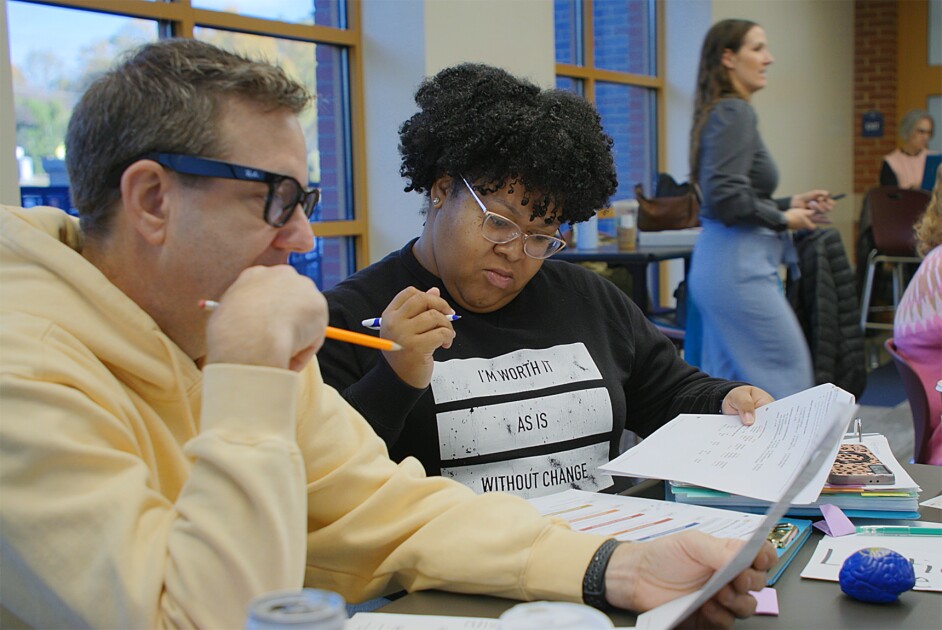
The training also includes six one-hour sessions in which participants gather, usually in person or live online, in groups of about 30 to discuss and practice the concepts together.
To this base, the Marietta district in Georgia has taken a unique approach to the AIM training. Rather than teachers doing the bulk of the lessons online, Marietta hired two staff members who conduct some in-person facilitation and work in the middle schools to help staff implement the concepts in their classrooms, said Mary Hannah Gaddis, the district’s science of reading director, who also serves as the high school’s facilitator.
Marietta’s deputy superintendent said those investments are “critical” to sustaining the work long-term. It allows staff members easy access to someone who can answer their questions and give advice, and hold them accountable, he said.
“The asynchronous approach is great for the delivery of content and building their content knowledge, but we feel that transfer to practice is really important,” Gardner said.
The district isn’t located in the same place as AIM’s staff, and that limits interactions with the organization’s staff, he said. “The reality is, when you’re when you’re purchasing a tool like that, you’ve got to have somebody to monitor whether or not it’s happening in the classroom.”
Gaddis and the two middle school facilitators had previous instruction on secondary literacy, working with adult learners, and instructional coaching, and completed the course the summer prior to other staff members beginning.
Marietta’s teachers complete some of the training asynchronously, but if there is a particularly complex section—like phonics—the district sets aside time for the teachers to complete the session in person as a group.The facilitators will provide additional hands-on activities or classroom situations to practice, she said.
The extra work helps create “mental Velcro on which teachers can attach new information,” Gaddis said.
One state is rolling out the training at scale
At least one state is trying to taking aim at the problem at scale. New Mexico has begun requiring all 6th through 12th-grade ELA, special education, literacy coaches, and English-language-development teachers statewide to complete the AIM training to build their knowledge in reading research and teach best practices for language and literacy instruction in secondary classrooms.
The 55-hour, 16-module training spans about eight months in total. It began statewide in 2024 and will continue to be rolled out in phases over the next three school years. While it is required for educators who conduct reading instruction, some districts have voluntarily added additional staff members to the training, like math or history teachers, said Carolyn Durante, senior relationship manager at the AIM Institute.
“Whenever I talk to state leaders, I always say that the ultimate goal is that this is the type of work we won’t need in 10 to 15 years. The hope is that we’re going to be graduating kids from grades K-3 proficiently with the skills they need so we won’t have to have so many kids who need to be caught up,” Durante said. “But until then, there really has to be a focus here because we’re letting too many kids fall through the cracks.”
Windey McKelvie, an 11th and 12th grade English teacher at Cloudcroft High School in New Mexico, completed the course last year. She’d received some training prior to entering the classroom about teaching reading to secondary students because her master’s degree is in teaching English as a second language, which included topics like the etymology of words. But many of her colleagues had never received similar training, particularly those who had taken alternative pathways to receiving their teaching licenses.
“It’s good to do as a district because it gives us all a common understanding of what we’re doing and a common language to speak,” McKelvie said. “It’s also important because it bridges theory and practice. So, we have this theoretical concept of the study of the science behind reading, but then we’re able to actually implement it and put it into practice.”
Attending to student learning means thinking about how adults learn, too
For educators outside of states with expansive mandates who don’t want to take the full 55-hour course but still want to learn some of the key, AIM also offers some modules a la carte. Districts can gauge areas in which there may be gaps in understanding or knowledge about literacy and hand-pick the modules they want their educators to take.
For content-area teachers, especially in those middle and upper grades, “one of the challenges is there also isn’t time in the day set aside anymore to teach reading,” Durante said. “The math teacher doesn’t need the 55-hour training, or even if they need it, they’re not going to probably enjoy taking it. So here’s a way to get at that in a more digestible way.”
AIM also intentionally used examples and texts that are age appropriate—historically a sticking point for districts that have taken early grades’ training and tried to use it to train secondary teachers, AIM leaders said. Using recordings of middle and high school students reading, for example, has helped avoid teachers feeling “turned off” by a training that doesn’t reflect what’s actually in their classroom, Gaddis said.
It also acknowledges that elementary and secondary teachers are often trained in different ways, Gardner of the Marietta district added.
“It recognizes that elementary teachers tend to be more pedagogical experts, whereas secondary teachers tend to be trained as content experts,” he said. “The way the modules are delivered seem to recognize that the approaches to instruction and the delivery of it will look different in middle school than it might in a 1st grade classroom, even if it’s the same concept.”
The investment seems to be paying off, Gaddis said.
Facilitators have noted when they complete classroom walkthroughs an increase in teachers’ confidence addressing skill gaps, and the district has seen fluency gains among middle school students, particularly English learners, Gaddis said.
The key is ensuring that momentum continues, even years after teachers complete the training, she said.
Facilitators tend to “feel a heavy burden of making sure those teachers maintain the knowledge and continue implementing it in their classroom,” said Gaddis. “A teacher’s job is so hard, and when there’s not an intense focus on something, it’s easy to let it get pushed to the back burner.”
But when teachers are supported by someone who is circling back and reteaching things they’ve learned, she said, ” we’re driving it home long-term.”
Read the full article on the original site
