





Faith & Reflection: Voices from the Black Church and Beyond
- Terry Tempest Williams's account of the felling of the Divinity Tree exposes institutional rationales and the haunting phrase In Absence is my Presence.
- Widespread industrial logging leaves gaping mountains, soil erosion, and deep personal grief as trees fall, their loss felt viscerally across western Maine.
- Urgent plea to bridge divides through collaboration, reconcile inner feeling and thought, build community action to prevent ecocide and recover everyday joy.
The Glorians: Visitations from the Holy Ordinary is an astonishing book written by internationally acclaimed writer Terry Tempest Willams that is predicated on the necessity of bearing compassionate witness to all beings during these troubled times. It is a book about family, friends, earth and dreams, the later of which inspired the title. The volume is composed of a series of essays, only one of which I will discuss here.
Terry, who teaches at Harvard Divinity School, writes about the Divinity Tree, a two-hundred-year-old red oak that was removed from the Commons. Listening to this narrative as a ‘Tree Woman’ was/is excruciatingly painful. My stomach roils in misery, but I am compelled to listen, over and over, because this is my story too.
I came to the mountains because I was in love with trees and bears discovering an evergreen paradise or so I thought until the dreams began. In my night stories all the trees were being slaughtered and there was nothing I could do. Since I was surrounded by fragrant forests that stretched from horizon to horizon, I could make no sense of these terrifying warnings and let them be.
However, it wasn’t long before I witnessed my first catastrophe after feeling compelled to climb through piles of slash on the first tortured mountain I discovered in this area. The nauseating scent of weeping white pine stumps followed me back to my camp. The waterfall below my 6×12 dwelling sung me to sleep soothing the shock I experienced that day. I dreamed that LOVE for my little forested oasis was more powerful than the massive destruction I had witnessed the day before. For the moment I was comforted.
However, within a space of a few years great holes began to appear on the sides of too many mountains in this area. Equally frightening were the huge rumbling logging trucks that hauled dying trees away that swayed dangerously on (what used to be) winding country roads. In the beginning I must have engaged in magical thinking because I never thought this devastation could occur on the steep granite mountains that surrounded my small twenty-acre sanctuary. *
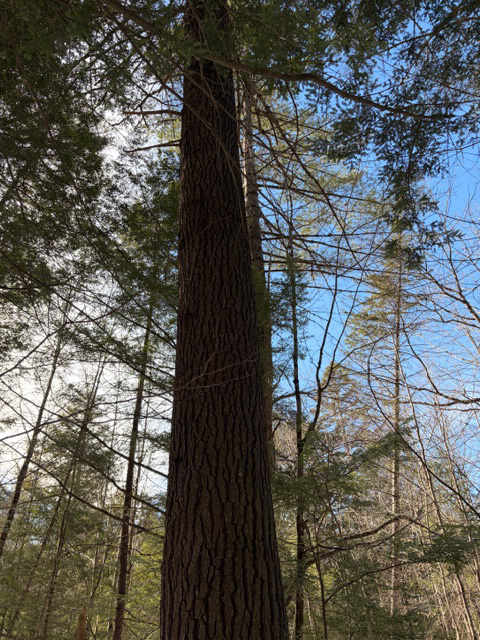
Now it seemed that everywhere I went chainsaws were severing trees from their roots. Giant yellow machines flattened whole forests leaving gaping holes in what once was rich woodland duff, not only destroying the trees and compacting what was left of the soil but opening the mountains to erosion.
When trees are cut, they scream before crashing to earth. The force is so great that the ground literally shakes beneath my feet.
Shuddering screeching innocents. Not like me. I own that I am part of the problem. We need trees for just about everything I can think of.
Still, in the beginning I advocated for all trees fiercely by writing about them, talking about them in classes I taught at university and elsewhere, approaching every person I knew, trying to bring this massacre to people’s attention, but no one seemed to care. Quite the opposite. Logging was how people made a living here, and besides the majestic pines would grow back they said. Eventually I gave up trying to talk to humans and started to talk to trees instead. But I kept on writing to save my sanity (though I published little about trees except natural history).
It was true that the loggers I used to know cut their forests with care. They left healthy seed trees behind as well as mixed deciduous trees and other evergreens, like spruce, hemlocks, and cedar. I walked through so many of these woodland roads up the mountain I lived against and was taught by the trees how they go about recovering their lives. Little pines and spruce sprung up quickly, lichens and mosses keep photosynthesizing, wildflowers re-appeared and within a couple of years the understory was thriving again. I became good friends with two local logging men and learned that these family – owned businesses were dying out because they were unable to compete with the great logging machine.
I don’t know when I finally understood that it was my job to be a witness to what would evolve into a massive carnage of whole mountains and now entire counties in western Maine. 40 plus years later.
I return to Terry’s essay whose experience so graphically describes the butchery I have lived with for so long. The night before Divinity lost her life Terry lay on the ground beneath the tree breathing into what was to come. When she heard these words coming from the tree, she believed: In Absence is my Presence.
The next day the Divinity Tree was cut and hauled away in pieces before the chipper finished the job. Only a weeping white stump remained. The rationale that Harvard used for taking down the tree was the one I hear all the time (conservation’ groups who log are no exception). The tree was diseased and dying, a threat to students on campus. In truth, the Divinity Tree was healthy and barely in her prime; her heartwood was intact.
Terry does not end her essay at this point. Instead, she uses the story to make a powerful argument for ALL of us to come together regardless of personal differences by using trees as an example. Today that means that those of us who ache for the loss of each tree must be willing to create a bridge to those who slaughter whole forests. A challenge so great that I continue to struggle to embody this truth, but I know that Terry is right. We must unite to bridge the chasm through collaboration and compromise before ecocide etc. destroys us too.
Sadly, I am still stuck in the space in between because I cannot feel what I know. With that much said I can also say that I am committed to working with anyone who is willing to help to bring this shift about. I am also keenly aware that until I can bring the two sides together inside me so that my thinking is supported by my feelings that I will continue to suffer. Terry reminds me that I have work to do.
I want to end by repeating that this exquisitely written volume is one that demonstrates the critical importance of bearing witness to ecocide, human suffering, and political insanity by staying awake and honoring our own individual processes/feelings as well as the importance of working through community. These three are all facets of the same story; we are all interconnected. Most important this book reminds us that feeling joy can be part of everyday experience
*(Today I am grateful that I had the sense to return sovereignty to nature who turned what was once a field into a young white pine forest below my house. Although I spend a lot of time on the woodland trails I created, one of which leads to an open wildflower field fragment, I can no longer see stripped mountains from my house).
The Glorians can be purchased here.
Discover more from Feminism and Religion
Subscribe to get the latest posts sent to your email.

Read the full article on the original source
