




Faith & Reflection: Voices from the Black Church and Beyond
- Judges shows Israel's failure to drive out the Canaanites led to compromise and spiritual decline.
- Persistent resistance by the enemies demonstrates how Satan uses lingering sin to draw God's people astray.
- Live in obedience, seek the Lord, and resist compromise, being in the world but not of it as Jesus taught.
- Evil persists until Christ's return, but the final harvest proves God's victory; overcome evil with good, per Romans 12:21.
Disclaimer: While some may construe modern-day applications to my thoughts today, I am making no direct correlation to current events. I am looking at the spiritual applications for those of us who are chosen in Christ Jesus and follow Him as Lord and Savior. That said, I want to share some thoughts from the first chapter of the book of Judges.
I recently finished a study of this book. It’s a hard one to read, because there is a sense that the people of Israel are floundering. Joshua is dead. They have no on-the-ground leader to keep them in line. There are priests, the tabernacle, and the Torah, but in all the busyness of occupying the land and settling into new homes, the people have become distracted. Plus, they’re far from done with the taking of the land. There are still pockets of people to clear out, as commanded by the Lord.
I’m hopeful, as the first verse of Judges tells us that the people came together and inquired of the Lord. They wanted Him to tell them who should go up to fight against the Canaanites. The Lord chooses Judah, and they, along with the men of Simeon, whom they grabbed along the way, defeated their enemy and even captured Jerusalem. It’s looking pretty good for the people, and by verse 19, we’re told, “the Lord was with Judah.” Maybe they will finally conquer the peoples in the land and be able to settle as a people “holy to the Lord.”
The first sign of trouble
That same verse unfortunately holds a short phrase that will show up many times in the remainder of the chapter: “did not drive out.”
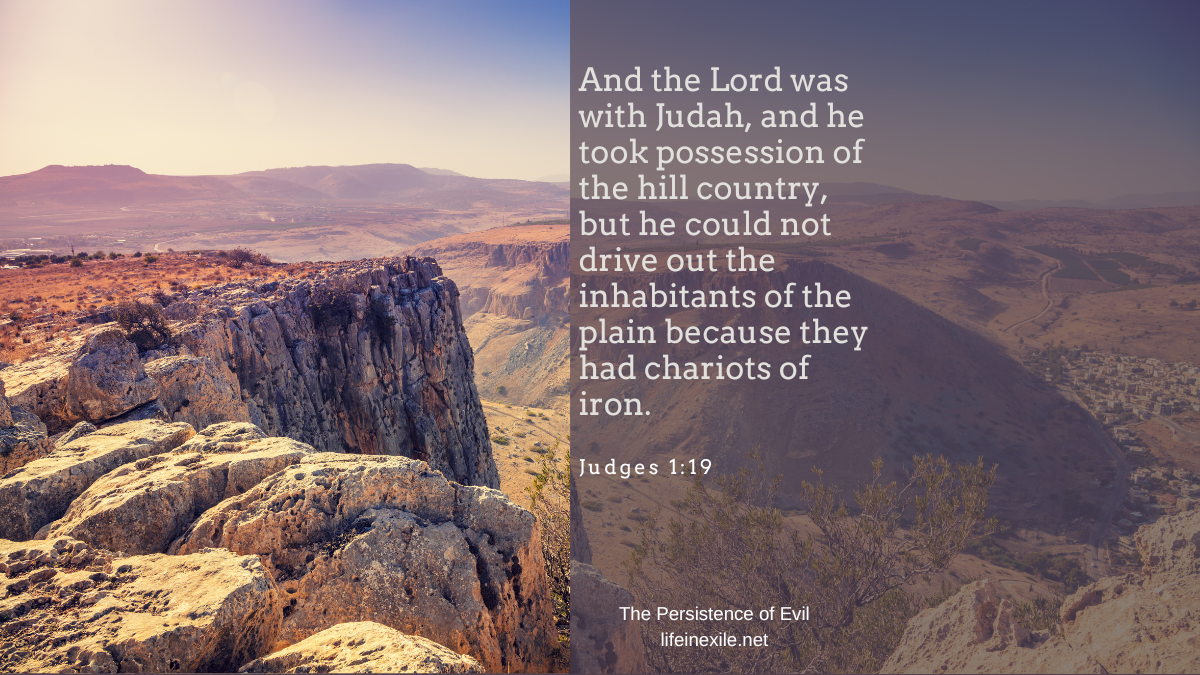
And the Lord was with Judah, and he took possession of the hill country, but he could not drive out the inhabitants of the plain because they had chariots of iron. (Judges 1:19 ESV, emphasis added)
Just as the Lord was with Judah, we also read that the Lord was with the house of Joseph (v. 22). If so, why were these tribes unable to wipe out their enemies? Had the Lord not promised them this land? Had He not promised that He would be with them and go before them to defeat their enemies?
Look at how many verses contain the phrase in this one chapter:
- But the people of Benjamin did not drive out the Jebusites who lived in Jerusalem, so the Jebusites have lived with the people of Benjamin in Jerusalem to this day. (v. 21)
- Manasseh did not drive out the inhabitants of Beth-shean and its villages, or Taanach and its villages, or the inhabitants of Dor and its villages, or the inhabitants of Ibleam and its villages, or the inhabitants of Megiddo and its villages, for the Canaanites persisted in dwelling in that land. When Israel grew strong, they put the Canaanites to forced labor, but did not drive them out completely. (vs. 27-28)
- And Ephraim did not drive out the Canaanites who lived in Gezer, so the Canaanites lived in Gezer among them. (v. 29)
- Zebulun did not drive out the inhabitants of Kitron, or the inhabitants of Nahalol, so the Canaanites lived among them, but became subject to forced labor. (v. 30)
- Asher did not drive out the inhabitants of Acco, or the inhabitants of Sidon or of Ahlab or of Achzib or of Helbah or of Aphik or of Rehob, so the Asherites lived among the Canaanites, the inhabitants of the land, for they did not drive them out. (vs. 31-32)
- Naphtali did not drive out the inhabitants of Beth-shemesh, or the inhabitants of Beth-anath, so they lived among the Canaanites, the inhabitants of the land. Nevertheless, the inhabitants of Beth-shemesh and of Beth-anath became subject to forced labor for them. (v. 33)
A persistent push against the plans of God
Along with the repeated revelation that the tribes were failing to drive out the inhabitants of the land, these verses give us an indication of the resistance they faced. In relation to Manasseh’s fight against the Canaanites, verse 27 tells us that the “Canaanites persisted in dwelling in the land.” They stood up to Israel and said, “We’re not going anywhere.” Their resistance led them to forced labor by the Israelites.
The same word is used for the Amorites, who resisted the advancement of the men of Dan into the hill country. “The Amorites persisted in dwelling in Mount Heres, in Aijalon, and in Shaalbim, but the hand of the house of Joseph rested heavily on them, and they became subject to forced labor (v. 35).
So how do we handle this outright resistance of these peoples to the plan of God? The land was not purified, as God had commanded, and it would be Israel’s downfall. The persistent presence of these peoples would be used by Satan to lead Israel astray. Was God not strong enough to fulfill His plan through His people? The answer is obviously no, because we saw that when He was consulted and His Word followed, the people gained victory over huge armies and against all odds. We saw what He’d done for Israel in Egypt and throughout the wilderness years. We saw the walls come down at Jericho. So, what went wrong?
For Israel’s part, we have already seen a lack of trust in God. While they had the Ten Commandments and Torah, they were not faithful in following God’s commands. As for the battles waged to take the land, they failed to use greater force, often had no real strategy to overtake the enemy. They were exhausted from years of battle, and chose peace with compromise over continued conflict that would lead to ultimate victory. In other words, they were not persistent in following out God’s command to take the land.
The persistence of evil
We know from reading the rest of the book of Judges that Israel’s ultimate failure was found in this oft-repeated sentence: “And the people of Israel did what was evil in the sight of the Lord,” which led to “everyone doing what was right in his own eyes.”
There may not have been an earthly king in Israel during those days, but that did not mean the people of Israel did not have a king. Their King was the Lord God Almighty, and they were to seek His face and inquire of Him through the priests. This they failed to do, and that’s the main reason for their failure to take the land.
There will never be a time in Israel’s history when the land is without foreign influence—it is never pure, as the Lord intended. We know it’s not possible this side of heaven, because man is bent toward evil.
So, what does this say to us today? What does it mean for those who follow Jesus Christ? Simply put, it is a reminder that evil is here to stay as long as this earth lasts—but it does have an expiration date! In the meantime, we live in obedience to God and His Word. As we work out our salvation with fear and trembling, Satan may be persistent, but he has no hold on us. Jesus told us that we are to live in the world but not of it. “I do not ask that you take them out of the world, but that you keep them from the evil one. They are not of the world, just as I am not of the world” (John 17:15-16).
Though the ideal of the Promised Land remains an earthly pipe dream, because of sin, it has always been a future eternal reality. Until that day, we must choose to live with integrity as evil persists. Then, on that final day, the Parable of the Wheat and the Tares will be fulfilled.
He put another parable before them, saying, “The kingdom of heaven may be compared to a man who sowed good seed in his field, but while his men were sleeping, his enemy came and sowed weeds among the wheat and went away. So when the plants came up and bore grain, then the weeds appeared also. And the servants of the master of the house came and said to him, ‘Master, did you not sow good seed in your field? How then does it have weeds?’ He said to them, ‘An enemy has done this.’ So the servants said to him, ‘Then do you want us to go and gather them?’ But he said, ‘No, lest in gathering the weeds you root up the wheat along with them. Let both grow together until the harvest, and at harvest time I will tell the reapers, “Gather the weeds first and bind them in bundles to be burned, but gather the wheat into my barn.”’” (Matt. 13:24-30)
The seeds of the Kingdom have been sown by God. The enemy, who came to thwart the plan of God, sows those under his influence amongst us. With every passing day, we are able to see the difference between the fruit-bearing wheat and the evil weeds. God has allowed Satan to continue in his efforts, just as He allowed the persistent enemies of Israel to remain in the land. Why? Because He knows a final harvest is coming on the day of Christ’s return, and on that day, the Lord wins the battle and gathers His people to Himself.
Yes, evil persists but it does not overcome. Keep your eyes on the King of kings and live for Him and His purposes until the Day of His return. “Do not be overcome by evil, but overcome evil with good” (Rom. 12:21).
Grace and Peace
If you missed the last Wednesday Wisdom, click HERE, or check out these posts on the persistence of evil: Why Is There So Much Evil?, Light Versus Darkness, God Remembers His Enemies, Standing Fast, Standing Firm, and The Masquerade of Evil.
Discover more from A Life in Exile
Subscribe to get the latest posts sent to your email.
Read the full article on the original source
