





Game On: Latest in Gaming News, Reviews & Industry Buzz
- Bowser Jr. discovers a sentient encyclopedia, Mr. E, prompting the Yoshis to leap into pages and document strange creatures.
- Yoshi and the Mysterious Book emphasizes observation and experimentation, blending puzzle-platforming with sandbox-like discovery across inventive habitats.
- Each habitat acts as a self-contained mini-game: stealth, fishing, floating clouds, plant creatures, and many outside-the-box interaction puzzles.
- Narrative feels pleasant but lightweight; the game lacks connectivity, clear progression, and meaningful danger or punishment for mistakes.
- Good-Feel's hand-drawn painterly visuals and stop-motion feel charm; 100% completion demands 30+ hours and optional post-game tools.

by
Evan Norris
, posted 10 hours ago / 815 Views
When you pick a Mario Kart or Animal Crossing game off the shelf, you know what you’re getting, more or less. When you pick up a new Yoshi game, it’s a somewhat different story. While many Nintendo franchises are clearly defined, having locked in their mechanical and visual identities long ago, the Yoshi IP continues to bounce around among different play styles and aesthetics, seemingly unable to find a permanent home. In a way, that’s a good thing. It allows the programmers at Nintendo to experiment with many different mechanics, textures, and gameplay possibilities under a single, familiar banner. That’s certainly the case with Yoshi and the Mysterious Book, which is the most experimental Yoshi game yet — in more ways than one.
Yoshi and the Mysterious Book starts as all great stories do: with Bowser Jr. The diminutive prince sneaks into an old, forgotten library, where he discovers a magical, sentient encyclopedia. Using the book as a compass, he travels to the island of the dinosaur-like Yoshis, searching for some unknown item. Sadly, the intersection of incompetence and fate strikes the Bowser family again, as the heir apparent becomes separated from the book before crashing down on the island. A group of playful, curious Yoshis then discovers the leather-bound tome and learns about its true nature. He is Mister Encyclopedia, or Mr. E, and his purpose is to catalog mysterious creatures. Unfortunately, he cannot directly access the information sandwiched between his covers, so he kindly asks the Yoshis to leap into his pages and jot down their discoveries.
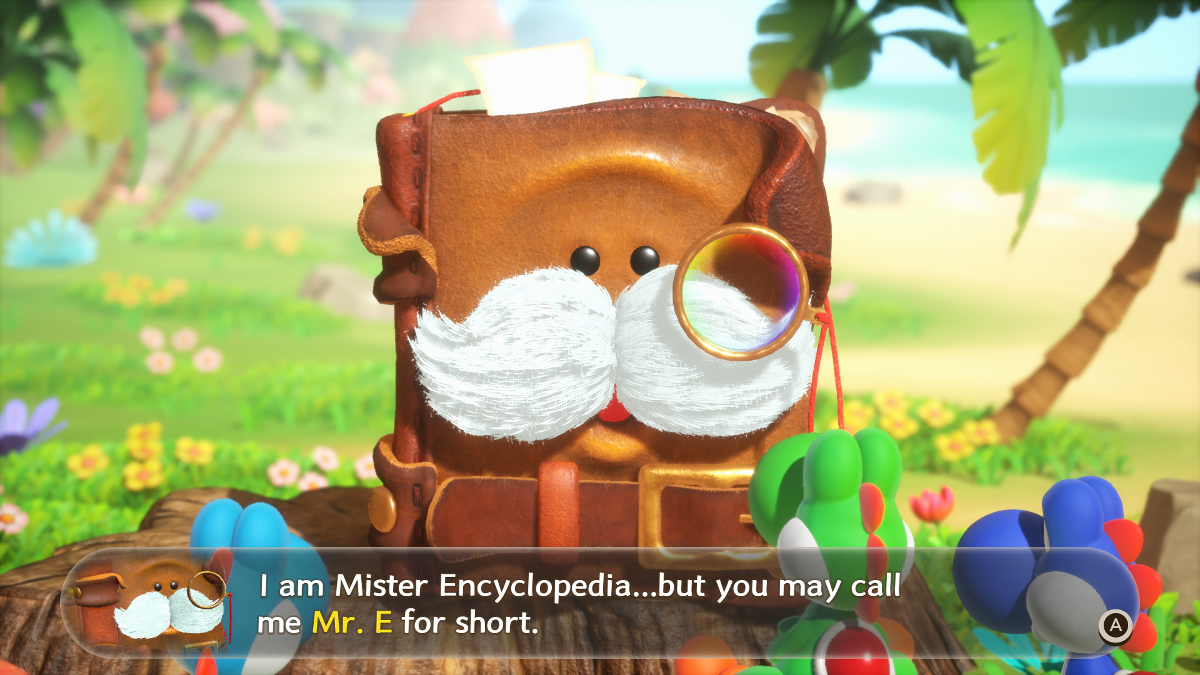
This is a fun, inviting premise for a platformer. The colorful, eager Yoshis sit in a semi-circle around the propped-up book, taking turns leaping into its pages to explore the biodiversity within. Regrettably, it never gets much deeper than that. Now, it’s not like platformers are known for intense, involved storylines — Super Mario, one of the industry’s greatest franchises, has made a living recycling the same basic plot — but there’s certainly room for a little drama. Bowser Jr. and Kamek show up now and then to antagonize Yoshi, and there is one big end-game revelation, but in general the narrative lacks urgency. It’s pleasant but largely forgettable.
That’s not to say the game lacks personality. It just reveals itself through gameplay instead of story. Judged solely on that metric, Yoshi and the Mysterious Book is surprising, risky, and wildly creative. The way the adventure unfolds is quite unlike your typical Nintendo action-platformer. It’s more of a puzzle-platformer, but with the experimental qualities of something like Scribblenauts. Yoshi still handles as smoothly as ever — he can extend his tongue, flutter jump, and leap around at will — but his mission is more focused on observation and experimentation.

In response to Mr. E’s urging, Yoshi will magically journey into the pages of the living encyclopedia, to explore each creature’s habitat. Once there, he will interact with it and document its characteristics, abilities, and, in the name of science, taste. Every habitat has a big, climactic discovery to reveal; once you find it, you can move on to the next creature.
Things start off slowly in Chapter 1: Wildwoods. You’ll drag your magnifying glass/monocle across the page until it lands on a strange flower-like creature. Is it flora, fauna, or both? Soon, you’re inside its habitat, carrying it, tossing it, watering it, bringing it to points of interest to see how it will interact with them, etc. Then you’ll enter the domain of a multiplying, infectious dandelion seed-like creature that’s scarier than anything you’ll find in The Last of Us (seriously). Then it’s on to the habitat of a stationary, singing frog-bird, at which point the unbridled creativity of the whole venture becomes obvious. Developer Good-Feel has turned in something as inventive, dynamic, and enchanting as recent Super Mario titles.

Indeed, each habitat is a game in itself. In one, you’ll travel across floating clouds. In another, you’ll go fishing. In yet another, you’ll guide those previously-mentioned flower people away from dangerous, roaming urchins, in the style of Oddworld. There’s even a stealth habitat, where you can coat yourself in mud, Predator-style, to avoid a relentless monster. And in each one of these areas, there are two to three dozen observations to make, some of them straightforward, others requiring outside-the-box thinking. There’s a joyful sense of discovery and newness throughout.
Unfortunately, this experimental, observational formula — the thing that makes Yoshi and the Mysterious Book unique — keeps it just shy of greatness. Playing through the game, I often found myself wondering how amazing things could be if these mechanics were deployed in a more traditional action-platformer or, better yet, an open-ended Metroidvania. Imagine if you could use the creatures’ unique abilities to bypass obstacles and open new areas in a larger, interconnected game world, instead of within discrete playgrounds. As it stands, the game lacks a feeling of connectivity and progression.
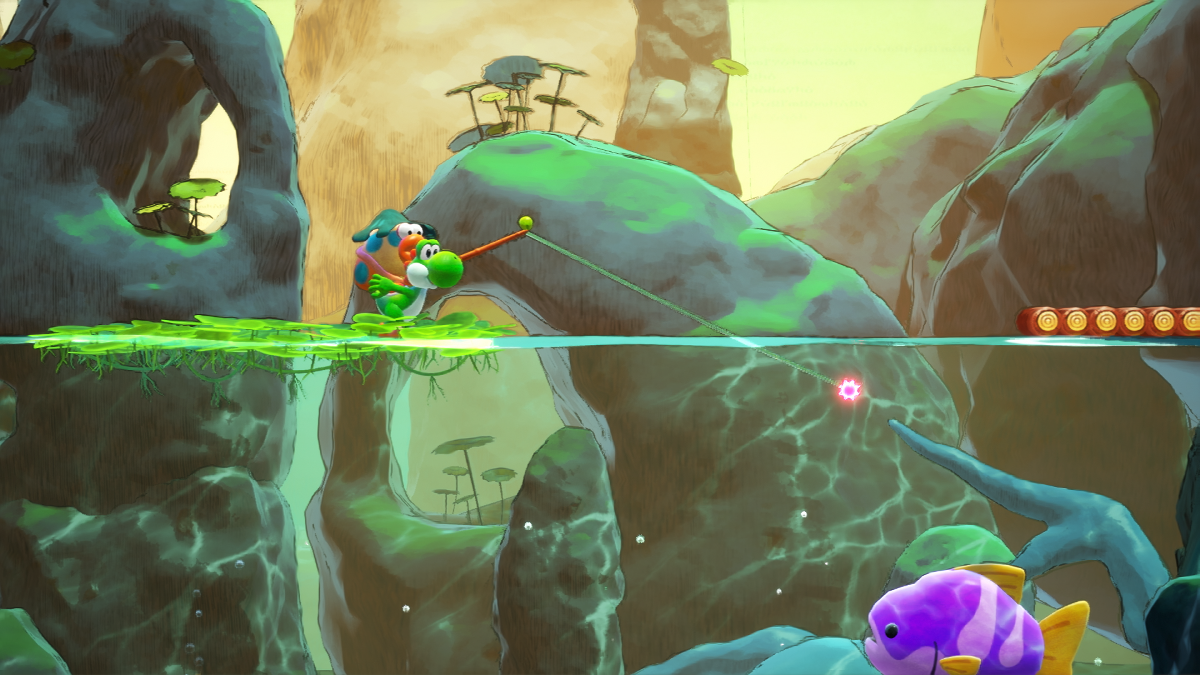
It also lacks a sense of danger. Apart from that one stealth habitat, the game is reluctant to hold players accountable for mistakes. If you fall into a bottomless pit, you’ll respawn at the closest platform. If you come into contact with an enemy or projectile, you’ll flinch and move on with your day. The game is designed around leisurely experimentation, so this makes sense, but it does diminish your victories somewhat.
To be fair, the game finds other ways to challenge its players. Each habitat has a couple dozen hidden interactions waiting to be discovered, alongside three to five smiley flowers nestled in hard-to-find spots. Getting 100 percent completion is no easy task. Sure, you could speed through the game in 10 hours, but you’ll need 30-plus hours to find every last secret and overcome an assortment of post-game trials, several of which are diabolical. One thing to note for the completionists out there: Mr. E will provide multiple exploration tools for purchase after the game’s first ending, some of which make it far easier to track your discovery progress.
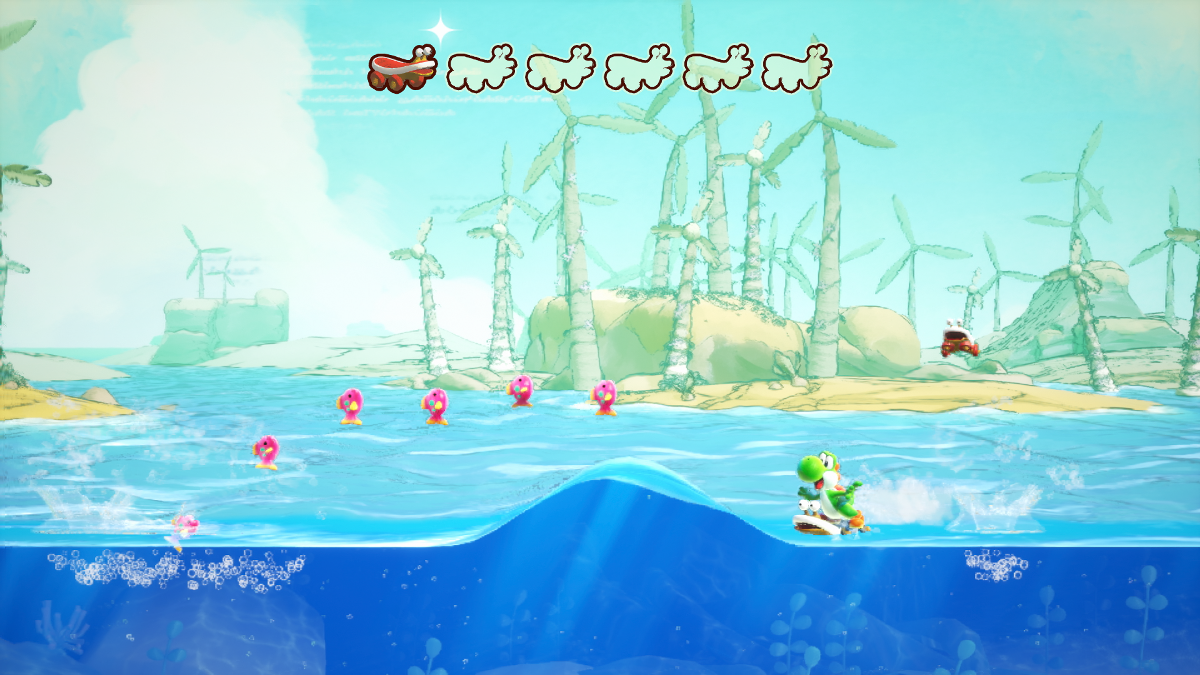
No matter how many hours you spend in the pages of Mr. E, you’ll enjoy a truly lovely art style. Good-Feel opted for a painterly, hand-drawn aesthetic to match the theme, and it works wonders. Each new discovery pops up on the screen as if it’s being sketched by some invisible hand. Characters move and pivot at slightly lower frame rates, to simulate stop-motion animation. One of the very best visual details is the way color fades as you get closer to the outer edges of each stage, as if you’ve run into the end of a drawing.
The game’s music isn’t quite as good, but it’s perfectly fine. The highlight is absolutely “Hauger & Spincone”, a driving theme with dueling guitar and harmonica.
Yoshi and the Mysterious Book continues the tradition of the Yoshi IP defying easy categorization. Thanks to a hand-drawn aesthetic, an encyclopedic setting, and gameplay that transforms the friendly dinosaur into an amateur zoologist, it could pass as an entirely new franchise, if not for the familiar characters and creatures. If it were a new franchise, it would be a very promising start, due to its diverse settings, inventive mechanics, and rewarding problem-solving gameplay. It’s not as cohesive, as adventurous, or as dangerous as it could be, but its unbridled creativity helps overcome those issues. If you’re looking for something that carries on the tradition of Yoshi’s Island, this isn’t it. If you’re into puzzle-platforming and experimental, sandbox gaming, however, this is an easy recommendation.
This review is based on a retail copy of Yoshi and the Mysterious Book for the NS2
More Articles
Read the full article on the original site
