




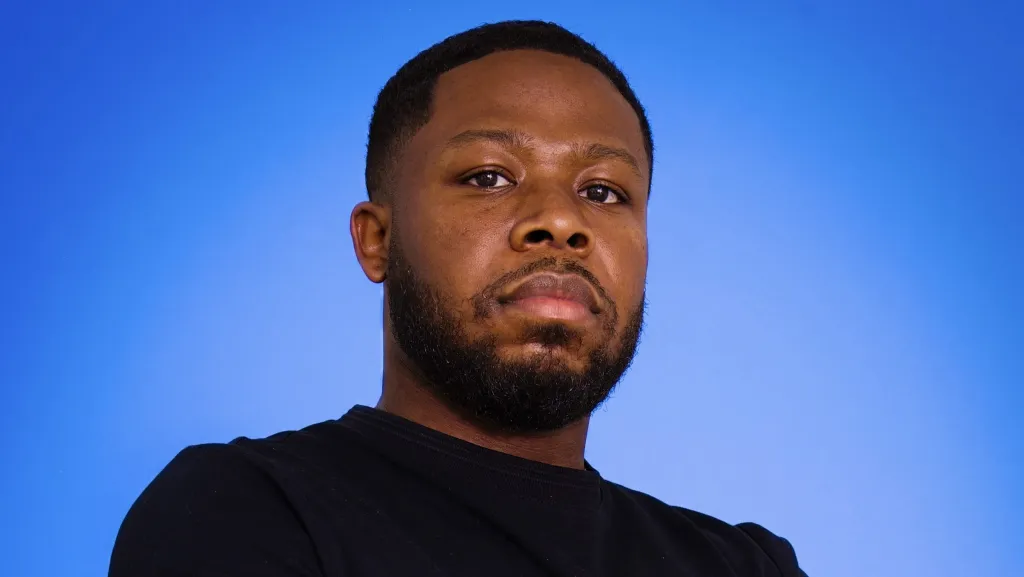
From Hollywood to Home: Black Voices in Entertainment
- James Rosemond Jr. turned proximity into a structured music-business blueprint, converting access into a repeatable, scalable strategy.
- Engineered Ice Spice's rise through strategic positioning, visibility loops, and cultural placements that translated viral moments into mainstream validation.
- Secured cross-genre co-signs, like Taylor Swift, to propel artists into new cultural tiers and institutional platforms.
- Balancing ambition with family intent, he seeks to redefine legacy and pursue his goal to bring Jimmy Henchman home.
There’s a certain kind of silence that follows someone when they walk into a room, and people already think they know their story. For James Rosemond Jr., that silence has always had a double edge. It first follows his surname and everything that comes with it, then waits for him to prove himself on his terms.
But what gets lost in that shadow is what actually matters: he didn’t inherit a finished blueprint. He inherited proximity to one. And in the music business, proximity is often the difference between theory and execution.
Long before the Ice Spice wave, before the cultural co-signs, before the viral language of “Munch” entered the internet bloodstream, James Rosemond Jr. was learning something simpler: how to turn access into understanding, and understanding into structure.
“I didn’t know until I was in college,” he says straightforwardly. “When things got real financially, the only thing I could think of was what I was around.” What he was around wasn’t abstract. It was Brooklyn hustle and observation disguised as education. Eventually, it became a business model.
He wasn’t planning to become a manager. He was responding to pressure. Survival has a way of revealing skill sets you didn’t know you were studying. “I just fell in love with business,” he says. “That’s when I knew I was good at it.”
Before the headlines and the industry validation, there were experiments. Digital instincts. Early relationship building. Writers, producers, small deals that didn’t look like much on paper, but taught him how to value opportunities and move through music ecosystems.
By the time Ice Spice entered the picture, the foundation wasn’t new; it was just untested at scale.
A mutual connection introduced them in early 2022. The industry was already shifting again at that moment. Female rap wasn’t just competitive; it was expanding in real time. Latto. Cardi. A new ecosystem formed faster than the traditional gatekeepers could map it. James didn’t talk about discovery. He talked about positioning. “I was able to understand what was going on in the market,” he adds. “And my game plan was always, how do I make it look like she’s everywhere?” That line is where the executive brain reveals itself.
No hype or luck. Visibility and architecture.
The first record, “Munch,” didn’t move like a song. It moved like a stress signal. Digital platforms picked it up. The streets reinforced it. Radio followed. Then came TikTok. Then came everything at once. What made it different wasn’t just the record; it was the acceleration of cultural agreement.
And then, the moment that shifted everything from viral to undeniable: co-signs that extended beyond genre. Seeing Ice Spice in a football stadium suite with Taylor Swift was off-putting in the best way…for many, it didn’t fully compute. That moment wasn’t just celebrity adjacency. It was a placement in a different cultural tier. Not rap validation. Pop infrastructure validation.
Then came the institutional signals: late-night television, award-show presence, and, most importantly, repetition. The kind that turns novelty into permanence. But James doesn’t frame it as an arrival. He frames it as continuity.

(L-R) James Rosemond Jr., Jacqueline Saturn, President of Virgin Music, and Ice Spice at Sir Lucian Grainge’s 2023 Artist Showcase in Los Angeles.
“We took two of the biggest super looks back-to-back with Taylor,” he says proudly. “SNL, Golden Globes… She was showing support. That relationship is still there.”
In modern music, relationships between artists and cultural figures are no longer passive. They are active solar systems. They are visibility loops. They reinforce brand identity in real time. James understands that better than most. And still, he resists the idea that this moment defines him.
Instead, he pivots to evolution. “I don’t want a carbon copy of what’s already out there,” he explains. “What we’re doing is different.” That difference is where his next phase lives. Ice Spice wasn’t just a success story; it was a proof of concept. A trial run for his approach to attention, branding, and cultural saturation.
And now, he’s thinking bigger.
“I enforced a high-end standard when I did the Ice project,” he said. “From here on out, I want to go bigger.” Bigger, in this case, isn’t volume. It’s structure.
He talks about transitioning into a diversified media company driven by cultural IP, with a language that sounds corporate on the surface but is actually rooted in a simple idea: ownership of attention, not just access to it. But the most revealing part of James Rosemond Jr. isn’t the business strategy. It’s the tension underneath it.
Because while he’s building forward, he is also building backward.
At one point in the conversation, the tone shifts. The industry talk fades. The strategy talk softens, and what’s left is something more personal.
“I want to bring my father home,” he says.
His dad is James Rosemond a.k.a. Jimmy Henchman, the former mega-music manager to the stars and founder of Czar Entertainment. Mike Tyson, The Game, Brandy, Salt-N-Pepa, and Akon all valued his services. His work in the urban entertainment field is just as legendary as his street dealings. In October 2013, he was sentenced to serve a life sentence for drug trafficking, obstruction of justice, firearms violations, among other infractions.
James Jr. is looking into a space without industry framing. Just family intent. That moment reframes everything that came before it.
Because suddenly, the story isn’t just about building a career in the shadow of a famous name. It’s about redefining what that name leads to. Legacy, in this case, isn’t branding. It’s unfinished business.
The music industry has always been generational in its own way. The old guard built systems through streets, radio, and physical infrastructure. Street teams. Vans. Club promotion. Regional control. James is operating in a different reality entirely. “Back then, it was street teams and vans,” he said. “Now it’s TikTok, streaming, AI, podcasts… different tempo.”
But the underlying principle hasn’t changed. Attention is still the currency. Only the battlefield has expanded.
What makes James Rosemond Jr. compelling isn’t just that he understands both worlds; it’s that he lives at the intersection of them. Old instincts. New tools. Same objective.
And somewhere between those two eras, he’s trying to build something stable enough to last beyond both. There’s a line in the conversation where he talks about walking into rooms and representing more than himself. About how presence matters. About how perception shapes opportunity. But the deeper idea is simpler: He understands that every time he enters a space, he’s also inspiring the next person who looks like him to follow.
That’s not branding. That’s responsibility. And in an industry that often confuses visibility with value, James Rosemond Jr. is building toward something more deliberate: continuity.
The Ice Spice moment will always be part of his story. So will the industry co-signs, the cultural placements, and the rapid acceleration of attention that followed. But none of it reads like a destination. Because for all the noise around success in music, the real question has never been who breaks through. And James Rosemond Jr., whether intentionally or not, seems to be answering that question in real time.
Not by stepping out of his father’s shadow. But by rebuilding what that shadow means in a different era.
Read the full article on the original site
