




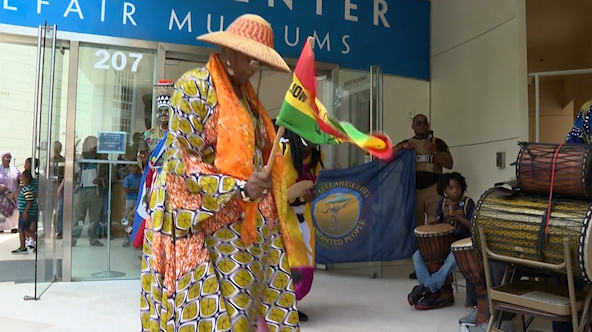
- Gullah Geechee descendants of West and Central Africa developed a distinct language, art, music, food, and storytelling tradition.
- Many Southern soul food dishes trace roots to Gullah Geechee traditions, including shrimp and grits, okra, Hoppin' John.
- Anita Singleton-Prather said the Gullah Geechee experience is essential to African American, South Carolina, and American history.
- The Civil War was a turning point, leading to formation of the First South Carolina Infantry of African Descent.
- Anita Singleton-Prather helped preserve culture through teaching, the Gullah Traveling Theater, and Gullah Kinfolk, showcasing traditions.
A living history: Gullah Geechee culture and America’s story
Gullah Geechee traditions helped shape America, and leaders say that history must be preserved as the nation marks 250 years.
BEAUFORT COUNTY, S.C. —
As America marks 250 years, we’re highlighting the cultures that helped shape the nation — including the Gullah Geechee people.
Their traditions, language and stories have been handed down from generation to generation for centuries, and they’re still being preserved today.
Up and down the coast from the Carolinas to Florida, the Gullah Geechee culture has existed long before the United States became a country. Descendants of West and Central Africa, the Gullah Geechee people developed a distinct language, art, music, food and storytelling tradition shaped by history.
“It is a blending of all those cultures,” said Anita Singleton-Prather, describing how the culture came together during the transatlantic slave trade.
Many Southern soul food dishes also trace their roots to Gullah traditions, including shrimp and grits, okra and Hoppin’ John. For Singleton-Prather, those foods are part of her family story.
“I started cooking when I was 3 or 4 years old for a grandmother who was a very proud Black woman, a Gullah Geechee woman,” she said.
She remembers Sunday dinners rotating from one relative’s house to another across rural communities in Colleton County and beyond.
When it comes to the nation’s history, Singleton-Prather says the Gullah Geechee story must be included.
“You cannot have African American history without the Gullah Geechee experience,” she said. “If you don’t have African American history, then South Carolina history is incomplete. If you don’t have South Carolina history, American history is incomplete.”
The Civil War marked a turning point for the nation and for the Gullah Geechee people. Talking about slavery can be difficult, but Singleton-Prather says the full story must be told.
“We have to tell all parts of the story, the good, the bad and the ugly,” she said. “And it’s all of that that makes us who we are.”
When Union forces arrived on the Sea Islands in 1861, they found people ready to fight for their freedom. That led to the formation of the First South Carolina Infantry of African Descent.
For Singleton-Prather, that history is personal. As one of the first Black families in Beaufort to integrate schools, she said her parents instilled cultural pride early in life.
“My mother and dad emphasized that we weren’t second to anyone and that our culture is important,” she said.
That sense of purpose later shaped her work as a teacher and helped inspire the Gullah Traveling Theater and Gullah Kinfolk, keeping traditions alive for the next generation.
“We keep this history alive, we showcase it,” she said.
From visual arts to music and storytelling, the Gullah Geechee culture remains very much alive — and part of America’s story.
