





Glow & Grow: Black Beauty, Haircare, and Skincare Tips
- Begin with the baseline: a product must work and leave your skin healthy; this matters especially for Black women.
- Be honest: is this purchase for efficacy or for preference? Don't pay for feeling and credit it as results.
- Allocate budget: spend more on serums and treatments, save on cleansers and body care judged by cost per use.
Estimated reading time: 12 minutes
Most of us keep one: a shelf or a drawer that has quietly become a graveyard of good intentions. A treatment you committed to for about a week. Something you reached for because it looked like it should be effective. A bottle you grabbed after a video made you feel behind. Not one of those felt like a mistake in the moment, which is exactly how the money slips away, in small and sensible-looking amounts that only add up to something once you are staring at everything you never finished. Hardly anyone teaches you to see it coming, and that is the whole purpose of this post.
By the end, you will have a repeatable way to size up any product before it reaches your cart: the baseline every formula has to clear, the question that separates a real need from a nice-to-have, the one category that tends to reward spending a little more, and the places where paying less takes nothing away from your skin. This is the conscious-consumer approach Beauty In Color brings to everything: look past the marketing on the front of the bottle and learn what your skin actually needs. I first put this lens on sunscreen in How to Choose a Sunscreen That Disappears on Dark Skin. Here, we aim the same skill at everything else you buy. We are staying at the category level, which kinds of products earn their price and which do not. Which specific ingredients are worth choosing is a separate conversation that gets its own post next.
What Makes a Product Worth Your Money
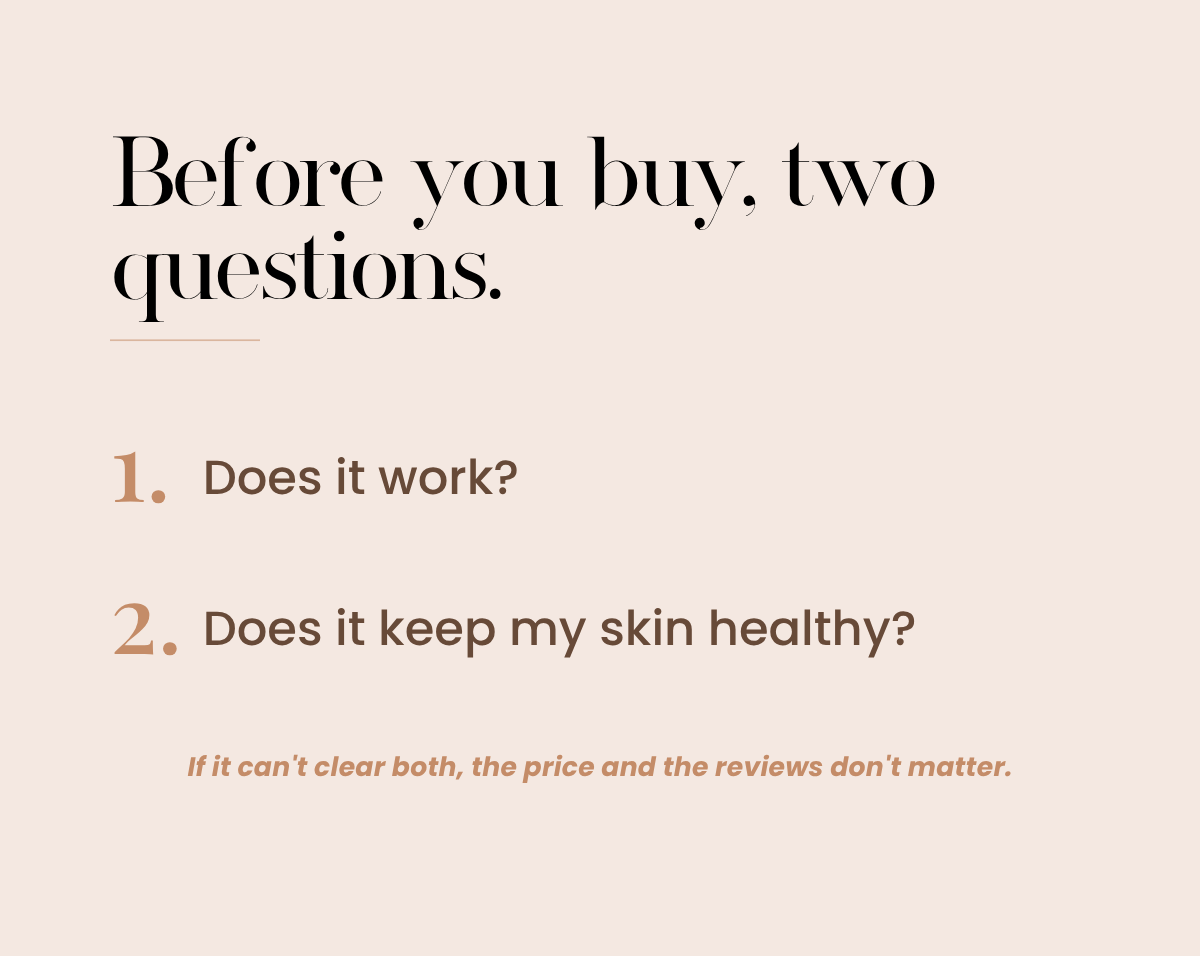
Set aside everything a brand wants you to notice, and any product has exactly one assignment. It has to deliver what it claims, and it has to leave your skin healthy while doing it. Call that the baseline. It is the bar a product clears before anything else about it is worth a second of your attention, and it holds no matter your skin type, your budget, or your taste.
The baseline matters because it overrides the rest. When a product cannot meet it, nothing else gets a vote. A high price cannot buy a pass, and a wall of five-star reviews cannot talk its way through. A formula that costs a fortune and leaves your skin inflamed has not handed you an expensive product with a small flaw. It has failed the one test that decided everything, and charged you extra to do it. Begin every decision here and you have already sidestepped most of what turns into clutter you never use.
The One Question That Tells You Whether to Buy
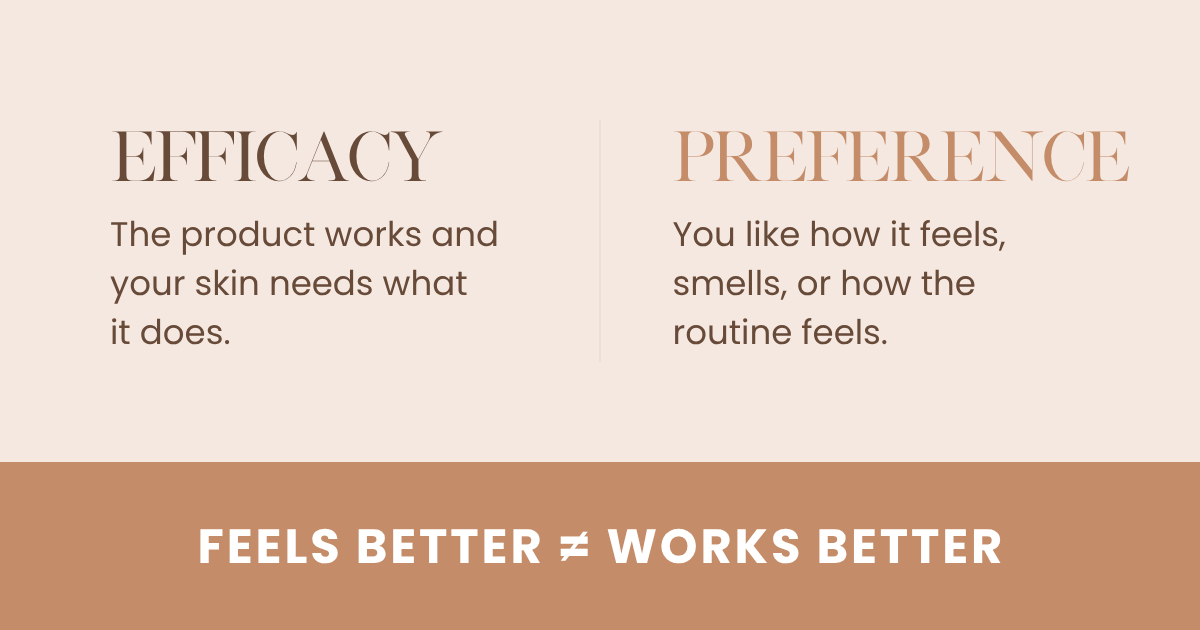
This is where the spending springs a leak. Pare your reasons for buying down to the core, and only two remain.
- Efficacy. The product does something your skin genuinely needs.
- Preference. You enjoy how it feels, how it smells, or how it makes the routine feel.
Spending on either is fair game. Trouble starts when the two blur, when a richer, silkier, nicer-to-apply formula quietly persuades you it must be working harder as well. A product that feels better and a product that performs better are not automatically the same bottle, and often enough they are not the same purchase at all. So before anything reaches your cart, put the reason into words. Is this efficacy, or is this preference? That one small act of honesty keeps you from paying for a sensation and then crediting it as a result. It also keeps you from passing over something plain and effective simply because it does not feel like much.
Dana’s Tip: A product that dazzles you in the first few seconds is usually showing off its texture, not its actives. Real change tends to be quiet and gradual, the kind you clock around week three rather than on contact. Let that keep a luxurious first impression from running off with your wallet.
Where Your Money Is Worth Spending

If your budget only stretches in one direction, aim it at serums and treatments. Out of everything in a routine, these are the products with an actual assignment to change something, to fade, firm, smooth, or calm, whatever you are working toward. The rest of your lineup is mostly there to hold the line. Because treatments are asked to do the heavy lifting, they are also where a thoughtful formula and careful manufacturing have the best chance of showing up in what you see in the mirror, which makes a higher price easier to defend here than anywhere else in your routine.
None of that means costly always wins, or that you have to spend big to get results. It means that if there is a single place where a few extra dollars can actually buy you something, this is it. And because a treatment only does its job in the right spot in a sequence, it helps to know how it layers in before you commit.
Where You Can Save Without Giving Anything Up
Now, the relief: because saving in the right places takes nothing away from your skin.
Cleanser is the clearest case. Its entire job is over in a minute before you rinse it off, so a premium price has almost no time on your skin to earn itself back. Plenty of inexpensive cleansers do that job beautifully, and for most people, this is simply not where the extra money returns to you.
Body care is the second easy one, for a different reason. You move through it quickly, so the figure that should guide you is not what it costs on the shelf but what it costs each time you use it. A modestly priced lotion you reach for without thinking, every day, head to toe, will do more for your skin than a premium one you hoard because you are afraid of the day it runs out. When the bottle empties fast, generosity beats prestige.
Dana’s Tip: With anything you use in volume, run a quick cost-per-use check before you buy. Take the price, divide by the number of uses you will realistically get, and compare from there. The cheaper option you actually use freely almost always outperforms the expensive one rationing itself on your shelf.
When Preference Is a Good Reason to Spend
Let me be the first to admit I do not always follow my own math, and that is fine. There are mornings I cheerfully overspend on a cleanser, of all things, the product bound straight for the drain, purely because I love the way it feels and the small ritual of using it. Preference is a legitimate line in the budget. The texture, the scent, the few unhurried minutes a routine gives you, those are real things to value and real reasons to spend.
My only ask is that you call it what it is. Choose the indulgent cleanser because it brings you something, not because you have quietly talked yourself into believing it outperforms the one at a third of the price. Then give yourself the same honesty in reverse, and do not let an unremarkable first impression scare you off a product that genuinely works. The aim is not to drain the pleasure out of your skincare. It is to stop paying efficacy prices for preference without ever noticing the swap.
If you would like a place to begin, I keep the products I actually reach for sorted by where they belong in a routine, and I update it as things earn or lose their spot. Have a look anytime in Find What Your Skin Needs.
What This Means for Black Women’s Skin
For us, this skill is less a nicety than a form of protection. A product that irritates skin like ours can do more than waste what you paid for it, because that irritation is one of the things that can leave behind the dark spots so many of us are already working to fade (post-inflammatory hyperpigmentation occurs after skin inflammation and affects deeper skin tones with greater frequency and severity). Put plainly, the wrong choice can keep charging you long after the bottle is in the trash.
That is why the baseline carries even more weight for us. Ahead of cheap or expensive, ahead of the reviews, the first thing to settle is whether a product treats your skin with respect. We put real money into our skin, and it deserves to land on what truly serves us rather than on whatever we were persuaded to try. For a long stretch, the shelf was not built with our skin in mind. That is shifting, and getting good at choosing is how you make sure your dollars reward the brands finally getting it right.
For my full roundup of brown-skin-friendly picks, including options I have tested and compared, see The 7 Best Brown-Skin-Friendly Sunscreens. You can also browse the no-cast sunscreens I keep and update in my sunscreen collection. In the spirit of conscious consumerism, a note: several of the formulas I love are not affiliate links. I would rather tell you what works on my skin than point you only toward what I can link.
Dana’s Tip: When you find a sunscreen that genuinely disappears on your skin and feels good to wear, buy a backup before it runs out. Consistency is what protects your skin, and you protect consistency by never letting yourself run empty.
Three Mistakes to Skip
- Trusting the front of the package. Brightening, firming, luxury, clean: that language exists to move product, not to inform you. The part worth reading is on the back, where nothing was designed to seduce you.
- Dressing preference up as efficacy. A formula felt lovely once, and now you are paying top dollar across a whole routine on the belief that pleasant must mean effective. It does not, at least not dependably.
- Switching before anything has a chance. Skincare reveals itself over weeks, not days. Chase the next launch every time one appears and nothing ever gets a fair trial, which is exactly how a cabinet fills with bottles that are half-used and never really judged.
Watch the Companion Lesson
This post is your written reference. The companion YouTube lesson covers the same ground in a more visual way, including the exact way I decide where my own money goes and the categories I do and do not spend on. Every YouTube topic at Beauty In Color is built to pair with a searchable, reference-friendly post like this one.
Watch the full lesson here:
How to Choose Skincare FAQ
- How do I know if a skincare product is worth the money? Ask whether it clears the floor first: does it work, and does it keep your skin healthy while it does. If it cannot do both, the price and the reviews do not matter. After that, decide whether you are paying for what it does or for how it feels, and make sure that reason is one you actually meant to choose.
- What skincare is worth spending more on? Serums and treatments, as a category. They are the products doing the real work of changing your skin, so a better formula has the most room to earn its price there. If your budget only stretches in one place, that is the most logical place to put it.
- What skincare can I buy cheap without losing quality? Cleansers and body care. A cleanser rinses off in seconds, and there are excellent options at drugstore prices. Body care is used in volume, so judge it by cost per use rather than sticker price. A more affordable product you apply generously often serves your skin better than a luxury one you ration.
- How do you pick the right skincare products for your skin? Run every option through the floor first, then match it to what your skin actually needs rather than what the label promises. Spend where a product changes your skin, save where it does not, and be honest about whether you are buying results or a nice experience.
- Is it bad to buy skincare just because I like how it feels? Not at all. Preference is a legitimate reason to spend, as long as you know that is the reason. The trap is paying for feel while believing you are paying for function, or skipping an effective product because it feels unremarkable.
- Why does choosing the wrong product matter more for Black women? Because irritation from a product that does not suit your skin can lead to dark spots, which adds a cost well beyond the price of the product itself. That makes choosing products that respect your skin especially worth getting right.
The Bottom Line
Wasted skincare money rarely comes from one dramatic splurge. It collects out of a long line of reasonable-seeming choices, each made off the front of a package instead of the substance behind it. The repair is not to spend more, and it is not to spend less. It is to spend deliberately.
So when you are about to buy, hold it against three things. Put your money where a product can genuinely change your skin. Hold it back where a product is only there to maintain. And every single time, be clear with yourself about whether you are buying a result or an experience. Do that with any consistency and the cabinet stops collecting regrets, your routine becomes something you trust, and your spending finally follows what actually works.
What To Do Next
Shop With Me
The products I keep in rotation, plus my budget-friendly picks, all in one place.
Read the full article from the original source
