




Along America’s southeastern coast, descendants of enslaved Africans pass down traditions and knowledge of crafts, ecology and food through generations
:focal(1000x667:1001x668)/https://tf-cmsv2-smithsonianmag-media.s3.amazonaws.com/filer_public/b2/1c/b21cc915-7750-49ab-a4de-285addb10696/gullah_geechee_basket_weaving.jpg)
Sophia Michelen
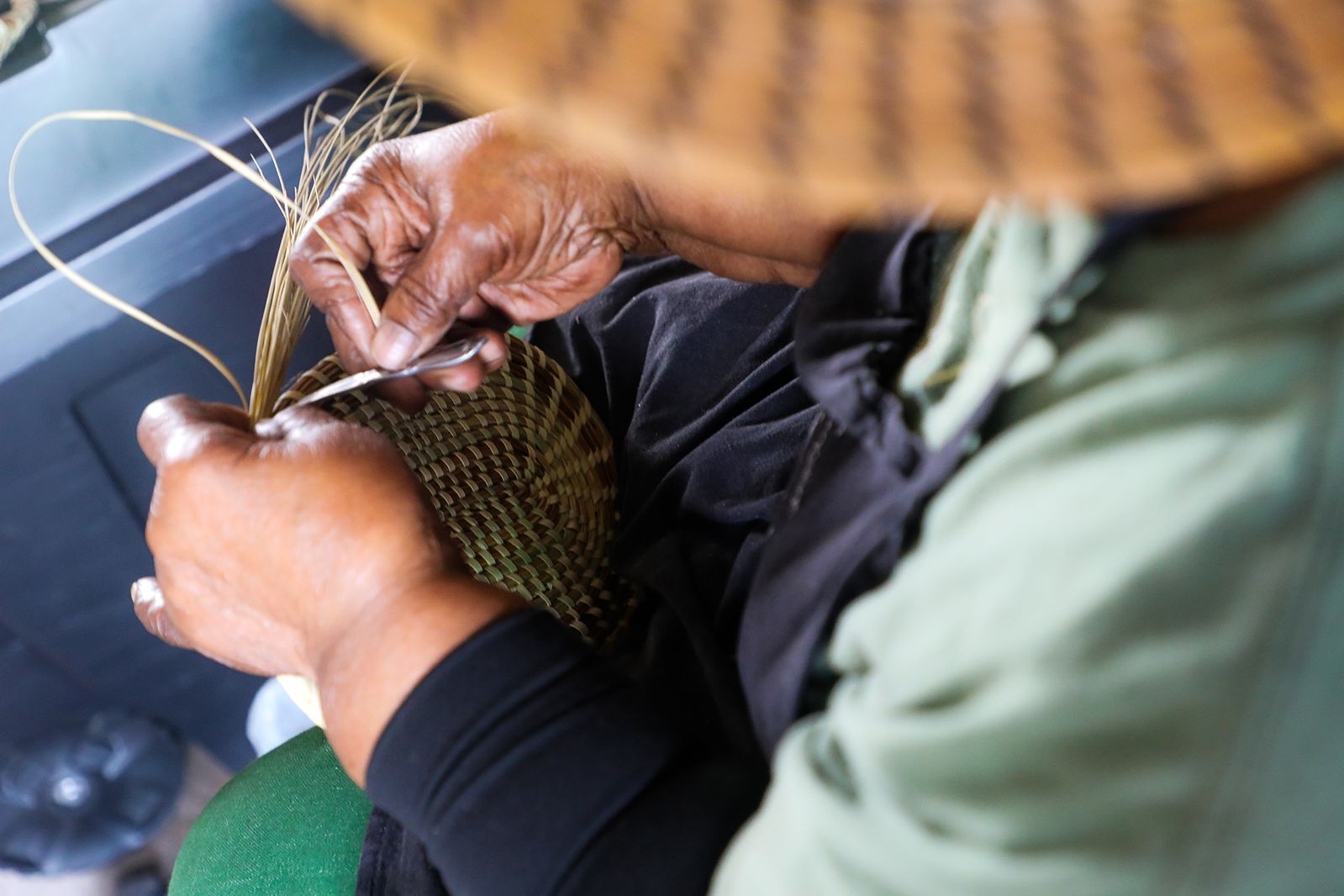
Lynette D. Youson slowly stitches a bundle of South Carolina sweetgrass into a coil. The work begins at the center: a tight spiral anchored with palmetto, each stitch pulled through in a rhythm that has been repeated for generations. The basket expands outward, row by row, widening into a form that once carried rice from fields, held produce in kitchens and stored grain in homes across the Lowcountry.
For Youson, a fifth-generation sweetgrass basket weaver outside Charleston, that center point is not just a starting place—it is a lineage.
“I learned sitting at my mother’s side, watching her hands,” she says. “She learned from her mother, and her mother before that. That’s how it continues—you watch, you do, and then you teach.”
Sweetgrass basket weaving is one of the most enduring cultural traditions of the Gullah Geechee people, descendants of Africans enslaved on the rice, indigo and cotton plantations of the southeastern United States. Along coastal regions stretching from Pender County, North Carolina, to St. Johns County, Florida, scholars estimate that hundreds of thousands of people identify as Gullah Geechee across the southeastern coastal corridor. These communities developed a distinct culture shaped by language, foodways, craftsmanship and a deep knowledge of land and water.
Quick fact: Origins of the Gullah Geechee
-
- The slave trade brought thousands of West Africans to America’s Lowcountry in the late 1700s. The enslaved laborers adapted to the Sea Islands of this region, which were much like the marshes of their homelands, and their different languages and traditions blended together to create Gullah Geechee culture.
The baskets themselves trace back to West and Central African coiled-basketry traditions, brought across the Atlantic and adapted to Lowcountry materials. Enslaved Africans used them in rice cultivation, winnowing grain and carrying harvests—tools of labor that would become vessels of memory.
Today, examples of Gullah Geechee basketry are held in museum collections, including the Smithsonian American Art Museum. But within the community, their significance has never been confined to display.
“The traditions and knowledge carried by enslaved Africans and the living cultural practices of Gullah Geechee communities today are not separate,” says Victoria Smalls, former executive director of the Gullah Geechee Cultural Heritage Corridor and principal consultant at Smalls Cultural Resources, a cultural preservation consultancy focused on history, art and heritage. “They are a continuous story of survival, adaptation and memory.” For Youson and her family, that continuity is lived daily. She learned to weave as a child, taught by her mother, Marilyn W. Dingle—a master basket weaver whose own work carries forward knowledge passed down from her grandmother. Both Youson and her mother have baskets in the Smithsonian collections.
“My grandmother taught me,” Dingle says. “We didn’t think of it as art—we were making what we needed. But we were also carrying something forward, even if we didn’t have the words for it then.”
Now Youson teaches her own children and grandchildren. “I’m teaching all of them—boys and girls,” she says. “They need to know where they come from. If they don’t learn it, it stops with me.”
/https://tf-cmsv2-smithsonianmag-media.s3.amazonaws.com/filer_public/a0/ad/a0ad1462-7694-43a0-af66-6502480a43c2/0n8a0388.jpg)
The materials themselves remain rooted in place. Sweetgrass grows in coastal marshes, and harvesting it requires familiarity with seasonal cycles and sustainable gathering practices. But accessing that landscape has become increasingly difficult.
“Places where we used to gather sweetgrass are gone now,” Youson says. “There’s development; there are fences. You can’t just go where your family used to go.”
As the environment changes, the practice adapts. Baskets that once served agricultural purposes are now also created as works of art, collected and exhibited. Still, their deeper meaning remains embedded in the act of making.
“The center of that coiled basket is the mother of mankind … and each row that is sewn together is a generation,” Smalls says. This sense of generational continuity extends beyond weaving. Across the Lowcountry, cultural knowledge has long been carried not just through objects, but through relationships to land, water and food—systems in which women have played a central role.
“Our culture has always been carried, protected and passed on by women—often quietly, without recognition,” Smalls says. Just beyond the marshes where sweetgrass grows, another form of preservation unfolds on the water.
Preserving the marsh
Charleston’s estuaries and tidal creeks have sustained Gullah Geechee communities for centuries. Since the 1700s, fishing, crabbing and shellfish harvesting have provided both food and livelihood—practices shaped by intimate knowledge of tides, seasons and coastal ecosystems.
“The water brought us, and the water kept us,” Smalls says. Today, that relationship continues through the work of Tia Clark, a Charleston-based crabber and oyster conservationist and the founder of Casual Crabbing With Tia.
“I grew up on this water,” Clark says. “This is where I learned, where my family worked, where our food came from. It’s always been a part of who we are.”
Clark’s work centers on oyster reefs—living structures that play a critical role in coastal ecosystems. According to the National Oceanic and Atmospheric Administration, oyster reefs filter water, provide habitat for marine life and help prevent coastal erosion. But for Clark, their importance extends beyond ecology.
“Oysters are everything out here,” she says. “They clean the water, they protect the shoreline and they feed the community. When you lose oysters, you lose a whole system.”
Through hands-on experiences during her two-and-a-half-hour crabbing excursions, she teaches international and domestic visitors, locals, corporate groups and families to read the rhythms of the marsh: how tides shape daily life, how to handle crab traps and how entire ecosystems work.
“I’m teaching people what was taught to me,” Clark says. “Not just how to crab, but how to respect the water and understand it.” Her work also challenges persistent misconceptions about Black relationships to coastal environments.
“There’s this idea that Black people don’t have a connection to nature or the water,” she says. “But that couldn’t be further from the truth. Our history is deeply tied to these environments.” For Smalls, these practices are inseparable from the region’s past. “These traditions are not just about survival—they are about knowledge systems that were developed over generations and are still evolving today,” she says.
Across the Lowcountry, traditions tied to marsh and estuary remain central to Gullah Geechee heritage. But preservation doesn’t only take place in landscapes—it also unfolds in kitchens.
/https://tf-cmsv2-smithsonianmag-media.s3.amazonaws.com/filer_public/38/fd/38fdc311-d49b-4cef-8654-93f1e12f6e06/0n8a2476.jpg)
/https://tf-cmsv2-smithsonianmag-media.s3.amazonaws.com/filer_public/b8/f1/b8f1fbed-3925-44f2-b5ec-edc3ae519e0b/0n8a2462.jpg)
Preserving the table
In Charleston, chef and writer Amethyst Ganaway approaches food as both craft and an archive that carries the history of migration, adaptation and resilience. Through her pop-up dining concept, Bramble, and articles she writes for publications including Eater, Serious Eats and Garden & Gun, Ganaway explores the historical roots of Southern food and the African American traditions that shaped it. “Food is memory,” Ganaway says. “It tells you where people have been, what they had access to and how they made something out of what they were given.”
The ingredients and techniques of Lowcountry cuisine are shaped by African culinary traditions: rice, okra, benne seed, groundnuts, leafy greens, cowpeas and fresh seafood, adapted to the resources of the American South. “You always have a pot of rice … and conversation always happens over food,” Smalls says. Yet Ganaway argues that the origins of these traditions are often obscured. “A lot of what people think of as Southern food is actually rooted in African American and Gullah Geechee traditions,” she says. “But that history isn’t always acknowledged.”
Through her research, Ganaway has traced familiar dishes back through layers of cultural exchange. Shrimp and grits, for example, reflects what she describes as an amalgamation of West African and Indigenous American ingredients and methods. She also reinterprets historical recipes in contemporary contexts. Ganaway has created her own red rice, a defining Gullah Geechee dish, inspired in part by a duck and red rice recipe that Edna Lewis, the Virginia-born chef who elevated Southern food from the late 1940s to the ’80s, developed during her time in Charleston. “It’s not about recreating something exactly as it was,” Ganaway says. “It’s about understanding where it comes from and letting it evolve while still honoring that history.”
Ganaway’s work also reflects a broader movement among chefs and scholars seeking to document and preserve African American culinary heritage.
A living tradition
Basket weaving, coastal stewardship and foodways may seem to be distinct practices. But within Gullah Geechee culture, they represent an interconnected system—one shaped by land, water and generations of knowledge.
Basket weaving preserves profound botanical understanding and craftsmanship passed through families. Coastal stewardship reflects generations of environmental awareness in marsh ecosystems and foodways carry stories of migration, resilience and creativity.
Together, they form part of the cultural landscape protected by the Gullah Geechee Cultural Heritage Corridor Commission, established by Congress in 2006 to help preserve Gullah Geechee heritage across the southeastern United States. The corridor stretches across approximately 12,000 square miles of coastal North Carolina, South Carolina, Georgia and Florida, recognizing the historical homeland of Gullah Geechee communities.
“Culture is not just something we perform … it is a practice,” Smalls says. That practice is increasingly under pressure. Development, environmental change and restricted access to land and waterways threaten the conditions that have sustained these customs for centuries.
“If we lose access to land and waterways, we cannot sustain our traditions in a meaningful way,” Smalls says. At the same time, new generations are continuing the work.
For Youson, teaching her children and grandchildren to weave is not simply about preserving a skill. “This isn’t just about baskets,” she says. “It’s about making sure they know who they are and where they come from.”
Across the Lowcountry, similar acts of transmission are taking place: on boats in tidal creeks, in kitchens and at weaving tables. What persists is not simply the culture’s memory but its ongoing creation. “We are not just carrying this culture—we are still birthing it,” Smalls says.
Each basket, oyster reef and recipe becomes part of a living record—one preserved not in glass cases but by the people who continue to practice these traditions.
